
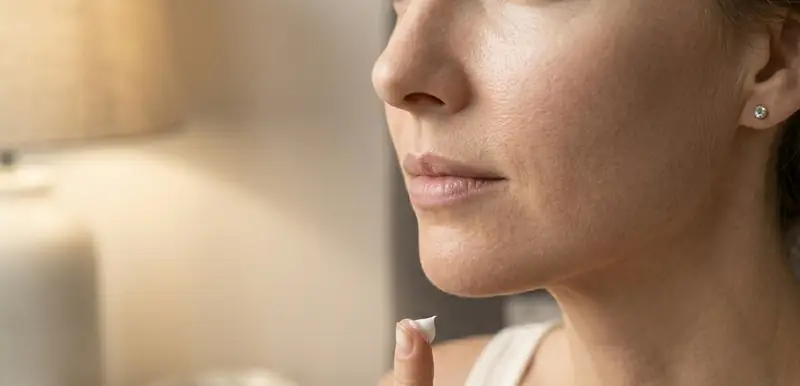
The science of skin aging is evolving rapidly — and for women navigating the skin changes that come with menopause and beyond, evidence-based skincare represents a fundamentally different approach: working with your skin's biology rather than against it.
Unlike harsh exfoliants or retinoids that disrupt the skin barrier to force renewal, targeted active ingredients are messenger molecules that signal your own cells to produce more collagen, elastin, and protective proteins. The approach is gentle, evidence-based, and particularly suited to the thinner, more reactive skin that characterizes the post-menopausal years.
One Product for the Two Areas That Show Aging Most
The face and neck are anatomically different — the neck has thinner skin, fewer oil glands, less subcutaneous fat, and the platysma muscle that creates horizontal bands when it weakens — but they share the same fundamental aging mechanisms: collagen loss, elastin degradation, and gravity-induced laxity. A single, well-formulated firming cream can treat both areas effectively, but the application technique must be adapted for each area's unique anatomy. Using the same cream for face and neck eliminates the need for a separate 'neck cream' product — a category that often charges premium prices for formulations that are functionally identical to quality facial moisturizers.[1]
The ingredients that provide genuine firming for face and neck over 50: (1) Peptides (Matrixyl 3000 at 3-8%) — stimulate collagen production in both facial and neck dermis. The neck often shows more dramatic improvement because it starts from a greater deficit (typically neglected in earlier skincare routines). (2) Retinol (0.3-0.5%) — the most proven collagen-stimulating topical, effective on both face and neck. Important: the neck requires a lower initial concentration or the sandwich method due to its thinner, more sensitive skin. (3) DMAE (2-3%) — provides immediate, temporary firming effect visible within 30 minutes. Particularly effective on the neck where the thin skin responds quickly to DMAE-induced muscle fiber contraction. (4) Ceramides — repair the barrier that is more compromised on the neck (fewer oil glands) than the face, ensuring the active ingredients remain effective rather than escaping through barrier gaps.
Clinical research confirms that application technique differences between face and neck: Face — apply in upward strokes from the chin to the forehead. Use moderate pressure to work the cream into the skin. Concentrate extra product along the jawline and nasolabial folds. Neck — apply in upward strokes ONLY, from the base of the neck to the jawline. NEVER apply in downward strokes. Use lighter pressure than on the face — the neck's thinner skin is more susceptible to stretching. Extend the cream to the sides of the neck and the 'V' of the chest (décolleté) if exposed to sun. Apply the cream after retinol or peptide serum has been absorbed, using the cream as both treatment delivery and occlusive seal.
The common mistake with face and neck firming cream: using a lightweight lotion instead of a rich cream. The face and neck over 50 need the occlusive properties of a rich cream formulation — the thicker vehicle provides the sustained contact time that lightweight lotions cannot maintain. A rich cream also supplies the occlusives (squalane, shea butter) that replace the sebum production that has declined on both face and neck after menopause. If the cream absorbs within 30 seconds and leaves no detectable film, it's too lightweight for the firming task. The right firming cream takes 2-3 minutes to absorb and leaves a comfortable, barely perceptible protective layer that maintains active ingredient contact for hours.
Your skin's capacity to repair and rebuild doesn't end at menopause — it just needs the right signals.
— Dr. Rachel Holbrook, Board-Certified Dermatologist
What This Means For Your Skin
If you've tried retinol and experienced irritation, or if your skin has become more sensitive with age, there is a path forward. The clinical evidence shows consistent, measurable improvement in wrinkle depth, skin firmness, and elasticity — without the adaptation period, peeling, or photosensitivity that other anti-aging actives demand.
Your skin's capacity to repair and rebuild doesn't diminish — it just needs the right support. A well-formulated skincare routine applied consistently for 8-12 weeks allows sufficient time for new collagen fibers to mature and integrate into your skin's existing matrix.
The science is clear. The evidence is consistent. The results are measurable.
What happens next is up to you.