
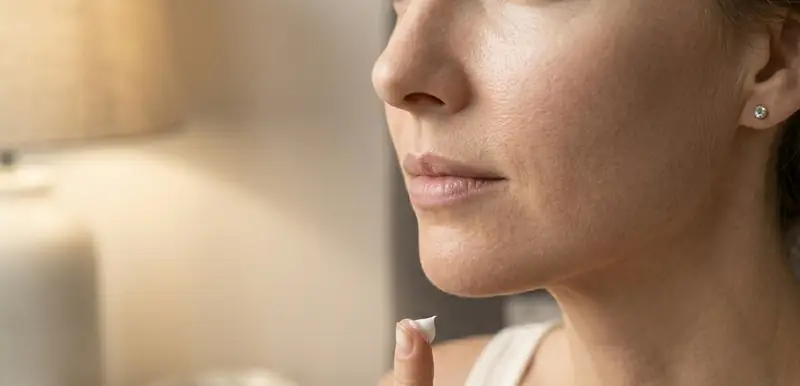
The science of skin aging is evolving rapidly — and for women navigating the skin changes that come with menopause and beyond, evidence-based skincare represents a fundamentally different approach: working with your skin's biology rather than against it.
Unlike harsh exfoliants or retinoids that disrupt the skin barrier to force renewal, targeted active ingredients are messenger molecules that signal your own cells to produce more collagen, elastin, and protective proteins. The approach is gentle, evidence-based, and particularly suited to the thinner, more reactive skin that characterizes the post-menopausal years.
At-Home Treatments That Improve Facial Firmness Over Time
Tightening loose facial skin at home is possible — within realistic limits. The key distinction: home treatments can improve skin firmness (the skin's resistance to deformation) and density (the thickness and structural integrity of the dermis), which produces a visible tightening effect. They cannot, however, physically retract skin that has stretched beyond its elastic limit or reposition descended tissue. Understanding this distinction prevents both discouragement (giving up because home treatments don't produce surgical results) and wasted money (buying products that promise impossible outcomes).[1]
The three at-home approaches with clinical evidence for skin tightening: (1) Retinoid therapy — the most proven topical for increasing dermal thickness and collagen density. Retinol 0.5% applied nightly for 24 weeks increased dermal collagen by measurable amounts in photoaged skin. Thicker dermis = firmer skin that resists gravitational deformation. For loose facial skin specifically, retinol addresses the structural deficit that allows the skin to sag. (2) Peptide treatment — signal peptides (Matrixyl, copper peptides) stimulate collagen and elastin production through cell-signaling pathways. The combination of retinol + peptides provides dual-pathway structural rebuilding for maximum firmness improvement. (3) Microneedling (0.25-0.5mm) — at-home derma rolling creates controlled micro-injuries that trigger the wound-healing cascade, producing new collagen in the treated area. Studies show measurable improvement in skin firmness after 4-6 weekly sessions.
Clinical research confirms that the at-home tightening routine: Morning — vitamin C serum (collagen cofactor + UV protection) + peptide moisturizer with DMAE (immediate tightening effect + long-term collagen stimulation) + SPF 50. Evening — retinol (applied with the sandwich method for tolerance) + peptide night cream + squalane oil seal. Weekly — microneedling (0.25mm) followed immediately by peptide serum (the micro-channels created by the needles enhance peptide penetration by up to 300%). Important: do not microneedle on the same evening as retinol application — wait 48 hours between microneedling and retinol to avoid barrier damage.
The results timeline for at-home skin tightening: Weeks 1-4 — improved hydration and surface texture create the appearance of firmer skin (this is a moisture effect, not structural tightening, but it's real and visible). Weeks 4-12 — early collagen rebuilding begins to increase dermal density. Skin feels firmer when pressed and bounces back more quickly from deformation. Months 3-6 — measurable improvement in skin firmness and facial contour as cumulative collagen production reaches structurally significant levels. Month 6-12+ — sustained and improving results with continued treatment. The women who achieve the best at-home tightening results combine retinol + peptides + microneedling + facial massage consistently for 12+ months. Consistency and patience are the primary determinants of success.
Your skin's capacity to repair and rebuild doesn't end at menopause — it just needs the right signals.
— Dr. Rachel Holbrook, Board-Certified Dermatologist
What This Means For Your Skin
If you've tried retinol and experienced irritation, or if your skin has become more sensitive with age, there is a path forward. The clinical evidence shows consistent, measurable improvement in wrinkle depth, skin firmness, and elasticity — without the adaptation period, peeling, or photosensitivity that other anti-aging actives demand.
Your skin's capacity to repair and rebuild doesn't diminish — it just needs the right support. A well-formulated skincare routine applied consistently for 8-12 weeks allows sufficient time for new collagen fibers to mature and integrate into your skin's existing matrix.
The science is clear. The evidence is consistent. The results are measurable.
What happens next is up to you.