
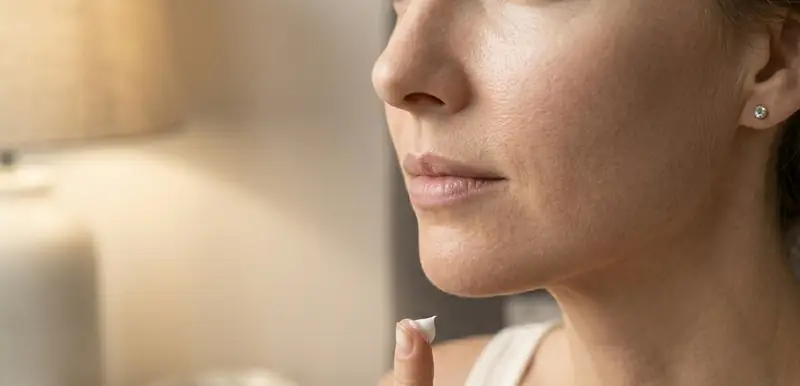
The science of skin aging is evolving rapidly — and for women navigating the skin changes that come with menopause and beyond, evidence-based skincare represents a fundamentally different approach: working with your skin's biology rather than against it.
Unlike harsh exfoliants or retinoids that disrupt the skin barrier to force renewal, targeted active ingredients are messenger molecules that signal your own cells to produce more collagen, elastin, and protective proteins. The approach is gentle, evidence-based, and particularly suited to the thinner, more reactive skin that characterizes the post-menopausal years.
Does At-Home Microcurrent Actually Lift Sagging Skin?
Microcurrent devices have become the most popular at-home facial technology, with claims of 'non-invasive face lifting' that appeal to women seeking surgical-level results without the surgeon. The technology delivers low-level electrical current (below the threshold of sensation) that stimulates facial muscle contraction, theoretically re-educating muscles to maintain a lifted position. The clinical evidence supports some of these claims — but with significant caveats about magnitude, duration, and the ongoing commitment required.[1]
How microcurrent works at the cellular level: the low-amplitude electrical current (typically 200-600 microamperes) stimulates ATP (adenosine triphosphate) production in muscle cells and fibroblasts. Increased ATP provides energy for muscle contraction and cellular activities including collagen synthesis. A clinical study using professional-grade microcurrent treatments showed a 14% increase in facial muscle tone and a 48% increase in local ATP production after a course of 12 treatments. At-home devices deliver lower current than professional units — typically 200-400 microamperes versus 400-600 for professional devices — producing proportionally more modest results.
Clinical research confirms that the realistic assessment of at-home microcurrent: (1) Immediate effect — after a single 5-minute treatment, most users observe a subtle lifting and firming effect that lasts 24-72 hours. This is primarily a muscle-toning response (similar to how muscles look more defined immediately after exercise) rather than structural change. (2) Cumulative effect — daily use over 60-90 days produces measurable improvement in facial contour and muscle tone. A study on at-home microcurrent found statistically significant improvement in jowl area and nasolabial fold depth after 60 days of daily use. (3) Maintenance requirement — the effects require ongoing daily use to maintain. Stopping treatment for 2-3 weeks results in return to baseline, as the muscle-toning effect is not permanent structural change.
How to maximize microcurrent results: (1) Always use a conductive gel — microcurrent cannot penetrate dry skin effectively. A water-based peptide serum serves as both conductor and treatment. (2) Use upward strokes following the muscle direction — lift from jawline to cheekbone, from brow to hairline, from neck to chin. (3) Treat for at least 5 minutes per facial zone (one zone = one side of the face). (4) Combine with peptide skincare — microcurrent enhances topical ingredient penetration, and the mechanical stimulation combined with peptide collagen signals may produce additive benefits. (5) Be consistent — daily use for 60 days minimum before assessing results. The women who report the best microcurrent results use the device daily without exception, combined with a peptide-retinol skincare routine. Microcurrent alone produces modest temporary lifting. Combined with structural skincare, it provides a more comprehensive non-surgical lifting approach.
Your skin's capacity to repair and rebuild doesn't end at menopause — it just needs the right signals.
— Dr. Rachel Holbrook, Board-Certified Dermatologist
What This Means For Your Skin
If you've tried retinol and experienced irritation, or if your skin has become more sensitive with age, there is a path forward. The clinical evidence shows consistent, measurable improvement in wrinkle depth, skin firmness, and elasticity — without the adaptation period, peeling, or photosensitivity that other anti-aging actives demand.
Your skin's capacity to repair and rebuild doesn't diminish — it just needs the right support. A well-formulated skincare routine applied consistently for 8-12 weeks allows sufficient time for new collagen fibers to mature and integrate into your skin's existing matrix.
The science is clear. The evidence is consistent. The results are measurable.
What happens next is up to you.