
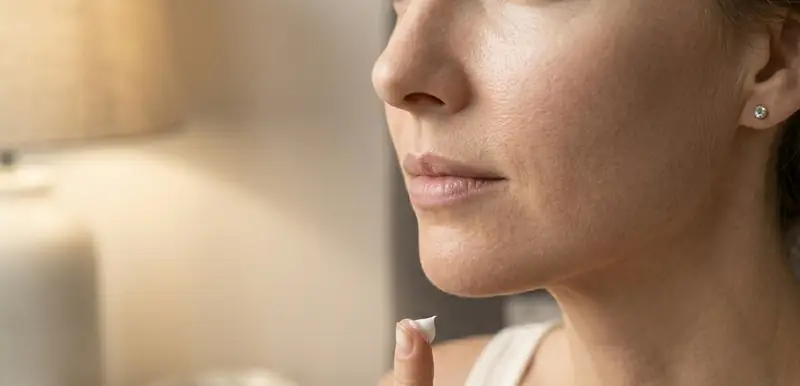
The science of skin aging is evolving rapidly — and for women navigating the skin changes that come with menopause and beyond, evidence-based skincare represents a fundamentally different approach: working with your skin's biology rather than against it.
Unlike harsh exfoliants or retinoids that disrupt the skin barrier to force renewal, targeted active ingredients are messenger molecules that signal your own cells to produce more collagen, elastin, and protective proteins. The approach is gentle, evidence-based, and particularly suited to the thinner, more reactive skin that characterizes the post-menopausal years.
What Non-Surgical Options Can Realistically Achieve
The search for at-home face lift alternatives reflects a universal desire: to improve facial sagging without the cost, risk, recovery, and social downtime of surgery. The honest assessment: no home treatment replicates a surgical face lift, which physically repositions descended tissue and removes excess skin. However, several home approaches produce meaningful improvement in skin firmness, contour definition, and overall youthful appearance — improvements that, while more modest than surgery, accumulate over time and maintain the face at a better baseline than no intervention at all.[1]
The at-home alternatives ranked by evidence and impact: (1) Topical retinoid + peptide protocol — the foundation of any non-surgical lifting strategy. Retinol rebuilds dermal collagen that structural aging has depleted. Peptides provide additional collagen-stimulating signals through complementary pathways. Together, they incrementally restore the structural density that supports facial contour. Impact: 15-25% improvement in skin firmness over 6-12 months. Not dramatic, but consistently detectable. (2) Facial massage and gua sha — manual lymphatic drainage reduces the fluid retention that accentuates sagging, while deep-tissue massage provides mechanical stimulation that temporarily lifts and firms. Impact: immediately visible (temporary) lifting effect plus cumulative improvement in muscle tone over months.
Clinical research confirms that (3) At-home microneedling — 0.25-0.5mm needle rollers create micro-injuries that trigger wound-healing collagen production. When combined with peptide serum (applied immediately post-needling for enhanced penetration), microneedling produces targeted collagen rebuilding in treated areas. Impact: measurable firmness improvement after 6-8 weekly sessions. (4) LED red light therapy — at-home devices emitting 630-660nm red light stimulate fibroblast activity and collagen production through photobiomodulation. Clinical studies show modest improvement in skin firmness and wrinkle depth after 8-12 weeks of 10-minute daily sessions. Impact: modest, gradual improvement that supplements topical treatment.
The realistic expectation framework: at-home face lift alternatives produce cumulative improvement that, at 12 months, is visually equivalent to approximately 3-5 years of age reversal in perceived facial age. This means a 55-year-old woman who diligently follows a comprehensive at-home protocol may appear 50-52 to objective observers — a meaningful improvement, but not the 10-15 year reversal that surgical face lifts can achieve. The advantages of the at-home approach: zero downtime, zero surgical risk, progressive improvement rather than sudden change, and sustainable long-term maintenance. The key principle: at-home alternatives work best when started early (before sagging becomes severe), maintained consistently (daily treatment for months and years), and combined (topical + mechanical + device approaches together).
Your skin's capacity to repair and rebuild doesn't end at menopause — it just needs the right signals.
— Dr. Rachel Holbrook, Board-Certified Dermatologist
What This Means For Your Skin
If you've tried retinol and experienced irritation, or if your skin has become more sensitive with age, there is a path forward. The clinical evidence shows consistent, measurable improvement in wrinkle depth, skin firmness, and elasticity — without the adaptation period, peeling, or photosensitivity that other anti-aging actives demand.
Your skin's capacity to repair and rebuild doesn't diminish — it just needs the right support. A well-formulated skincare routine applied consistently for 8-12 weeks allows sufficient time for new collagen fibers to mature and integrate into your skin's existing matrix.
The science is clear. The evidence is consistent. The results are measurable.
What happens next is up to you.