
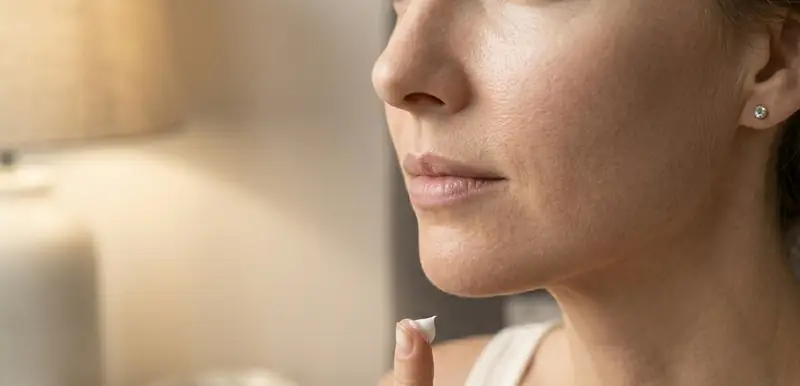
The science of skin aging is evolving rapidly — and for women navigating the skin changes that come with menopause and beyond, evidence-based skincare represents a fundamentally different approach: working with your skin's biology rather than against it.
Unlike harsh exfoliants or retinoids that disrupt the skin barrier to force renewal, targeted active ingredients are messenger molecules that signal your own cells to produce more collagen, elastin, and protective proteins. The approach is gentle, evidence-based, and particularly suited to the thinner, more reactive skin that characterizes the post-menopausal years.
The Lifting Strokes That Improve Contour and Reduce Puffiness
Facial massage for sagging skin is one of the most underutilized anti-aging tools — perhaps because it feels too simple to be effective. Yet the clinical evidence supports measurable benefits: improved lymphatic drainage (reducing the facial puffiness that accentuates sagging), enhanced blood circulation (delivering more nutrients and oxygen to fibroblasts), mechanical stimulation of muscle fibers (improving muscle tone), and increased penetration of topical products (amplifying the efficacy of peptides and retinol). A Japanese clinical study found that women who performed daily facial massage for 10 minutes showed significant improvement in cheek height and jawline definition compared to controls who used the same products without massage.[1]
The three essential massage techniques for sagging: Technique 1 — Lymphatic drainage (reduces puffiness): using flat fingertips, make light sweeping strokes from the center of the face outward and downward toward the ears and neck. Pressure should be very light — lymphatic vessels are superficial and respond to gentle stimulation. Start at the forehead (center to temple), then cheeks (nose to ear), then jawline (chin to ear), then neck (behind ear to collarbone). Repeat each stroke 5 times. This sequence moves stagnant fluid away from the face, immediately reducing the heaviness that makes sagging more prominent.
Clinical research confirms that technique 2 — Deep tissue lifting (improves muscle tone): using knuckles or a gua sha tool, apply firm upward strokes along the natural lifting vectors. Start at the jawline and stroke firmly upward along the mandible to the ear. Then from the nasolabial fold upward along the cheekbone to the temple. Then from between the brows upward to the hairline. Use enough pressure to feel the tool moving over the bone beneath the skin — this deep stimulation reaches the muscle layer and periosteum. Hold at each endpoint (ear, temple, hairline) for 3 seconds with sustained pressure. Repeat each path 10 times.
Technique 3 — Pinch and release (stimulates blood flow): using thumb and forefinger, gently pinch along the jawline from chin to ear, holding each pinch for 2 seconds before releasing and moving to the next point. Then pinch along the cheekbone from nose to ear. This technique stimulates local blood flow, bringing fresh oxygen and nutrients to the treated area while the micro-stimulation of pinching activates fibroblast activity. Perform the complete massage sequence over peptide serum — the massage enhances penetration by up to 40% compared to gentle application, and the peptide molecules reach the dermis where they can stimulate the collagen production that massage alone cannot achieve. Total time: 5-10 minutes daily. Best performed in the evening after cleansing and before night cream application.
Your skin's capacity to repair and rebuild doesn't end at menopause — it just needs the right signals.
— Dr. Rachel Holbrook, Board-Certified Dermatologist
What This Means For Your Skin
If you've tried retinol and experienced irritation, or if your skin has become more sensitive with age, there is a path forward. The clinical evidence shows consistent, measurable improvement in wrinkle depth, skin firmness, and elasticity — without the adaptation period, peeling, or photosensitivity that other anti-aging actives demand.
Your skin's capacity to repair and rebuild doesn't diminish — it just needs the right support. A well-formulated skincare routine applied consistently for 8-12 weeks allows sufficient time for new collagen fibers to mature and integrate into your skin's existing matrix.
The science is clear. The evidence is consistent. The results are measurable.
What happens next is up to you.