
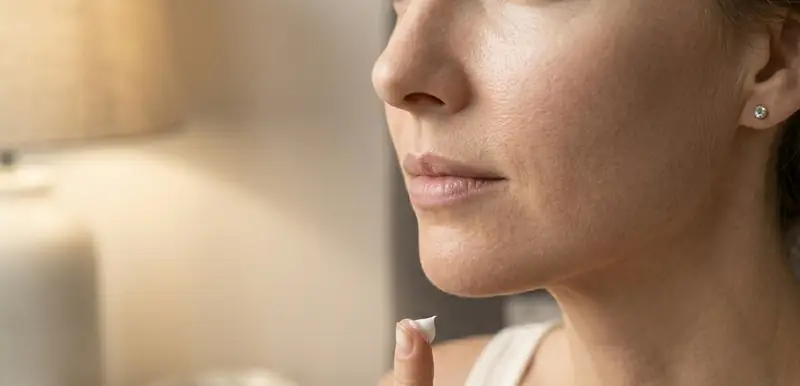
The science of skin aging is evolving rapidly — and for women navigating the skin changes that come with menopause and beyond, evidence-based skincare represents a fundamentally different approach: working with your skin's biology rather than against it.
Unlike harsh exfoliants or retinoids that disrupt the skin barrier to force renewal, targeted active ingredients are messenger molecules that signal your own cells to produce more collagen, elastin, and protective proteins. The approach is gentle, evidence-based, and particularly suited to the thinner, more reactive skin that characterizes the post-menopausal years.
Evidence-Based Approaches to Restore Cheek Fullness and Lift
Sagging cheeks are particularly distressing because the cheekbones are the primary structural landmark of the mid-face — when they lose prominence, the entire face appears to droop. The cheek area sags through two simultaneous processes: the malar fat pad (positioned over the cheekbone in youth) descends below the cheekbone due to gravity and weakened ligamentous attachments, while the collagen scaffolding that held it in place degrades. The result is a hollowed appearance at the cheekbone with excess fullness at the nasolabial fold — essentially, the youthful cheek volume has slid downward.[1]
The natural remedy hierarchy for sagging cheeks: (1) Peptide cream applied to the mid-face with upward pressure — this provides collagen-stimulating signals to the exact dermal zone where structural support is needed. Application technique matters: place fingertips at the nasolabial fold and press firmly upward toward the cheekbone while blending the cream. This upward pressure enhances peptide penetration into the area above the descended fat pad, where collagen rebuilding will have the greatest visual impact on cheek contour. (2) Facial exercises targeting the zygomaticus — the cheek-lifting muscle. The JAMA study found that cheek-lifting exercises performed for 30 minutes daily significantly improved cheek fullness, with dermatologists rating improvement at approximately 3 years younger perceived age.
Clinical research confirms that the facial massage technique for cheek lifting: using a gua sha stone or the knuckles, apply firm upward strokes from the jawline to the cheekbone, following the natural lift vector. This manual technique serves three purposes: (a) improves lymphatic drainage, reducing the fluid congestion that accentuates mid-face heaviness, (b) provides mechanical stimulation to the periosteum, which may support local collagen production, and (c) temporarily lifts the tissue along the upward vector, providing an immediately visible (though temporary) lifting effect. When performed over peptide serum, the massage enhances active ingredient penetration while providing the mechanical benefits.
The comprehensive natural remedy protocol for sagging cheeks: Morning — vitamin C serum + peptide moisturizer applied with upward strokes + SPF 50. Evening — retinol (builds structural collagen) + peptide night cream applied generously to the mid-face. Daily — 5-minute facial massage focusing on the cheek area with upward strokes. 3x/week — cheek-lifting exercises (smile lifts, cheek puffs, resistance exercises) for 10 minutes. The realistic timeline: improved skin texture and hydration by month 1 (skin looks less deflated), subtle lifting and improved cheek contour by month 3-4 (measurable firmness improvement), noticeable improvement in mid-face fullness by month 6-12 (structural collagen rebuilding becomes visible). These natural remedies produce meaningful, gradual improvement — not surgical-level lifting, but a naturally fuller, firmer cheek appearance.
Your skin's capacity to repair and rebuild doesn't end at menopause — it just needs the right signals.
— Dr. Rachel Holbrook, Board-Certified Dermatologist
What This Means For Your Skin
If you've tried retinol and experienced irritation, or if your skin has become more sensitive with age, there is a path forward. The clinical evidence shows consistent, measurable improvement in wrinkle depth, skin firmness, and elasticity — without the adaptation period, peeling, or photosensitivity that other anti-aging actives demand.
Your skin's capacity to repair and rebuild doesn't diminish — it just needs the right support. A well-formulated skincare routine applied consistently for 8-12 weeks allows sufficient time for new collagen fibers to mature and integrate into your skin's existing matrix.
The science is clear. The evidence is consistent. The results are measurable.
What happens next is up to you.