
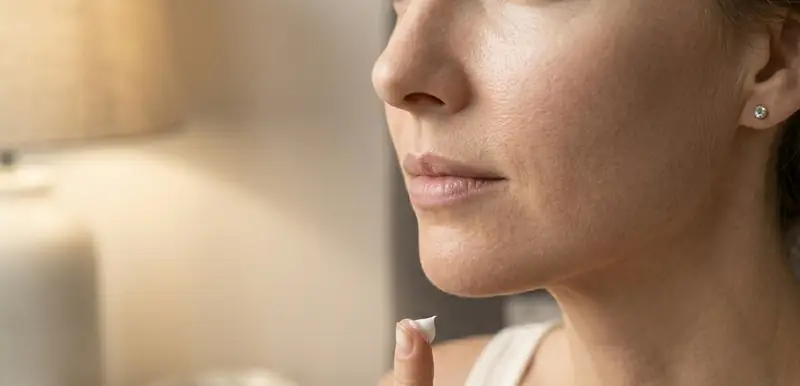
The science of skin aging is evolving rapidly — and for women navigating the skin changes that come with menopause and beyond, evidence-based skincare represents a fundamentally different approach: working with your skin's biology rather than against it.
Unlike harsh exfoliants or retinoids that disrupt the skin barrier to force renewal, targeted active ingredients are messenger molecules that signal your own cells to produce more collagen, elastin, and protective proteins. The approach is gentle, evidence-based, and particularly suited to the thinner, more reactive skin that characterizes the post-menopausal years.
Non-Invasive Options for Jawline Definition After 50
Jowls — the sagging skin and tissue that obscures the jawline — are among the most age-revealing facial changes because the jawline is the primary structural landmark of the lower face. Jowls form through a specific anatomical sequence: the buccal fat pad (naturally positioned in the cheek) descends with gravity over decades, sliding below the mandible where it accumulates as excess fullness at the jawline. Simultaneously, the skin and subcutaneous tissue along the mandibular border lose collagen and elastin support, allowing the descending fat pad to create a visible droop. The result: a smooth, defined jawline transitions into a soft, irregular contour that blurs the distinction between face and neck.[1]
Non-surgical jowl treatment operates through two strategies: (1) Rebuilding structural support along the jawline to improve skin resistance against the descended tissue, and (2) reducing fluid retention and tissue congestion that accentuates jowl prominence. Neither strategy can reposition the descended fat pad (only surgery achieves that), but both can meaningfully improve jawline definition by addressing the supportive tissue around and above the jowl area.
Clinical research confirms that the topical approach for jowl improvement: peptide cream applied along the jawline and lower face stimulates collagen production in the dermal layer directly above the mandible — the zone where structural support matters most for jawline definition. Application technique is critical: apply the cream in upward strokes from the neck, along the jawline, and toward the ear. Press firmly enough to create mechanical stimulation of the periosteum (bone lining) beneath — this pressure, combined with the peptide signals, encourages local collagen synthesis along the exact line where definition has been lost. Retinol in the evening provides complementary collagen stimulation. Together, the peptide + retinol combination rebuilds structural support along the jawline contour.
The physical techniques that complement topical treatment: (1) Gua sha along the jawline — using a flat stone tool, firm scraping strokes from the chin to the ear along the mandible mobilize stagnant lymphatic fluid that contributes to jowl heaviness. Daily practice for 3-5 minutes produces visible de-puffing that sharpens jawline contour immediately. (2) Jawline exercises — clenching the jaw, extending the chin forward, and performing resistance exercises against the hand placed under the chin can modestly improve masseter and platysma tone. (3) Sleep position — sleeping on the back prevents gravitational compression of the jowl area that occurs during side sleeping. A 2016 study confirmed that habitual side sleepers showed greater facial asymmetry and more pronounced jowling on the sleep side. Combined, these non-surgical approaches produce gradual but meaningful improvement in jawline definition over 3-6 months.
Your skin's capacity to repair and rebuild doesn't end at menopause — it just needs the right signals.
— Dr. Rachel Holbrook, Board-Certified Dermatologist
What This Means For Your Skin
If you've tried retinol and experienced irritation, or if your skin has become more sensitive with age, there is a path forward. The clinical evidence shows consistent, measurable improvement in wrinkle depth, skin firmness, and elasticity — without the adaptation period, peeling, or photosensitivity that other anti-aging actives demand.
Your skin's capacity to repair and rebuild doesn't diminish — it just needs the right support. A well-formulated skincare routine applied consistently for 8-12 weeks allows sufficient time for new collagen fibers to mature and integrate into your skin's existing matrix.
The science is clear. The evidence is consistent. The results are measurable.
What happens next is up to you.