
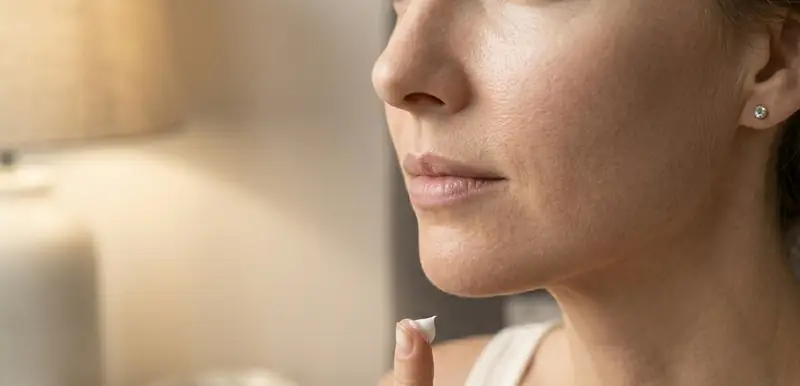
The science of skin aging is evolving rapidly — and for women navigating the skin changes that come with menopause and beyond, evidence-based skincare represents a fundamentally different approach: working with your skin's biology rather than against it.
Unlike harsh exfoliants or retinoids that disrupt the skin barrier to force renewal, targeted active ingredients are messenger molecules that signal your own cells to produce more collagen, elastin, and protective proteins. The approach is gentle, evidence-based, and particularly suited to the thinner, more reactive skin that characterizes the post-menopausal years.
Why the Face Deflates and How to Restore Fullness Naturally
Facial volume loss after menopause is one of the most distressing visible changes of aging because it affects the fundamental shape of the face — not just the skin's surface. The face appears to 'deflate,' transitioning from a youthful, full oval to a more angular, hollowed appearance. This volume loss occurs at three anatomical levels simultaneously: the skin thins and loses structural density (collagen loss), the subcutaneous fat pads shrink and descend (fat redistribution), and the facial bones actually remodel — the maxilla and mandible lose mineral density and volume, reducing the skeletal framework that everything else sits on.[1]
The estrogen connection is profound at all three levels. Estrogen receptors exist in dermal fibroblasts (collagen production), adipocytes (fat cell maintenance), and osteoblasts (bone formation). When estrogen levels collapse during menopause, all three cell types lose their hormonal growth signal. The result: collagen production drops 30% in the first 5 post-menopausal years, facial fat pads lose volume and shift downward under gravity, and the facial skeleton undergoes measurable bone resorption (the maxilla recedes and the mandible angles change). This triple-level volume loss is why menopausal facial aging appears to accelerate so dramatically — it's not just skin aging, it's structural, volumetric, and skeletal aging occurring in parallel.
Clinical research confirms that topical intervention can partially address the skin and superficial tissue layers. Peptide creams stimulate collagen synthesis in the dermis, incrementally rebuilding the structural density that provides facial fullness at the skin level. Hyaluronic acid-containing products restore dermal hydration that contributes to volume — HA binds 1,000x its weight in water, and even topical HA can modestly increase skin plumpness through surface and shallow-dermal hydration. The combination of peptides (structural rebuilding) + HA (hydration volume) + ceramides (barrier repair that retains the hydration) provides the most comprehensive topical approach to facial volume support.
The lifestyle factors that support facial volume maintenance: (1) Adequate protein intake — collagen synthesis requires amino acids, particularly glycine, proline, and hydroxyproline. Women over 50 often under-consume protein, limiting the raw materials available for collagen production even when topical stimulants are applied. (2) Vitamin C — essential cofactor for collagen assembly enzymes. Both dietary and topical vitamin C support facial collagen maintenance. (3) Avoid excessive weight loss — losing more than 10% of body weight after 50 dramatically accelerates facial volume loss because facial fat pads shrink along with body fat. This is the 'face or figure' dilemma that many women experience: aggressive weight loss produces a leaner body but a more gaunt face. (4) Sun protection — UV-induced collagen degradation compounds the estrogen-related collagen loss, making SPF critically important for volume preservation.
Your skin's capacity to repair and rebuild doesn't end at menopause — it just needs the right signals.
— Dr. Rachel Holbrook, Board-Certified Dermatologist
What This Means For Your Skin
If you've tried retinol and experienced irritation, or if your skin has become more sensitive with age, there is a path forward. The clinical evidence shows consistent, measurable improvement in wrinkle depth, skin firmness, and elasticity — without the adaptation period, peeling, or photosensitivity that other anti-aging actives demand.
Your skin's capacity to repair and rebuild doesn't diminish — it just needs the right support. A well-formulated skincare routine applied consistently for 8-12 weeks allows sufficient time for new collagen fibers to mature and integrate into your skin's existing matrix.
The science is clear. The evidence is consistent. The results are measurable.
What happens next is up to you.