
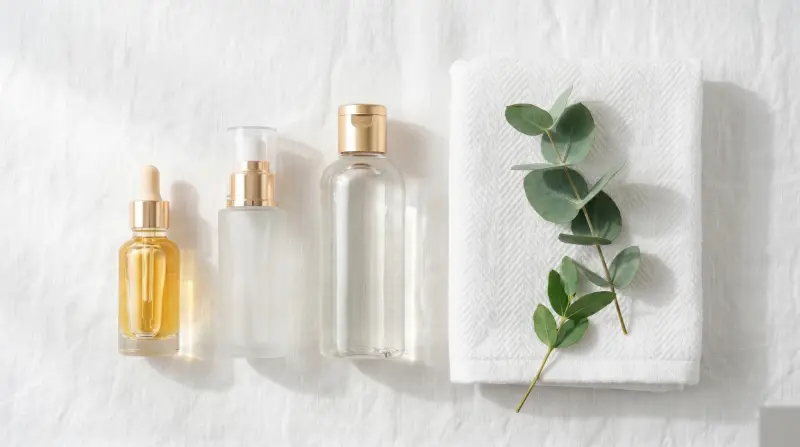
The science of skin aging is evolving rapidly — and for women navigating the skin changes that come with menopause and beyond, evidence-based skincare represents a fundamentally different approach: working with your skin's biology rather than against it.
Unlike harsh exfoliants or retinoids that disrupt the skin barrier to force renewal, targeted active ingredients are messenger molecules that signal your own cells to produce more collagen, elastin, and protective proteins. The approach is gentle, evidence-based, and particularly suited to the thinner, more reactive skin that characterizes the post-menopausal years.
The Absolute Essentials — Nothing More, Nothing Less
The Pareto principle applies to skincare: 80% of anti-aging results come from 20% of products. For women over 50 who want meaningful wrinkle reduction without a complex routine, three products deliver the vast majority of clinical benefit. This 3-step approach is not a compromise — it's an optimization. Each product is chosen for maximum multi-functional impact, eliminating the redundancy and complexity that causes most women to abandon their routines within weeks.[1]
Step 1: Gentle cream cleanser (morning and evening). This single product replaces micellar water, toner, makeup remover, and exfoliant. A well-formulated cream cleanser with ceramides or glycerin removes impurities while depositing a thin moisture film — net positive for the barrier rather than net negative. For women who wear heavy makeup or waterproof SPF, an oil cleanser can precede the cream cleanser in the evening only. Foaming cleansers, gel cleansers, and any product that leaves skin feeling 'squeaky clean' should be permanently eliminated — that squeaky feeling is the sound of your lipid barrier being stripped.
Clinical research confirms that step 2: Multi-active peptide moisturizer with SPF (morning). This combination product replaces separate serum, moisturizer, and sunscreen — three steps compressed into one. Look for formulations containing named peptides (Matrixyl, Argireline), ceramides, hyaluronic acid, and SPF 30+ mineral or hybrid protection. Applied to damp skin after cleansing, this single product provides collagen stimulation, barrier repair, hydration, and UV protection simultaneously. In the evening, use the same moisturizer without SPF, or a richer ceramide night cream if your skin is very dry.
Step 3: Peptide treatment (evening). After cleansing, apply a peptide serum or a richer peptide night cream. This evening-only treatment step leverages the nocturnal repair window — cell proliferation and collagen synthesis peak between 11 PM and 4 AM, making evening treatment the highest-leverage application time. The night product can be richer than the morning product because cosmetic elegance (texture under makeup) is irrelevant at bedtime. Total routine time: 2 minutes morning, 2 minutes evening. Total products: 3 (cleanser + SPF moisturizer + night treatment). Results at 12 weeks: clinically comparable to 7-step routines in adherent users, and dramatically superior in real-world compliance.
Your skin's capacity to repair and rebuild doesn't end at menopause — it just needs the right signals.
— Dr. Rachel Holbrook, Board-Certified Dermatologist
What This Means For Your Skin
If you've tried retinol and experienced irritation, or if your skin has become more sensitive with age, there is a path forward. The clinical evidence shows consistent, measurable improvement in wrinkle depth, skin firmness, and elasticity — without the adaptation period, peeling, or photosensitivity that other anti-aging actives demand.
Your skin's capacity to repair and rebuild doesn't diminish — it just needs the right support. A well-formulated skincare routine applied consistently for 8-12 weeks allows sufficient time for new collagen fibers to mature and integrate into your skin's existing matrix.
The science is clear. The evidence is consistent. The results are measurable.
What happens next is up to you.