
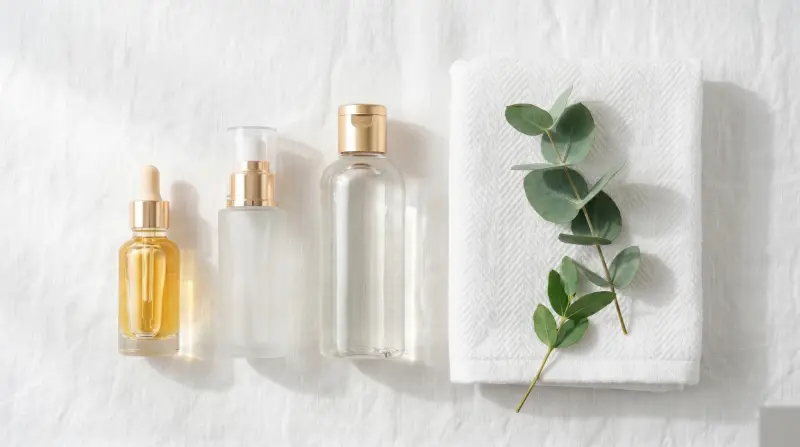
The science of skin aging is evolving rapidly — and for women navigating the skin changes that come with menopause and beyond, evidence-based skincare represents a fundamentally different approach: working with your skin's biology rather than against it.
Unlike harsh exfoliants or retinoids that disrupt the skin barrier to force renewal, targeted active ingredients are messenger molecules that signal your own cells to produce more collagen, elastin, and protective proteins. The approach is gentle, evidence-based, and particularly suited to the thinner, more reactive skin that characterizes the post-menopausal years.
Why Fewer Products Often Deliver Better Results
The skincare industry profits from complexity — selling 10-step routines, layering guides, and product wardrobes that promise comprehensive anti-aging through sheer volume. But clinical evidence tells the opposite story. A 2021 consumer adherence study found that women using 4-product routines maintained 87% compliance at 12 weeks, while those using 7+ products dropped to 34%. Since consistency is the primary determinant of anti-aging results, the simple routine that you actually follow daily will outperform the elaborate routine you abandon after two weeks — every time.[1]
The minimalist aging skin routine requires exactly four products: (1) Gentle cleanser — removes impurities without disrupting the barrier. One product, used morning and evening. (2) Multi-active treatment — a well-formulated peptide serum or cream that combines collagen stimulation (peptides), hydration (hyaluronic acid), and barrier support (ceramides) in a single product. This replaces separate serum, essence, ampoule, and moisturizer steps. (3) Sunscreen — SPF 30+ daily, morning only. (4) Night cream — a richer version of your daytime moisturizer, providing occlusive protection during the overnight repair window.
Clinical research confirms that the science behind why minimalism works better for aging skin: each additional product layered on compromised skin increases three risks simultaneously. First, ingredient interaction — some active combinations cancel each other out (vitamin C + niacinamide at certain pHs, peptides + strong acids). Second, barrier stress — each product application involves physical manipulation of fragile skin and exposure to additional preservatives, fragrances, and emulsifiers that cumulate irritation potential. Third, dilution — layering 5 products on the face means each individual product's contact with skin is reduced as subsequent layers push earlier products aside.
The minimalist test: if you can't explain what each product in your routine specifically does differently from the others, you have redundancy. A cream cleanser, a peptide moisturizer with ceramides and HA, a sunscreen, and a night cream — four products that cover cleansing, treatment, protection, and overnight repair with zero redundancy. Add retinol as a fifth product only if your skin tolerates it after 4 weeks of the base routine. This 4-5 product approach is what most dermatologists who specialize in mature skin actually recommend — not the 10-step routines that skincare influencers sell.
Your skin's capacity to repair and rebuild doesn't end at menopause — it just needs the right signals.
— Dr. Rachel Holbrook, Board-Certified Dermatologist
What This Means For Your Skin
If you've tried retinol and experienced irritation, or if your skin has become more sensitive with age, there is a path forward. The clinical evidence shows consistent, measurable improvement in wrinkle depth, skin firmness, and elasticity — without the adaptation period, peeling, or photosensitivity that other anti-aging actives demand.
Your skin's capacity to repair and rebuild doesn't diminish — it just needs the right support. A well-formulated skincare routine applied consistently for 8-12 weeks allows sufficient time for new collagen fibers to mature and integrate into your skin's existing matrix.
The science is clear. The evidence is consistent. The results are measurable.
What happens next is up to you.