
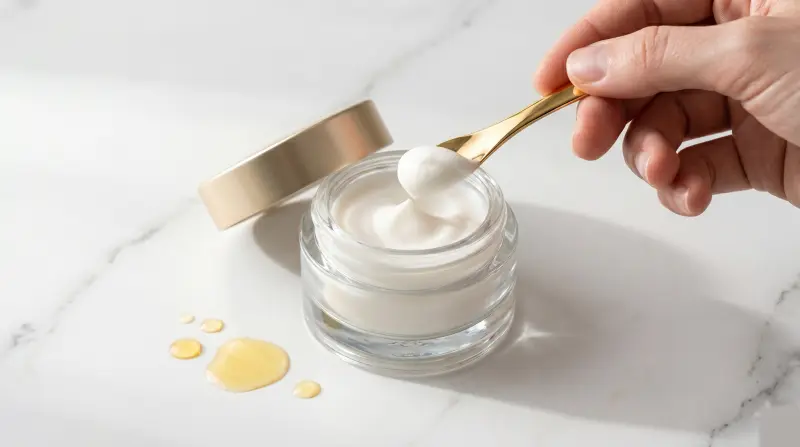
The science of skin aging is evolving rapidly — and for women navigating the skin changes that come with menopause and beyond, evidence-based skincare represents a fundamentally different approach: working with your skin's biology rather than against it.
Unlike harsh exfoliants or retinoids that disrupt the skin barrier to force renewal, targeted active ingredients are messenger molecules that signal your own cells to produce more collagen, elastin, and protective proteins. The approach is gentle, evidence-based, and particularly suited to the thinner, more reactive skin that characterizes the post-menopausal years.
Managing Eczema and Aging With the Same Foundation
Eczema (atopic dermatitis) and aging skin share a remarkably similar biochemical profile: both conditions are characterized by depleted ceramides, compromised barrier function, increased transepidermal water loss, and elevated inflammatory markers. The seminal study by Imokawa et al. that established ceramide deficiency as the primary driver of eczema barrier dysfunction has been subsequently confirmed in aging skin research — the same lipid depletion pattern that causes eczema vulnerability in children creates aging vulnerability in adults. For women with eczema-prone aging skin, this shared pathology means one well-chosen ceramide cream can address both conditions simultaneously.[1]
The ceramide deficit in eczema is particularly severe for ceramide EOS (the long-chain crosslinking ceramide) and ceramide NP — the same subtypes that decline most sharply with menopausal aging. This overlap means women with lifelong eczema tendencies who enter menopause face compounded ceramide depletion. Research in the Journal of Investigative Dermatology found that atopic skin at age 55 had 60% less total ceramide content than non-atopic skin of the same age — roughly double the deficit of either condition alone.
Clinical research confirms that ceramide creams developed for eczema are often the best choice for eczema-prone aging skin because they're formulated to clinical standards of barrier repair: physiological ceramide ratio, strict elimination of common sensitizers (fragrance, dyes, preservatives), and clinical validation in compromised skin populations. These formulations — originally designed for severe barrier dysfunction — provide the most robust repair available, benefiting aging skin that may not have clinical eczema but shares the underlying lipid deficiency.
The management strategy for eczema-prone aging skin: use ceramide cream as the permanent daily foundation (morning and evening, 365 days per year — eczema and aging are both chronic conditions requiring ongoing lipid supplementation). During eczema flare-ups: simplify to cleanser + ceramide cream + SPF only, pausing all anti-aging actives until the flare resolves. Between flares: layer gentle anti-aging actives (peptide serum — lowest irritation risk of any anti-aging class) under the ceramide cream. Avoid retinol and strong acids entirely — eczema-prone skin cannot tolerate barrier-disrupting ingredients, regardless of their anti-aging benefits. Peptides provide the anti-aging results without the barrier stress that triggers flares.
Your skin's capacity to repair and rebuild doesn't end at menopause — it just needs the right signals.
— Dr. Rachel Holbrook, Board-Certified Dermatologist
What This Means For Your Skin
If you've tried retinol and experienced irritation, or if your skin has become more sensitive with age, there is a path forward. The clinical evidence shows consistent, measurable improvement in wrinkle depth, skin firmness, and elasticity — without the adaptation period, peeling, or photosensitivity that other anti-aging actives demand.
Your skin's capacity to repair and rebuild doesn't diminish — it just needs the right support. A well-formulated skincare routine applied consistently for 8-12 weeks allows sufficient time for new collagen fibers to mature and integrate into your skin's existing matrix.
The science is clear. The evidence is consistent. The results are measurable.
What happens next is up to you.