
The science of skin aging is evolving rapidly — and for women navigating the skin changes that come with menopause and beyond, evidence-based skincare represents a fundamentally different approach: working with your skin's biology rather than against it.
Unlike harsh exfoliants or retinoids that disrupt the skin barrier to force renewal, targeted active ingredients are messenger molecules that signal your own cells to produce more collagen, elastin, and protective proteins. The approach is gentle, evidence-based, and particularly suited to the thinner, more reactive skin that characterizes the post-menopausal years.
Gentle Cleansing That Supports the Barrier Instead of Stripping It
Oil cleansing represents a paradigm shift for women who've spent decades using foaming cleansers that stripped their skin with every wash. The principle is simple: oil dissolves oil. When applied to dry skin and massaged gently, a cleansing oil dissolves sebum, SPF, makeup, and environmental debris through like-dissolves-like chemistry — without the surfactants that foam up by destroying the lipid barrier. For aging dry skin that can no longer afford to lose barrier lipids, oil cleansing is the most protective method available.[1]
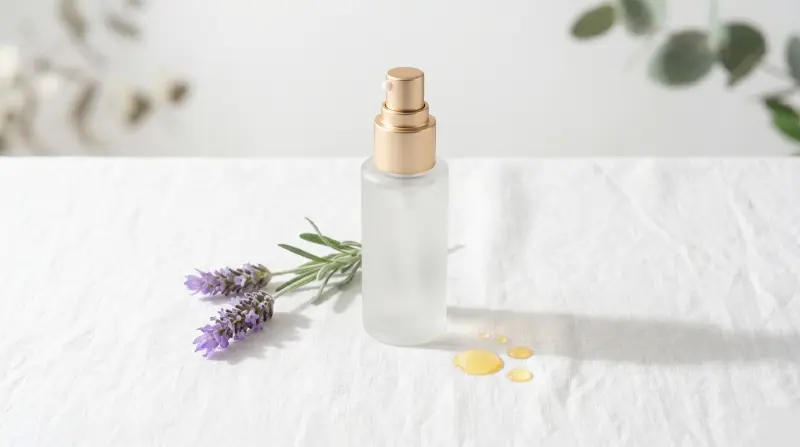
Lavender-infused oil cleansers add a sensory dimension to the cleansing ritual, but it's important to distinguish between lavender essential oil (which contains linalool and linalyl acetate — known sensitizers that can irritate compromised skin) and lavender extract or lavender-scented formulations using synthetic fragrance. For aging dry skin, the safest approach is fragrance-free oil cleansers that rely on the base oils themselves for benefit. If lavender scent is desired for the ritualistic calming effect, choose a product where lavender is listed low in the ingredient list (minimal concentration) or use a lavender-scented candle during cleansing rather than applying the essential oil to sensitized skin.
Clinical research confirms that the clinical benefits of oil cleansing for aging skin extend beyond gentle makeup removal. A study comparing oil cleansing versus cream cleansing versus foaming cleansing in women with dry mature skin found that oil cleansing produced the lowest post-wash TEWL increase (8% versus 15% for cream and 25% for foaming), the least reduction in surface lipids, and the highest subjective comfort scores. After 4 weeks of oil-only cleansing, the oil cleansing group showed 19% improvement in baseline barrier function — not from any treatment product, but simply from eliminating the daily barrier stripping that surfactant cleansers caused.
The oil cleansing technique for aging dry skin: apply a generous amount of cleansing oil to dry face and neck (not wet — water prevents the oil from properly dissolving sebum-based impurities). Massage gently for 60 seconds using circular motions — this dissolves SPF, makeup, and accumulated debris while the massage stimulates circulation. Add lukewarm water and continue massaging — the emulsifiers in the cleansing oil will transform it into a milky emulsion that rinses cleanly. Pat dry. Your skin should feel clean but not tight — a comfortable, slightly dewy finish that indicates the barrier was protected during cleansing. Follow immediately with your peptide serum on the still-damp skin.
Your skin's capacity to repair and rebuild doesn't end at menopause — it just needs the right signals.
— Dr. Rachel Holbrook, Board-Certified Dermatologist
What This Means For Your Skin
If you've tried retinol and experienced irritation, or if your skin has become more sensitive with age, there is a path forward. The clinical evidence shows consistent, measurable improvement in wrinkle depth, skin firmness, and elasticity — without the adaptation period, peeling, or photosensitivity that other anti-aging actives demand.
Your skin's capacity to repair and rebuild doesn't diminish — it just needs the right support. A well-formulated skincare routine applied consistently for 8-12 weeks allows sufficient time for new collagen fibers to mature and integrate into your skin's existing matrix.
The science is clear. The evidence is consistent. The results are measurable.
What happens next is up to you.