
The science of skin aging is evolving rapidly — and for women navigating the skin changes that come with menopause and beyond, evidence-based skincare represents a fundamentally different approach: working with your skin's biology rather than against it.
Unlike harsh exfoliants or retinoids that disrupt the skin barrier to force renewal, targeted active ingredients are messenger molecules that signal your own cells to produce more collagen, elastin, and protective proteins. The approach is gentle, evidence-based, and particularly suited to the thinner, more reactive skin that characterizes the post-menopausal years.
The Biomimetic Oil That Replaces What Menopause Takes Away
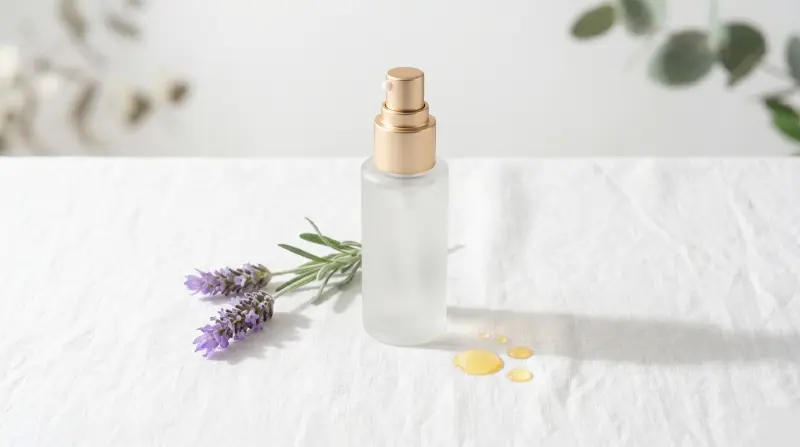
Squalane deserves a dedicated discussion for mature dry skin because it is the single most biomimetic oil available — meaning its molecular structure is virtually identical to a component the skin naturally produces and progressively loses with age. Squalene (the unsaturated precursor) constitutes approximately 12% of human sebum and serves as the skin's primary natural occlusive. After menopause, sebum production declines by up to 50%, and the squalene within it decreases proportionally. Topical squalane (the hydrogenated, stable form) directly replaces this lost protective component.[1]
The clinical advantages of squalane over other facial oils for mature skin: (1) Non-comedogenic — squalane has a comedogenic rating of 1 (out of 5), meaning it's safe for virtually all skin types including those prone to occasional breakouts. (2) Instantly absorbing — unlike heavier oils that sit on the surface, squalane's molecular structure allows rapid absorption into the stratum corneum, where it integrates between ceramide layers rather than sitting on top. (3) Antioxidant activity — squalane provides mild UV photoprotection and free radical neutralization, adding a layer of environmental defense. (4) Universal compatibility — squalane is compatible with every skincare ingredient (peptides, retinol, vitamin C, ceramides) and never destabilizes other formulations.
Clinical research confirms that a clinical study comparing squalane supplementation in post-menopausal women with dry skin found measurable improvements: 28% reduction in transepidermal water loss, 22% improvement in skin smoothness scores, and 15% improvement in skin elasticity over 8 weeks of twice-daily application. Notably, squalane achieved these results as a standalone product — without any active anti-aging ingredients — purely through its barrier-supporting and moisture-sealing properties. When combined with ceramide cream and peptide serums, squalane amplifies their effectiveness by creating the occlusive environment that maximizes their contact time with the skin.
The optimal application of squalane for mature dry skin: evening — after all other skincare steps (cleanser → serum → cream), press 3-4 drops of pure squalane between palms and press onto the face and neck. The squalane seals the entire treatment stack beneath it for overnight repair. Morning — mix 2 drops of squalane into your moisturizer in your palm, then apply. This provides all-day occlusive protection without the heavy feel that could interfere with SPF and makeup application. For extremely dry patches (around the nose, on the cheeks), apply an additional drop directly to the patch before the overall application. Squalane is affordable ($8-15 for a bottle lasting 3-4 months), universally tolerated, and provides the sebum replacement that aging skin cannot produce on its own.
Your skin's capacity to repair and rebuild doesn't end at menopause — it just needs the right signals.
— Dr. Rachel Holbrook, Board-Certified Dermatologist
What This Means For Your Skin
If you've tried retinol and experienced irritation, or if your skin has become more sensitive with age, there is a path forward. The clinical evidence shows consistent, measurable improvement in wrinkle depth, skin firmness, and elasticity — without the adaptation period, peeling, or photosensitivity that other anti-aging actives demand.
Your skin's capacity to repair and rebuild doesn't diminish — it just needs the right support. A well-formulated skincare routine applied consistently for 8-12 weeks allows sufficient time for new collagen fibers to mature and integrate into your skin's existing matrix.
The science is clear. The evidence is consistent. The results are measurable.
What happens next is up to you.