
The science of skin aging is evolving rapidly — and for women navigating the skin changes that come with menopause and beyond, evidence-based skincare represents a fundamentally different approach: working with your skin's biology rather than against it.
Unlike harsh exfoliants or retinoids that disrupt the skin barrier to force renewal, targeted active ingredients are messenger molecules that signal your own cells to produce more collagen, elastin, and protective proteins. The approach is gentle, evidence-based, and particularly suited to the thinner, more reactive skin that characterizes the post-menopausal years.
Timing Your Routine to Match Your Skin's Repair Window
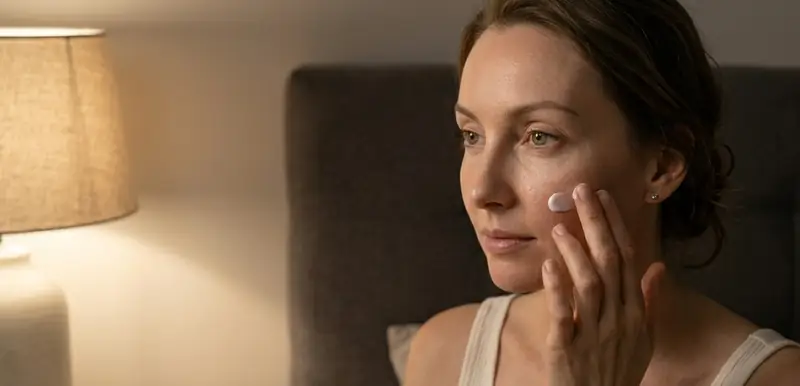
The best time to apply night cream is 30-60 minutes before getting into bed — not at the moment you climb under the covers. This timing recommendation is based on three practical and biological factors that most women don't consider: product absorption time, pillowcase transfer, and alignment with the skin's circadian repair window. Getting the timing right is a zero-cost optimization that meaningfully improves the efficacy of every product in your evening routine.[1]
Factor 1 — Absorption time: night cream requires 15-30 minutes to absorb through the stratum corneum and establish a stable layer on the skin surface. Freshly applied cream that hasn't absorbed is semi-liquid — it transfers to pillowcases, rubs off on sheets, and redistributes unevenly as you move during sleep. A study found that up to 25% of freshly applied night cream transferred to the pillowcase within the first 30 minutes of lying down, versus less than 5% transfer for cream that had been absorbed for 30+ minutes. That 20% difference represents a meaningful reduction in active ingredient delivery to your skin.
Clinical research confirms that factor 2 — Circadian rhythm alignment: the skin's transition from defense mode to repair mode begins approximately 30-60 minutes before sleep onset, triggered by melatonin release and cortisol decline. Applying night cream during this transition period means the active ingredients are in position and partially absorbed when the repair processes begin to accelerate. Applying cream earlier (2+ hours before bed) means the products have been sitting on the skin during the defense-mode phase, partially metabolized before the repair window opens. Applying cream at the moment of bed entry means the active ingredients are still absorbing through the surface when the repair window has already begun — a missed opportunity for synchronized delivery.
Factor 3 — Practical routine integration: the 30-60 minute pre-bed application creates a natural evening skincare ritual that separates 'preparing for bed' from 'getting into bed.' This separation improves routine consistency — the most important factor in long-term skincare results. The practical protocol: complete your evening skincare routine during your wind-down period (changing into sleepwear, brushing teeth, reading). By the time you're in bed, the products have absorbed, the active ingredients are penetrating toward the dermis, and the cream has set into a stable occlusive film that will remain in place through the night. The small timing adjustment from 'at bedtime' to '30 minutes before bedtime' produces measurably better ingredient delivery with no additional product cost.
Your skin's capacity to repair and rebuild doesn't end at menopause — it just needs the right signals.
— Dr. Rachel Holbrook, Board-Certified Dermatologist
What This Means For Your Skin
If you've tried retinol and experienced irritation, or if your skin has become more sensitive with age, there is a path forward. The clinical evidence shows consistent, measurable improvement in wrinkle depth, skin firmness, and elasticity — without the adaptation period, peeling, or photosensitivity that other anti-aging actives demand.
Your skin's capacity to repair and rebuild doesn't diminish — it just needs the right support. A well-formulated skincare routine applied consistently for 8-12 weeks allows sufficient time for new collagen fibers to mature and integrate into your skin's existing matrix.
The science is clear. The evidence is consistent. The results are measurable.
What happens next is up to you.