
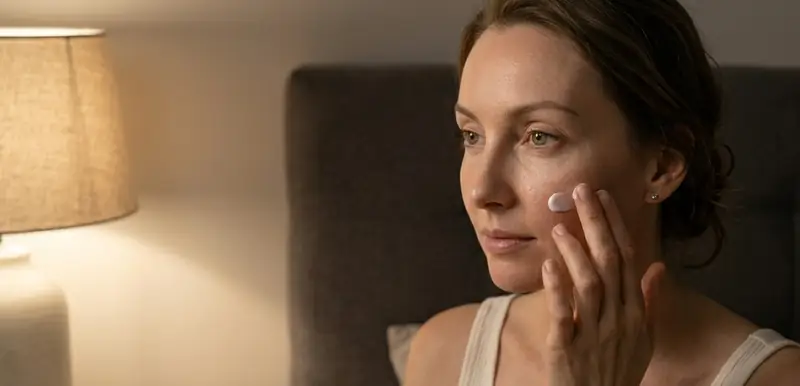
The science of skin aging is evolving rapidly — and for women navigating the skin changes that come with menopause and beyond, evidence-based skincare represents a fundamentally different approach: working with your skin's biology rather than against it.
Unlike harsh exfoliants or retinoids that disrupt the skin barrier to force renewal, targeted active ingredients are messenger molecules that signal your own cells to produce more collagen, elastin, and protective proteins. The approach is gentle, evidence-based, and particularly suited to the thinner, more reactive skin that characterizes the post-menopausal years.
The Evening Protocol That Maximizes Overnight Skin Repair
The nighttime skincare routine in your 50s is arguably the most important routine of your day — more impactful than morning skincare, more consequential than any single product choice. Between 10 PM and 2 AM, the skin enters its peak repair phase: cell division accelerates by 30%, blood flow to the dermis increases (delivering more nutrients and oxygen), and growth hormone released during deep sleep stimulates tissue regeneration. A well-designed evening routine capitalizes on this biological window by providing the raw materials — peptides, retinol, ceramides — that the skin's repair machinery needs to rebuild what the day has damaged.[1]
The 50s night routine differs fundamentally from younger routines because the repair mechanisms themselves are slowing. Fibroblast activity has declined, collagen synthesis is 25-35% below peak levels, and the barrier takes longer to recover from daily stressors. This means the evening routine must be more potent, more targeted, and more consistent than it needed to be at 35 or 40. The products haven't changed — peptides, retinol, ceramides remain the foundation — but the concentrations, layering strategy, and application technique must be optimized for skin that needs more input to produce the same output.
Clinical research confirms that the optimal 50s night routine in order: (1) First cleanse — oil cleanser to dissolve SPF, makeup, and environmental debris. Massage for 60 seconds, add water to emulsify, rinse. (2) Second cleanse (if needed) — gentle cream cleanser only if heavy makeup was worn. Skip on minimal-makeup days. (3) Treatment serum — retinol (if tolerated) or peptide serum on slightly damp skin. This is the highest-penetration step, applied when the stratum corneum is most permeable. Wait 2-3 minutes for absorption. (4) Eye cream — dedicated peptide eye treatment patted gently around the orbital bone. (5) Night cream — rich peptide and ceramide cream applied generously. This is both treatment and barrier repair. (6) Occlusive seal — 2-3 drops of squalane oil pressed over everything, creating the sealed environment that maximizes overnight ingredient contact time.
The two non-negotiable components for a 50s night routine: peptides and ceramides. Peptides (Matrixyl, copper peptides, Argireline) provide the collagen-stimulating signals that aging fibroblasts need — external instructions to produce the structural proteins they're producing less of on their own. Ceramides (in a cream with cholesterol and fatty acids at the physiological 3:1:1 ratio) repair the barrier that menopause has depleted, preventing the overnight moisture loss that makes morning skin feel dry and wrinkles appear deeper than their structural depth. Without peptides, there's no active anti-aging treatment. Without ceramides, there's no barrier to retain moisture or keep treatments in contact with the skin.
Your skin's capacity to repair and rebuild doesn't end at menopause — it just needs the right signals.
— Dr. Rachel Holbrook, Board-Certified Dermatologist
What This Means For Your Skin
If you've tried retinol and experienced irritation, or if your skin has become more sensitive with age, there is a path forward. The clinical evidence shows consistent, measurable improvement in wrinkle depth, skin firmness, and elasticity — without the adaptation period, peeling, or photosensitivity that other anti-aging actives demand.
Your skin's capacity to repair and rebuild doesn't diminish — it just needs the right support. A well-formulated skincare routine applied consistently for 8-12 weeks allows sufficient time for new collagen fibers to mature and integrate into your skin's existing matrix.
The science is clear. The evidence is consistent. The results are measurable.
What happens next is up to you.