
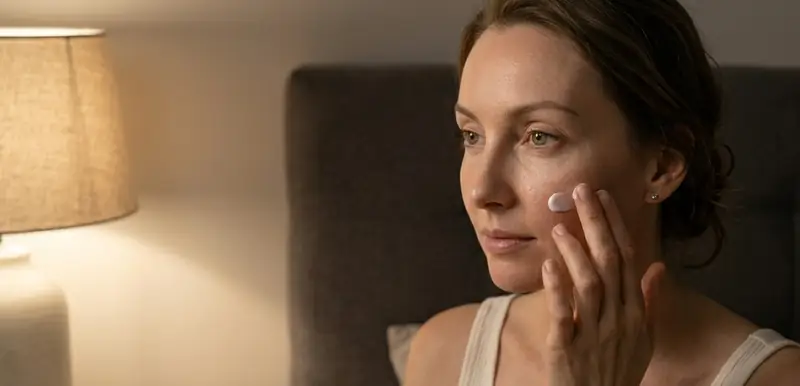
The science of skin aging is evolving rapidly — and for women navigating the skin changes that come with menopause and beyond, evidence-based skincare represents a fundamentally different approach: working with your skin's biology rather than against it.
Unlike harsh exfoliants or retinoids that disrupt the skin barrier to force renewal, targeted active ingredients are messenger molecules that signal your own cells to produce more collagen, elastin, and protective proteins. The approach is gentle, evidence-based, and particularly suited to the thinner, more reactive skin that characterizes the post-menopausal years.
Step-by-Step Evening Protocol for Maximum Overnight Results
The best night routine for mature skin isn't about having more products — it's about having the right products in the right order, applied at the right time. Clinical research has identified a hierarchy of ingredient penetration: lighter, water-based formulations penetrate first, followed by oil-based formulations that create an occlusive seal. Applying products in reverse order — cream before serum — physically blocks the serum's active ingredients from reaching the skin. For mature skin where every percentage point of ingredient efficacy matters, correct layering order is the difference between treatment and waste.[1]
The scientifically optimal night routine for mature skin follows the thin-to-thick principle: Step 1 — Cleanse (oil cleanser for thorough removal without barrier stripping). Step 2 — Tone (optional — a hydrating toner with hyaluronic acid on damp skin provides the moisture base that subsequent products need). Step 3 — Treatment serum (the highest-concentration active — retinol, peptide serum, or vitamin C derivative — applied to clean, slightly damp skin for maximum penetration). Step 4 — Eye treatment (dedicated eye cream patted around the orbital bone). Step 5 — Night cream (ceramide-peptide cream that serves as both treatment and barrier repair). Step 6 — Optional occlusive (squalane oil or sleeping mask for intensive overnight hydration).
Clinical research confirms that timing matters more than most women realize. A study on circadian skin biology found that the skin's permeability peaks between 4 PM and midnight — meaning evening application of active ingredients achieves greater penetration than morning application of the same products. Additionally, the skin's repair enzymes peak during early sleep (10 PM - 2 AM), creating a window where collagen-stimulating ingredients like peptides and retinol are most effectively utilized. Applying the night routine 30-60 minutes before bed — not at bed — allows the products to absorb before pillowcase contact and aligns peak ingredient delivery with peak repair activity.
The night routine mistakes that undermine mature skin treatment: (1) Over-cleansing — double cleansing with two harsh cleansers strips the barrier you're about to try to repair. One oil cleanse is sufficient for most days. (2) Too many actives in one routine — retinol + AHA + vitamin C in the same evening overwhelms the barrier. Choose one primary treatment per evening and rotate. (3) Skipping the occlusive seal — leaving treatment products unsealed allows evaporation and reduces overnight contact time by up to 40%. (4) Inconsistency — using an elaborate routine twice a week is less effective than a simple routine every night. A basic peptide cream applied consistently outperforms a complex multi-step routine used sporadically.
Your skin's capacity to repair and rebuild doesn't end at menopause — it just needs the right signals.
— Dr. Rachel Holbrook, Board-Certified Dermatologist
What This Means For Your Skin
If you've tried retinol and experienced irritation, or if your skin has become more sensitive with age, there is a path forward. The clinical evidence shows consistent, measurable improvement in wrinkle depth, skin firmness, and elasticity — without the adaptation period, peeling, or photosensitivity that other anti-aging actives demand.
Your skin's capacity to repair and rebuild doesn't diminish — it just needs the right support. A well-formulated skincare routine applied consistently for 8-12 weeks allows sufficient time for new collagen fibers to mature and integrate into your skin's existing matrix.
The science is clear. The evidence is consistent. The results are measurable.
What happens next is up to you.