
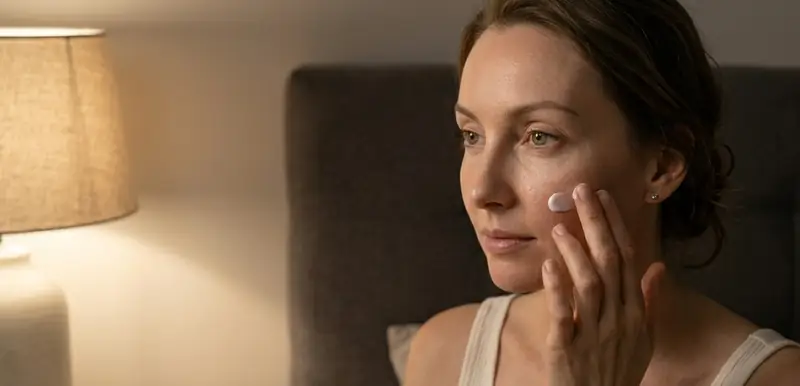
The science of skin aging is evolving rapidly — and for women navigating the skin changes that come with menopause and beyond, evidence-based skincare represents a fundamentally different approach: working with your skin's biology rather than against it.
Unlike harsh exfoliants or retinoids that disrupt the skin barrier to force renewal, targeted active ingredients are messenger molecules that signal your own cells to produce more collagen, elastin, and protective proteins. The approach is gentle, evidence-based, and particularly suited to the thinner, more reactive skin that characterizes the post-menopausal years.
The Physics of Product Penetration That Determines Results
Skincare layering is governed by physics, not marketing — and understanding two simple principles eliminates all confusion about product order. Principle 1: Thin before thick. Products with lower viscosity (watery serums) must go before products with higher viscosity (creams). Thin products cannot penetrate through a thick product layer already on the skin. Principle 2: Active before protective. Treatment products (retinol, peptides, vitamin C) must be applied before barrier products (ceramide cream, squalane oil). Treatment products need skin contact for efficacy. Barrier products are designed to create a seal — applying them first seals the skin before treatment products can reach it.[1]
The definitive layering order for aging skin PM routine: Layer 1 — Cleanser (removes barrier to clean skin). Layer 2 — Toner/essence (optional — adds hydration that enhances subsequent product penetration). Apply to damp skin, pat until mostly absorbed. Layer 3 — Active treatment serum (retinol OR peptide serum — the most important step, applied to clean skin for maximum penetration). Layer 4 — Secondary treatment (eye cream, spot treatment — localized products applied to specific areas). Layer 5 — Moisturizing cream (ceramide night cream — provides barrier repair and occlusion over the treatment layers). Layer 6 — Occlusive seal (squalane oil or sleeping mask — maximum occlusion for intensive repair nights).
Clinical research confirms that the wait-time controversy: do you need to wait between layers? The clinical consensus is nuanced. Between treatment serum and night cream: wait 2-3 minutes. The serum needs time to absorb into the stratum corneum before the cream's lipid barrier is applied over it. Applying cream immediately over serum can create a mixing layer that dilutes the serum's concentration and reduces its penetration. Between other layers: 30-60 seconds is sufficient for the previous layer to partially absorb. Waiting longer than 5 minutes between any layers is unnecessary — the product is either going to absorb or it's not.
Layering mistakes specific to aging skin: (1) Applying facial oil before cream — oil creates a hydrophobic barrier that prevents water-based cream ingredients from penetrating. Always apply oil last (after cream). (2) Using too many active treatments in one evening — retinol + AHA + vitamin C + niacinamide layered in sequence overwhelms the barrier and increases irritation without proportionally increasing efficacy. Choose 1-2 actives per evening. (3) Applying retinol around the eyes without a dedicated eye product — the orbital skin is 3-5x thinner than the rest of the face and absorbs retinol at a much higher rate, risking irritation. Use an eye-specific retinol product at a lower concentration. (4) Not adjusting cream thickness for aging skin — if your night cream absorbs within 5 minutes and leaves no detectable film, it's too lightweight for overnight occlusion on mature skin.
Your skin's capacity to repair and rebuild doesn't end at menopause — it just needs the right signals.
— Dr. Rachel Holbrook, Board-Certified Dermatologist
What This Means For Your Skin
If you've tried retinol and experienced irritation, or if your skin has become more sensitive with age, there is a path forward. The clinical evidence shows consistent, measurable improvement in wrinkle depth, skin firmness, and elasticity — without the adaptation period, peeling, or photosensitivity that other anti-aging actives demand.
Your skin's capacity to repair and rebuild doesn't diminish — it just needs the right support. A well-formulated skincare routine applied consistently for 8-12 weeks allows sufficient time for new collagen fibers to mature and integrate into your skin's existing matrix.
The science is clear. The evidence is consistent. The results are measurable.
What happens next is up to you.