
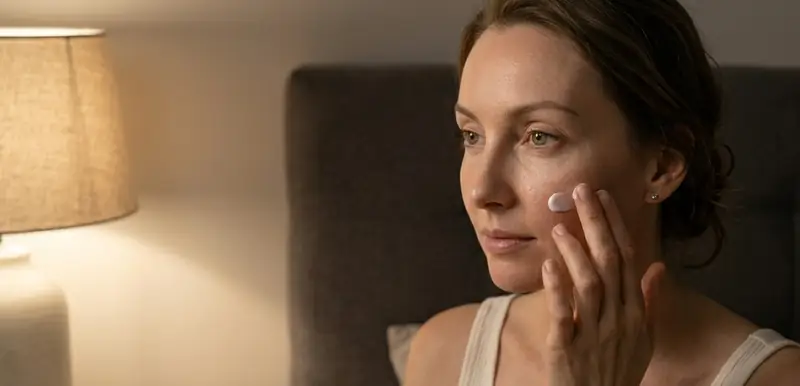
The science of skin aging is evolving rapidly — and for women navigating the skin changes that come with menopause and beyond, evidence-based skincare represents a fundamentally different approach: working with your skin's biology rather than against it.
Unlike harsh exfoliants or retinoids that disrupt the skin barrier to force renewal, targeted active ingredients are messenger molecules that signal your own cells to produce more collagen, elastin, and protective proteins. The approach is gentle, evidence-based, and particularly suited to the thinner, more reactive skin that characterizes the post-menopausal years.
Understanding When Each Format Delivers Superior Results
The night cream versus night serum debate creates a false choice that leads many women to use one when they should be using both. Night serum and night cream serve fundamentally different purposes through fundamentally different mechanisms, and for mature skin, using one without the other leaves significant anti-aging potential untapped. Understanding what each format does — and doesn't do — transforms the question from 'which is better?' to 'how do I use both effectively?'[1]
Night serum: a concentrated, low-viscosity formula designed for maximum penetration. Serums contain high concentrations of active ingredients (peptides, retinol, hyaluronic acid, niacinamide) in a lightweight vehicle that absorbs rapidly into the stratum corneum. The small molecular size and water-based delivery allow active molecules to reach the dermis where collagen production occurs. What serums DON'T provide: significant occlusion, barrier repair, or sustained moisture retention. A serum applied alone on mature skin delivers its active cargo effectively but allows moisture to evaporate and provides no protective barrier during the overnight repair window.
Clinical research confirms that night cream: a rich, lipid-heavy emulsion designed for barrier repair and sustained occlusion. Night creams contain ceramides, fatty acids, and occlusives (squalane, shea butter) that rebuild the lipid barrier and prevent transepidermal water loss during the 7-8 hours of sleep. Many night creams also contain active ingredients (peptides, niacinamide), though typically at lower concentrations than serums due to formulation constraints. What night creams DON'T provide: maximum-strength active ingredient delivery. The rich vehicle that makes creams excellent for barrier protection also slows penetration of active molecules — a trade-off between occlusion and penetration.
The optimal combination for mature skin: serum first, cream second. Apply night serum to clean skin — the active ingredients penetrate efficiently through the unobstructed stratum corneum, reaching the dermis at maximum concentration. Wait 2-3 minutes for absorption. Then apply night cream on top — the lipid-rich cream creates an occlusive seal over the serum, preventing the active ingredients from evaporating while simultaneously repairing the barrier and maintaining overnight hydration. Clinical studies confirm the combination approach outperforms either product alone: serum + cream produced 38% greater improvement in wrinkle depth than cream alone and 45% better hydration maintenance than serum alone over 12 weeks. The answer for mature skin is definitively both, not either/or.
Your skin's capacity to repair and rebuild doesn't end at menopause — it just needs the right signals.
— Dr. Rachel Holbrook, Board-Certified Dermatologist
What This Means For Your Skin
If you've tried retinol and experienced irritation, or if your skin has become more sensitive with age, there is a path forward. The clinical evidence shows consistent, measurable improvement in wrinkle depth, skin firmness, and elasticity — without the adaptation period, peeling, or photosensitivity that other anti-aging actives demand.
Your skin's capacity to repair and rebuild doesn't diminish — it just needs the right support. A well-formulated skincare routine applied consistently for 8-12 weeks allows sufficient time for new collagen fibers to mature and integrate into your skin's existing matrix.
The science is clear. The evidence is consistent. The results are measurable.
What happens next is up to you.