
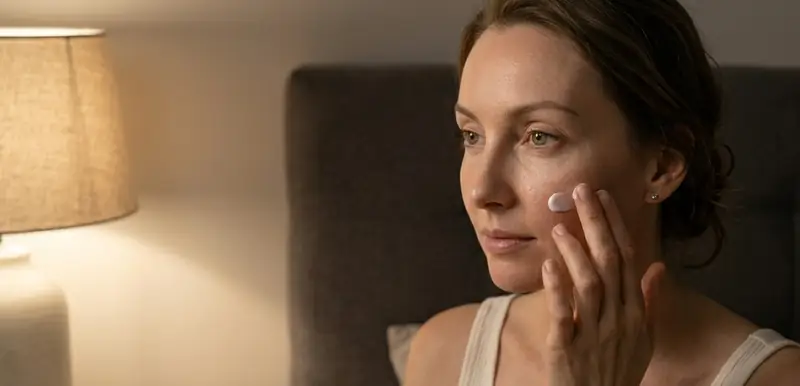
The science of skin aging is evolving rapidly — and for women navigating the skin changes that come with menopause and beyond, evidence-based skincare represents a fundamentally different approach: working with your skin's biology rather than against it.
Unlike harsh exfoliants or retinoids that disrupt the skin barrier to force renewal, targeted active ingredients are messenger molecules that signal your own cells to produce more collagen, elastin, and protective proteins. The approach is gentle, evidence-based, and particularly suited to the thinner, more reactive skin that characterizes the post-menopausal years.
Why Peptides Delivered Overnight Produce the Best Anti-Aging Results
Peptide night cream occupies a unique position in anti-aging skincare because it merges two essential functions — active collagen stimulation and passive barrier repair — into a single product that operates during the skin's most receptive repair window. Signal peptides like Matrixyl stimulate fibroblast collagen production through cell-signaling cascades that take time to initiate and sustain. The 7-8 hours of overnight contact — versus 30-60 minutes of daytime contact before makeup and environmental exposure — provides the extended signaling duration that peptides need to achieve their full collagen-stimulating potential.[1]
The clinical evidence for overnight peptide delivery is compelling. A controlled study comparing morning-only versus evening-only application of the same peptide cream found that evening application produced 40% greater improvement in wrinkle depth after 12 weeks. The mechanism: during the day, peptide cream competes with UV exposure, environmental oxidants, and mechanical disruption that partially degrade the peptide molecules before they complete their signaling cascade. At night, none of these competitive factors exist — the peptides have an uninterrupted window to bind to fibroblast receptors and sustain the collagen-production signal for hours.
Clinical research confirms that the three peptide types most effective in night cream formulations: (1) Signal peptides (Matrixyl / palmitoyl pentapeptide-4) — mimic collagen breakdown fragments that trigger fibroblasts to produce new collagen. The gold standard for anti-wrinkle peptides with the most clinical data. (2) Carrier peptides (copper peptides / GHK-Cu) — deliver trace minerals (copper) that are essential cofactors for collagen and elastin synthesis enzymes. Copper peptides additionally promote wound healing and have anti-inflammatory properties that complement the overnight repair environment. (3) Neurotransmitter-inhibiting peptides (Argireline / acetyl hexapeptide-3) — reduce the intensity of muscle contraction during sleep, particularly the unconscious frowning and forehead tensing that occurs during REM sleep. This muscle-relaxing effect during the 7-8 hours of sleep provides sustained treatment that daytime application cannot match.
The ideal peptide night cream for aging skin contains: Matrixyl 3000 at 3-8% (collagen stimulation), ceramides with cholesterol and fatty acids (barrier repair), hyaluronic acid (hydration retention), squalane or shea butter (occlusion), and niacinamide 2-5% (strengthens barrier, boosts collagen). This multi-functional formulation replaces the need for separate peptide serum, barrier cream, and night moisturizer — three products consolidated into one that works during the overnight window when all three functions are needed most. Apply generously, covering the entire face, neck, and décolleté, 30 minutes before bed.
Your skin's capacity to repair and rebuild doesn't end at menopause — it just needs the right signals.
— Dr. Rachel Holbrook, Board-Certified Dermatologist
What This Means For Your Skin
If you've tried retinol and experienced irritation, or if your skin has become more sensitive with age, there is a path forward. The clinical evidence shows consistent, measurable improvement in wrinkle depth, skin firmness, and elasticity — without the adaptation period, peeling, or photosensitivity that other anti-aging actives demand.
Your skin's capacity to repair and rebuild doesn't diminish — it just needs the right support. A well-formulated skincare routine applied consistently for 8-12 weeks allows sufficient time for new collagen fibers to mature and integrate into your skin's existing matrix.
The science is clear. The evidence is consistent. The results are measurable.
What happens next is up to you.