
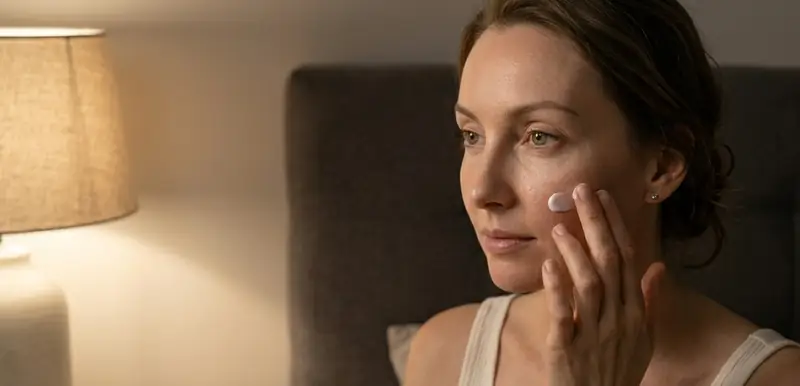
The science of skin aging is evolving rapidly — and for women navigating the skin changes that come with menopause and beyond, evidence-based skincare represents a fundamentally different approach: working with your skin's biology rather than against it.
Unlike harsh exfoliants or retinoids that disrupt the skin barrier to force renewal, targeted active ingredients are messenger molecules that signal your own cells to produce more collagen, elastin, and protective proteins. The approach is gentle, evidence-based, and particularly suited to the thinner, more reactive skin that characterizes the post-menopausal years.
How Overnight Ceramide Therapy Restores What Menopause Takes Away
Ceramide night cream is the single most important product in a post-menopausal woman's evening routine — more important than retinol, more important than peptide serum, more important than any active treatment. The reason is biological priority: without a functional barrier, no active ingredient can work effectively. Retinol applied to barrier-compromised skin either penetrates too deeply (causing irritation) or evaporates before reaching the dermis (providing no benefit). Peptides applied to barrier-compromised skin escape through the gaps in the lipid matrix rather than remaining in contact with the epidermis long enough to signal fibroblasts. The barrier is the foundation upon which every other anti-aging intervention depends.[1]
The overnight window is uniquely suited for ceramide therapy because the skin's natural ceramide synthesis peaks during sleep. Keratinocytes in the stratum granulosum produce ceramides through serine palmitoyltransferase — an enzyme whose activity follows a circadian rhythm, peaking during the nighttime hours. Topical ceramide cream applied before bed provides exogenous ceramides that supplement this natural overnight production, effectively doubling the barrier's repair resources during the window when it's most actively rebuilding. A clinical study found that overnight ceramide application restored barrier function to pre-menopausal levels within 4 weeks of nightly use.
Clinical research confirms that the optimal ceramide night cream contains the physiological lipid ratio: ceramides 50%, cholesterol 25%, fatty acids 25% (the 3:1:1 ratio). This ratio mimics the natural composition of the stratum corneum's lipid matrix, ensuring that the exogenous lipids integrate seamlessly with the skin's own barrier structure. Products that contain ceramides without cholesterol and fatty acids provide only one-third of the barrier's building materials — like providing bricks without mortar. The complete trio of ceramides, cholesterol, and fatty acids assembles into the lamellar structures that form the functional barrier — the sealed layers between corneocytes that prevent water escape and irritant entry.
The practical application for maximum overnight barrier repair: apply ceramide night cream generously after all treatment serums have been absorbed. Use upward strokes to apply from the chin to the forehead, then outward strokes from the nose to the ears. Don't forget the neck and décolleté — these areas have even fewer natural ceramides than the face and benefit proportionally more from supplementation. The cream should feel rich going on and take 2-3 minutes to fully absorb, leaving a barely detectable protective film that persists throughout the night. For severe barrier compromise (chronic dryness, post-procedure recovery, winter damage), add 2-3 drops of squalane oil pressed over the ceramide cream for maximum overnight occlusion.
Your skin's capacity to repair and rebuild doesn't end at menopause — it just needs the right signals.
— Dr. Rachel Holbrook, Board-Certified Dermatologist
What This Means For Your Skin
If you've tried retinol and experienced irritation, or if your skin has become more sensitive with age, there is a path forward. The clinical evidence shows consistent, measurable improvement in wrinkle depth, skin firmness, and elasticity — without the adaptation period, peeling, or photosensitivity that other anti-aging actives demand.
Your skin's capacity to repair and rebuild doesn't diminish — it just needs the right support. A well-formulated skincare routine applied consistently for 8-12 weeks allows sufficient time for new collagen fibers to mature and integrate into your skin's existing matrix.
The science is clear. The evidence is consistent. The results are measurable.
What happens next is up to you.