
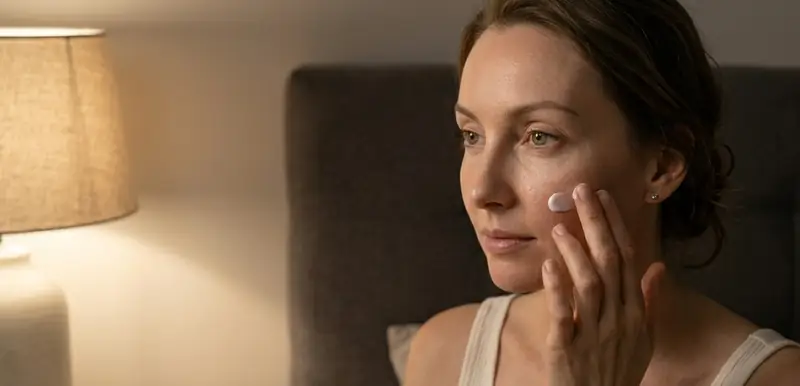
The science of skin aging is evolving rapidly — and for women navigating the skin changes that come with menopause and beyond, evidence-based skincare represents a fundamentally different approach: working with your skin's biology rather than against it.
Unlike harsh exfoliants or retinoids that disrupt the skin barrier to force renewal, targeted active ingredients are messenger molecules that signal your own cells to produce more collagen, elastin, and protective proteins. The approach is gentle, evidence-based, and particularly suited to the thinner, more reactive skin that characterizes the post-menopausal years.
When to Use Each — and When to Layer Both
Overnight masks and night creams share enough characteristics to create confusion — both are applied before bed, both provide occlusion, both claim anti-aging benefits — but they serve distinct roles in a mature skin routine and are not directly interchangeable. Understanding the functional difference prevents both the waste of using redundant products and the gap of assuming one replaces the other when it doesn't. The short answer: overnight masks supplement night cream 2-3 times per week for intensive treatment, but they don't replace the daily barrier maintenance that a ceramide night cream provides.[1]
Night cream (daily essential): a balanced emulsion containing ceramides, peptides, and moderate occlusion designed for nightly use. Night cream's primary function is barrier repair — restoring the ceramide-cholesterol-fatty acid matrix that menopause depletes. Its secondary function is anti-aging treatment through incorporated peptides or retinol. The texture is rich enough to provide overnight protection but not so heavy that it clogs pores or transfers excessively to the pillowcase. Night cream is the reliable daily maintenance that keeps the barrier functional and treatments in contact with the skin.
Clinical research confirms that overnight mask (intensive treatment, 2-3x/week): a thicker, more heavily occlusive formulation designed for maximum moisture sealing. Overnight masks contain higher concentrations of humectants (hyaluronic acid, glycerin), higher levels of occlusives (dimethicone, petrolatum), and often additional active ingredients (vitamin C, niacinamide, AHA). The key difference: overnight masks provide 50-70% reduction in transepidermal water loss versus 30-40% for night cream. This more intense occlusion creates a microenvironment where skin hydration and treatment contact time are maximized beyond what nightly cream achieves.
The practical integration: use night cream every night as your daily barrier repair and anti-aging maintenance. On 2-3 nights per week, layer the overnight mask on top of your night cream (not instead of it) for intensive treatment. The cream provides barrier repair at the skin level while the mask provides maximum occlusion at the surface level — complementary functions at different layers. The nights you choose for mask treatment should coincide with your retinol nights — the enhanced occlusion from the mask amplifies retinol's efficacy by extending its contact time and reducing the evaporation that occurs with cream alone. For mature skin dealing with chronic dryness or during winter months, nightly mask use may be appropriate for 2-4 week intensive repair periods before returning to 2-3x weekly maintenance.
Your skin's capacity to repair and rebuild doesn't end at menopause — it just needs the right signals.
— Dr. Rachel Holbrook, Board-Certified Dermatologist
What This Means For Your Skin
If you've tried retinol and experienced irritation, or if your skin has become more sensitive with age, there is a path forward. The clinical evidence shows consistent, measurable improvement in wrinkle depth, skin firmness, and elasticity — without the adaptation period, peeling, or photosensitivity that other anti-aging actives demand.
Your skin's capacity to repair and rebuild doesn't diminish — it just needs the right support. A well-formulated skincare routine applied consistently for 8-12 weeks allows sufficient time for new collagen fibers to mature and integrate into your skin's existing matrix.
The science is clear. The evidence is consistent. The results are measurable.
What happens next is up to you.