
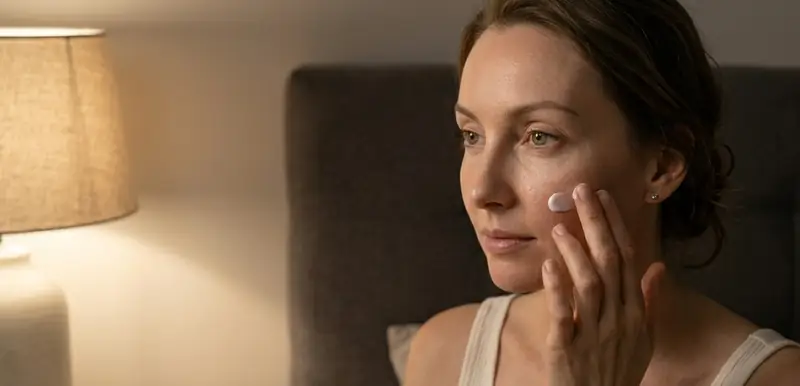
The science of skin aging is evolving rapidly — and for women navigating the skin changes that come with menopause and beyond, evidence-based skincare represents a fundamentally different approach: working with your skin's biology rather than against it.
Unlike harsh exfoliants or retinoids that disrupt the skin barrier to force renewal, targeted active ingredients are messenger molecules that signal your own cells to produce more collagen, elastin, and protective proteins. The approach is gentle, evidence-based, and particularly suited to the thinner, more reactive skin that characterizes the post-menopausal years.
Turning 8 Hours of Sleep Into Active Skin Repair
Overnight treatment represents the highest-leverage anti-aging intervention available at home because it combines three factors that no daytime routine can match: extended contact time (7-8 uninterrupted hours versus 30-60 minutes before makeup), peak biological repair activity (growth hormone release, accelerated cell turnover, increased blood flow), and absence of environmental stressors (no UV, no pollution, no mechanical friction from expressions). A treatment applied at night has approximately 3x the functional contact time and 2x the biological support of the same treatment applied in the morning.[1]
The three tiers of overnight anti-aging treatment, from essential to intensive: Tier 1 (essential, every night) — peptide night cream applied generously as the final step. The sustained contact time allows peptides to continuously stimulate fibroblast collagen production throughout the entire repair window. At 50+, this nightly peptide exposure is the minimum effective dose for maintaining collagen production. Tier 2 (3-5 nights per week) — retinol applied before the peptide cream, with the sandwich method if needed. Retinol works synergistically with the skin's natural nighttime repair cycle, amplifying the collagen synthesis that growth hormone initiates during deep sleep.
Clinical research confirms that tier 3 (1-2 nights per week, intensive) — overnight sleeping mask applied as a thick final layer over the entire routine. Sleeping masks provide maximum occlusion, creating a sealed microenvironment where active ingredients cannot evaporate and transepidermal water loss is reduced by 50-70%. A study found that overnight sleeping mask use improved morning hydration by 48% and wrinkle depth by 18% after just one week — faster results than any leave-on moisturizer because the extended occlusive contact amplifies every ingredient's efficacy.
The home overnight treatment protocol: (1) Cleanse thoroughly — overnight treatments work best on clean skin free of SPF residue and environmental debris. (2) Apply active serum (retinol or peptide) to bare, dry skin. (3) Layer night cream generously — don't be conservative with product application at night. There are no cosmetic elegance constraints (no makeup going over it, no one seeing the shiny layer). More product means more active ingredient delivery and more occlusion. (4) Optional: apply squalane oil or petroleum jelly to the driest areas (cheeks, around the mouth, forehead lines) as a targeted occlusive boost. (5) Sleep on a silk pillowcase — reduces friction-induced wrinkle formation and prevents product absorption into the fabric. The overnight treatment principle: your skin is working to repair itself. Your job is to provide the materials and the sealed environment that maximizes that repair.
Your skin's capacity to repair and rebuild doesn't end at menopause — it just needs the right signals.
— Dr. Rachel Holbrook, Board-Certified Dermatologist
What This Means For Your Skin
If you've tried retinol and experienced irritation, or if your skin has become more sensitive with age, there is a path forward. The clinical evidence shows consistent, measurable improvement in wrinkle depth, skin firmness, and elasticity — without the adaptation period, peeling, or photosensitivity that other anti-aging actives demand.
Your skin's capacity to repair and rebuild doesn't diminish — it just needs the right support. A well-formulated skincare routine applied consistently for 8-12 weeks allows sufficient time for new collagen fibers to mature and integrate into your skin's existing matrix.
The science is clear. The evidence is consistent. The results are measurable.
What happens next is up to you.