
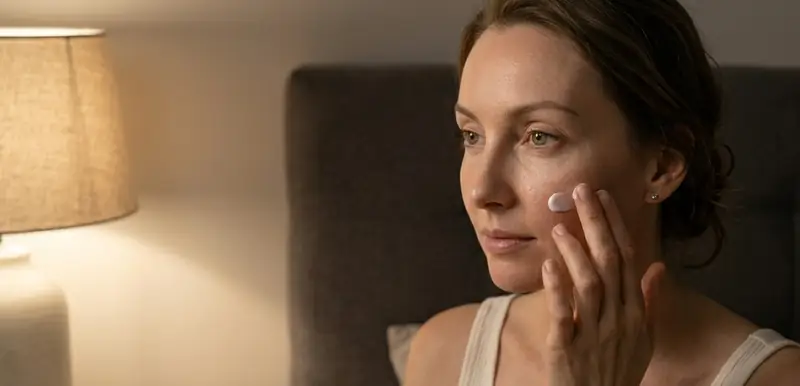
The science of skin aging is evolving rapidly — and for women navigating the skin changes that come with menopause and beyond, evidence-based skincare represents a fundamentally different approach: working with your skin's biology rather than against it.
Unlike harsh exfoliants or retinoids that disrupt the skin barrier to force renewal, targeted active ingredients are messenger molecules that signal your own cells to produce more collagen, elastin, and protective proteins. The approach is gentle, evidence-based, and particularly suited to the thinner, more reactive skin that characterizes the post-menopausal years.
The Biological Processes That Make Nighttime Skincare Critical
The skin is not a passive wrapper — it's a dynamic organ that cycles between two distinct modes: daytime defense and nighttime repair. During the day, the skin prioritizes protection against UV radiation, pollution, temperature extremes, and mechanical stress. At night, the skin shifts into repair mode, directing its metabolic resources toward fixing the damage accumulated during the day and producing the structural components (collagen, ceramides, hyaluronic acid) that maintain its integrity. Understanding this circadian rhythm reveals why the same ingredient applied at night can produce significantly better results than the same ingredient applied in the morning.[1]
The four nighttime repair processes that skincare can enhance: (1) Cell proliferation — skin cell division rate increases by approximately 30% during sleep, peaking between 11 PM and 4 AM. New keratinocytes produced during this window replace sun-damaged, pollution-exposed cells from the day. Retinol applied at night amplifies this natural turnover acceleration, producing even faster replacement of damaged surface cells. (2) Collagen synthesis — growth hormone released during deep sleep (60-90 minutes after sleep onset) directly stimulates fibroblast collagen production. Peptides applied before bed provide additional collagen-stimulating signals that combine with growth hormone's natural stimulus for enhanced structural repair.
Clinical research confirms that (3) Barrier restoration — the stratum corneum's lipid barrier, partially depleted during the day by UV exposure, cleansing, and environmental stress, regenerates most actively during sleep. Ceramide synthesis in keratinocytes increases overnight, rebuilding the mortar between skin cells. Ceramide cream applied at night provides the raw materials (exogenous ceramides, cholesterol, fatty acids) that supplement the skin's own production, accelerating barrier recovery. (4) DNA repair — UV radiation causes hundreds of DNA lesions in skin cells daily. Nucleotide excision repair — the enzymatic process that fixes UV-induced DNA damage — is most active during sleep when the skin is not receiving new UV insults. Antioxidants (vitamin E, niacinamide) applied at night support these repair enzymes by neutralizing residual free radicals that interfere with DNA repair.
The practical implication for mature skin: nighttime skincare is not merely applying products before bed — it's providing your skin with targeted support during its most active repair window. For women over 50, whose repair mechanisms are naturally slower, this nighttime support is proportionally more important. Every product in the evening routine should serve one of the four repair processes: retinol (amplifies cell proliferation), peptides (enhances collagen synthesis), ceramides (supports barrier restoration), antioxidants (assists DNA repair). Products that don't support at least one of these processes don't earn their place in a results-oriented PM routine.
Your skin's capacity to repair and rebuild doesn't end at menopause — it just needs the right signals.
— Dr. Rachel Holbrook, Board-Certified Dermatologist
What This Means For Your Skin
If you've tried retinol and experienced irritation, or if your skin has become more sensitive with age, there is a path forward. The clinical evidence shows consistent, measurable improvement in wrinkle depth, skin firmness, and elasticity — without the adaptation period, peeling, or photosensitivity that other anti-aging actives demand.
Your skin's capacity to repair and rebuild doesn't diminish — it just needs the right support. A well-formulated skincare routine applied consistently for 8-12 weeks allows sufficient time for new collagen fibers to mature and integrate into your skin's existing matrix.
The science is clear. The evidence is consistent. The results are measurable.
What happens next is up to you.