
The science of skin aging is evolving rapidly — and for women navigating the skin changes that come with menopause and beyond, evidence-based skincare represents a fundamentally different approach: working with your skin's biology rather than against it.
Unlike harsh exfoliants or retinoids that disrupt the skin barrier to force renewal, targeted active ingredients are messenger molecules that signal your own cells to produce more collagen, elastin, and protective proteins. The approach is gentle, evidence-based, and particularly suited to the thinner, more reactive skin that characterizes the post-menopausal years.
How to Align Your Routine With Your Skin's Natural Repair Clock
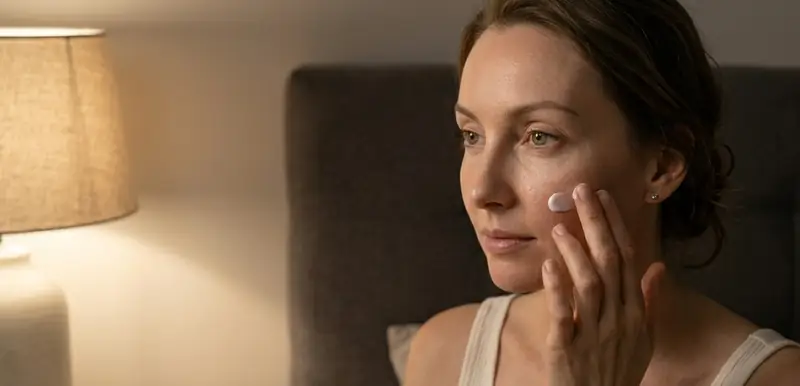
Beauty sleep is not a marketing myth — it's measurable biology. During sleep, three distinct repair processes accelerate simultaneously in the skin: (1) Cell proliferation increases by approximately 30% between 11 PM and 4 AM, producing new keratinocytes that replace damaged surface cells. (2) Growth hormone released during deep sleep (Stage 3-4 NREM sleep) directly stimulates fibroblast activity and collagen synthesis. (3) Cortisol — the stress hormone that inhibits collagen production and triggers inflammation — drops to its lowest levels during sleep, removing the biochemical brake on skin repair. A 'beauty sleep skincare routine' is simply a routine optimized to support all three of these processes.[1]
The timing protocol that maximizes beauty sleep benefits: 30-60 minutes before bed — complete your PM skincare routine. This gives products time to absorb into the skin before pillowcase contact (which can transfer up to 25% of freshly applied product to the fabric). The routine should be applied before the body begins its transition to sleep, allowing active ingredients to be in position when the repair window opens. 10 PM - 2 AM — the peak repair window. Growth hormone secretion peaks during the first deep sleep cycle, typically 60-90 minutes after falling asleep. Products applied before bed are now being processed by fibroblasts at their most active state.
Clinical research confirms that the beauty sleep routine optimized for mature skin: (1) Gentle oil cleanse — remove the day's accumulation without stripping the barrier that will protect overnight repair. (2) Peptide serum — the cornerstone product. Peptides delivered during peak growth hormone release amplify the collagen-stimulating signal — the external peptide signal combines with the internal growth hormone signal for maximum fibroblast activation. (3) Ceramide night cream — barrier repair during sleep prevents the overnight transepidermal water loss that dehydrates the new cells being produced. (4) Squalane oil seal — the occlusive final step that creates the protected microenvironment where all overnight processes operate at peak efficiency.
The sleep habits that complement the beauty sleep routine: (1) Sleep on your back — prevents compression wrinkles caused by pressing the face against the pillow for hours. (2) Silk pillowcase — reduces friction by 43% compared to cotton, minimizing mechanical stress on the skin and preventing product transfer. (3) Humidifier — maintaining 40-60% bedroom humidity reduces overnight TEWL by 28%, supporting the barrier repair that ceramide cream provides. (4) 7-9 hours of sleep — the full repair cycle requires sufficient time. Studies show that sleeping less than 6 hours reduces skin recovery from environmental stressors by 30% and accelerates visible aging. The complete beauty sleep protocol integrates skincare products with sleep hygiene for maximum overnight repair.
Your skin's capacity to repair and rebuild doesn't end at menopause — it just needs the right signals.
— Dr. Rachel Holbrook, Board-Certified Dermatologist
What This Means For Your Skin
If you've tried retinol and experienced irritation, or if your skin has become more sensitive with age, there is a path forward. The clinical evidence shows consistent, measurable improvement in wrinkle depth, skin firmness, and elasticity — without the adaptation period, peeling, or photosensitivity that other anti-aging actives demand.
Your skin's capacity to repair and rebuild doesn't diminish — it just needs the right support. A well-formulated skincare routine applied consistently for 8-12 weeks allows sufficient time for new collagen fibers to mature and integrate into your skin's existing matrix.
The science is clear. The evidence is consistent. The results are measurable.
What happens next is up to you.