
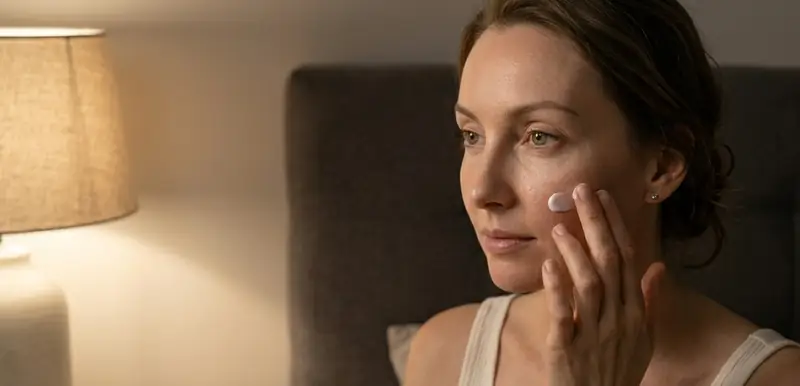
The science of skin aging is evolving rapidly — and for women navigating the skin changes that come with menopause and beyond, evidence-based skincare represents a fundamentally different approach: working with your skin's biology rather than against it.
Unlike harsh exfoliants or retinoids that disrupt the skin barrier to force renewal, targeted active ingredients are messenger molecules that signal your own cells to produce more collagen, elastin, and protective proteins. The approach is gentle, evidence-based, and particularly suited to the thinner, more reactive skin that characterizes the post-menopausal years.
The Correct Sequence That Ensures Each Product Reaches Its Target
The order of your PM routine determines whether expensive anti-wrinkle ingredients reach their target in the dermis or sit uselessly on the skin surface behind a barrier of products applied before them. The physics is simple: molecules move from high concentration to low concentration (diffusion), and they can only move through layers they can dissolve in. Water-based serums cannot penetrate through an oil layer. Oil-based products cannot penetrate through an aqueous layer effectively. Applying products in the wrong order creates physical barriers that block the ingredients you're relying on for wrinkle treatment.[1]
The correct PM order for wrinkle treatment, with the rationale for each position: Position 1 — Oil cleanser (removes the day's accumulated SPF, makeup, sebum, and pollutants). Position 2 — Hydrating toner or essence on damp skin (optional — provides a water-rich base that enhances penetration of subsequent water-soluble actives). Position 3 — Treatment serum (retinol or peptide serum — applied here because it's the highest-potency, lowest-viscosity product that needs maximum skin contact). This position ensures the active molecules have direct access to the stratum corneum without any preceding product barrier.
Clinical research confirms that position 4 — Eye cream (dedicated under-eye treatment patted gently with the ring finger — not rubbed — around the orbital bone from the outer corner inward). Position 5 — Night cream (ceramide-peptide cream that provides both active treatment and barrier repair). The cream's lipid-rich matrix creates an occlusive layer that seals the treatment serum applied in Position 3, preventing evaporation and extending its contact time with the skin. Position 6 — Occlusive boost (squalane oil or sleeping mask on particularly dry areas or 2-3 nights per week over the entire face for intensive treatment).
The most common sequencing errors for anti-wrinkle routines: (1) Applying retinol after a heavy cream — the cream's lipid layer physically blocks retinol from reaching the skin. (2) Mixing retinol and AHA in the same step — the pH conflict (retinol needs 5.5-6.5, AHAs need 3.5-4.0) reduces both ingredients' efficacy. Use on alternate nights. (3) Applying vitamin C and retinol simultaneously — vitamin C's low pH can destabilize retinol. Split them: vitamin C in the morning, retinol at night. (4) Skipping wait times — applying layers too quickly can cause pilling (products balling up on the surface) and reduces absorption of the preceding layer. Allow 60-90 seconds between each step for absorption before applying the next.
Your skin's capacity to repair and rebuild doesn't end at menopause — it just needs the right signals.
— Dr. Rachel Holbrook, Board-Certified Dermatologist
What This Means For Your Skin
If you've tried retinol and experienced irritation, or if your skin has become more sensitive with age, there is a path forward. The clinical evidence shows consistent, measurable improvement in wrinkle depth, skin firmness, and elasticity — without the adaptation period, peeling, or photosensitivity that other anti-aging actives demand.
Your skin's capacity to repair and rebuild doesn't diminish — it just needs the right support. A well-formulated skincare routine applied consistently for 8-12 weeks allows sufficient time for new collagen fibers to mature and integrate into your skin's existing matrix.
The science is clear. The evidence is consistent. The results are measurable.
What happens next is up to you.