
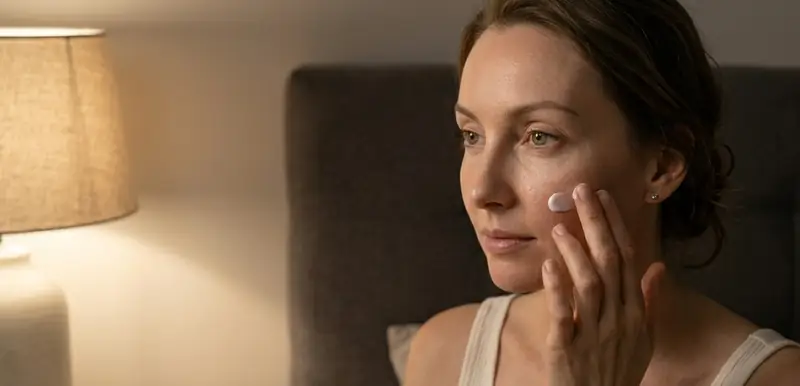
The science of skin aging is evolving rapidly — and for women navigating the skin changes that come with menopause and beyond, evidence-based skincare represents a fundamentally different approach: working with your skin's biology rather than against it.
Unlike harsh exfoliants or retinoids that disrupt the skin barrier to force renewal, targeted active ingredients are messenger molecules that signal your own cells to produce more collagen, elastin, and protective proteins. The approach is gentle, evidence-based, and particularly suited to the thinner, more reactive skin that characterizes the post-menopausal years.
The Complete Evening Protocol for Retinol Users
A retinol night routine is not simply 'apply retinol before bed.' Each step in the evening protocol serves a specific function that either prepares the skin for retinol, maximizes retinol's efficacy, or protects the barrier from retinol's temporary disruption. Skipping or misordering any step reduces the overall effectiveness of the routine — and in some cases, can increase irritation rather than results. This step-by-step protocol is based on dermatological evidence for the optimal integration of retinol into an evening skincare routine.[1]
Step 1 — Cleanse (7:00-8:00 PM or whenever you start your routine): oil cleanser massaged for 60 seconds, then emulsified with water and rinsed. This removes SPF, makeup, and environmental debris completely — residual SPF on the skin can react with retinol, reducing its efficacy. Pat dry with a clean towel. Step 2 — Wait (critical): let the skin air-dry for 5-10 minutes after cleansing. This waiting period is not optional for retinol routines — freshly cleansed skin has elevated permeability (the cleanser temporarily disrupts the lipid barrier), and applying retinol to this hyper-permeable state increases absorption beyond the therapeutic range, causing unnecessary irritation. The 5-10 minute wait allows the barrier to partially recover to its resting state.
Clinical research confirms that step 3 — Buffer moisturizer (beginners only): if using the sandwich method, apply a thin layer of ceramide cream and wait 2-3 minutes for it to absorb. Step 4 — Retinol application: dispense a pea-sized amount onto fingertips. Dot onto five areas (forehead, both cheeks, nose, chin) and blend gently. Avoid the eye area (unless using an eye-specific retinol), the lip border, nasolabial folds, and the neck (unless you've built separate tolerance for neck application). Step 5 — Wait 5 minutes: allow the retinol to absorb before the next step. This ensures the retinol molecules have begun penetrating the stratum corneum before an occlusive layer is placed over them.
Step 6 — Night cream: apply ceramide-peptide night cream generously over the retinol. This serves triple duty: barrier repair (ceramides replace what retinol temporarily disrupts), additional anti-aging treatment (peptides complement retinol's collagen-stimulating pathway), and occlusive seal (the cream's lipid matrix prevents retinol evaporation and extends its contact time). Step 7 — Eye cream: pat a dedicated eye treatment around the orbital bone with the ring finger. Step 8 — Optional occlusive: on particularly dry nights or retinol-introduction nights, press 2-3 drops of squalane oil over the entire routine as a final seal. Then — go to bed 30 minutes later, and let the overnight repair window do the rest.
Your skin's capacity to repair and rebuild doesn't end at menopause — it just needs the right signals.
— Dr. Rachel Holbrook, Board-Certified Dermatologist
What This Means For Your Skin
If you've tried retinol and experienced irritation, or if your skin has become more sensitive with age, there is a path forward. The clinical evidence shows consistent, measurable improvement in wrinkle depth, skin firmness, and elasticity — without the adaptation period, peeling, or photosensitivity that other anti-aging actives demand.
Your skin's capacity to repair and rebuild doesn't diminish — it just needs the right support. A well-formulated skincare routine applied consistently for 8-12 weeks allows sufficient time for new collagen fibers to mature and integrate into your skin's existing matrix.
The science is clear. The evidence is consistent. The results are measurable.
What happens next is up to you.