
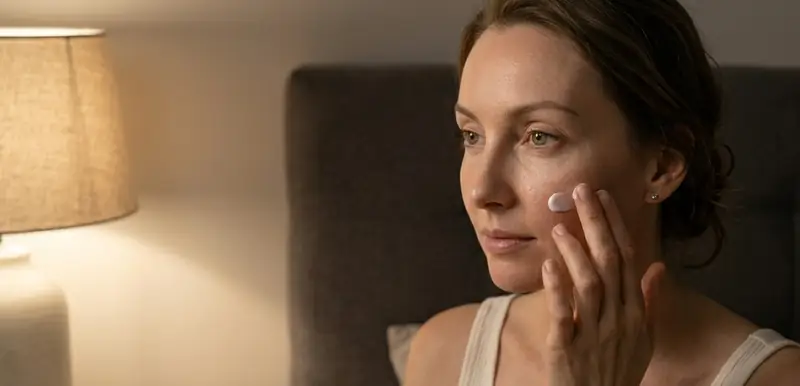
The science of skin aging is evolving rapidly — and for women navigating the skin changes that come with menopause and beyond, evidence-based skincare represents a fundamentally different approach: working with your skin's biology rather than against it.
Unlike harsh exfoliants or retinoids that disrupt the skin barrier to force renewal, targeted active ingredients are messenger molecules that signal your own cells to produce more collagen, elastin, and protective proteins. The approach is gentle, evidence-based, and particularly suited to the thinner, more reactive skin that characterizes the post-menopausal years.
One Evening Protocol That Treats Both Concerns Simultaneously
Wrinkles and dark spots are the two most common aging concerns for women over 40 — and they share a common underlying cause: cumulative UV damage. UV radiation simultaneously degrades collagen (creating wrinkles) and dysregulates melanocyte activity (creating hyperpigmented spots). Because the root cause is shared, a single well-designed night routine can address both concerns through ingredients that target the shared UV-damage pathway plus ingredients that address each concern's specific mechanism. This dual-target approach is more efficient and more effective than using separate routines or products for each concern.[1]
The night routine order for dual wrinkle-and-spot treatment: (1) Oil cleanse — thorough removal of SPF is essential because any residual sunscreen can interfere with the active ingredients that follow. (2) Retinol serum — the cornerstone dual-action ingredient. Retinol reduces wrinkles by stimulating collagen synthesis AND reduces dark spots by inhibiting tyrosinase, accelerating melanin-containing cell turnover, and dispersing melanosomes. A single ingredient addressing both concerns through different mechanisms. Apply to the entire face, with an extra dot directly on each dark spot. (3) Niacinamide serum — compatible with retinol, niacinamide inhibits melanosome transfer from melanocytes to keratinocytes (reducing spot visibility) while strengthening the barrier and boosting collagen synthesis. This ingredient amplifies both the anti-wrinkle and anti-spot effects of retinol.
Clinical research confirms that (4) Peptide night cream — ceramide-peptide cream provides additional collagen stimulation (supporting the anti-wrinkle pathway) while repairing the barrier (ensuring all active ingredients remain in contact with the skin overnight). (5) Squalane oil — the occlusive seal that maximizes overnight contact time for all preceding layers. For dark spots specifically, the enhanced occlusion increases retinol's contact time with the spot, amplifying its melanin-regulating effect.
The timeline for dual-concern improvement: dark spots typically respond faster than wrinkles because they involve cellular processes (melanin production and distribution) that cycle more rapidly than structural changes (collagen synthesis and remodeling). Expect initial spot fading by week 6-8 and significant improvement by week 12-16. Wrinkle improvement follows the standard retinol timeline: texture improvement by week 4, fine line softening by week 8-12, measurable depth reduction by week 24. The same routine addresses both concerns — dark spots respond first, wrinkles respond second — providing visible encouragement at the spot-fading stage that sustains motivation through the longer wrinkle-treatment timeline.
Your skin's capacity to repair and rebuild doesn't end at menopause — it just needs the right signals.
— Dr. Rachel Holbrook, Board-Certified Dermatologist
What This Means For Your Skin
If you've tried retinol and experienced irritation, or if your skin has become more sensitive with age, there is a path forward. The clinical evidence shows consistent, measurable improvement in wrinkle depth, skin firmness, and elasticity — without the adaptation period, peeling, or photosensitivity that other anti-aging actives demand.
Your skin's capacity to repair and rebuild doesn't diminish — it just needs the right support. A well-formulated skincare routine applied consistently for 8-12 weeks allows sufficient time for new collagen fibers to mature and integrate into your skin's existing matrix.
The science is clear. The evidence is consistent. The results are measurable.
What happens next is up to you.