
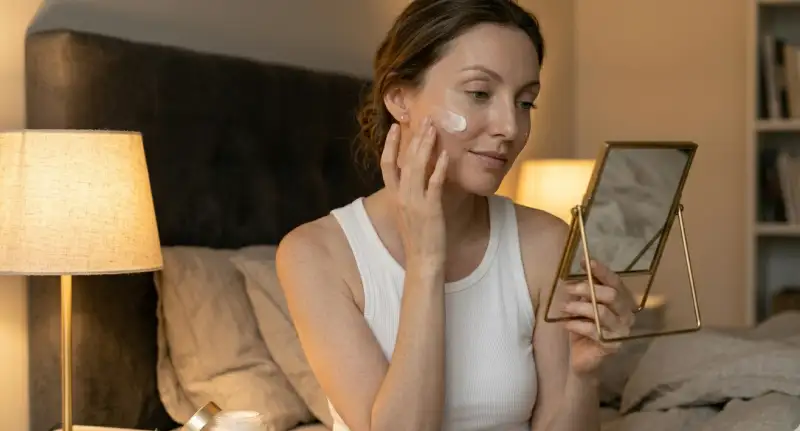
The science of skin aging is evolving rapidly — and for women navigating the skin changes that come with menopause and beyond, evidence-based skincare represents a fundamentally different approach: working with your skin's biology rather than against it.
Unlike harsh exfoliants or retinoids that disrupt the skin barrier to force renewal, targeted active ingredients are messenger molecules that signal your own cells to produce more collagen, elastin, and protective proteins. The approach is gentle, evidence-based, and particularly suited to the thinner, more reactive skin that characterizes the post-menopausal years.
Protecting Your Skin From 8 Hours of Nightly Compression
Sleep wrinkles are distinct from expression wrinkles in their cause, their pattern, and their treatment. Expression wrinkles follow the lines of facial muscle contraction — horizontal forehead lines (frontalis), crow's feet (orbicularis oculi), nasolabial folds (various mid-face muscles). Sleep wrinkles form from external compression of the face against the pillow and run in patterns that have nothing to do with muscle anatomy. They appear as diagonal lines on the cheeks, vertical lines on the forehead near the temples, and asymmetric deepening of the nasolabial fold on the sleeping side. Over decades of nightly compression, these patterns become permanent creases that are visible even during the day.[1]
Prevention strategy 1: Position modification. Back sleeping eliminates facial compression entirely and is the single most effective prevention measure. If back sleeping is difficult, try: (a) body pillow behind the back to prevent rolling, (b) elevated wedge pillow that makes side-turning less comfortable, (c) alternating sides nightly to at least distribute compression evenly rather than reinforcing one-sided patterns. The goal isn't perfection — even reducing side sleeping from 8 hours to 4 hours nightly provides meaningful wrinkle prevention benefit.
Clinical research confirms that prevention strategy 2: Surface modification. Silk pillowcase (22+ momme mulberry silk) reduces compression wrinkle depth by allowing the skin to glide across the surface rather than bunching and folding. For even greater protection, specialized anti-wrinkle pillows with facial cutouts or cradling shapes reduce the surface area of face-to-pillow contact. The combination of silk surface + contoured pillow provides the maximum reduction in sleep compression short of back sleeping. Prevention strategy 3: Pre-sleep hydration fortification. Well-hydrated skin is more resilient to compression — it springs back from deformation more quickly and resists permanent crease formation better than dehydrated skin. Apply HA serum + peptide cream + occlusive seal before bed to maximize overnight skin hydration.
Prevention strategy 4: Targeted overnight protection. For areas prone to sleep compression (lateral cheeks, temples, nasolabial folds on sleeping side), apply silicone wrinkle patches before bed. The patches physically hold the skin smooth during compression, preventing the folding that creates creases. This is particularly effective for women who cannot train themselves to sleep on their back. The comprehensive prevention protocol: silk pillowcase + contoured pillow + HA/peptide/occlusive evening routine + silicone patches on vulnerable areas + back sleeping when possible. This multi-layered approach addresses compression, friction, dehydration, and physical folding simultaneously. Women who implement all five measures typically report a visible reduction in morning sleep wrinkles within the first week, and a meaningful reduction in permanent sleep wrinkle depth over 6-12 months as the nightly compression damage is no longer reinforcing the patterns.
Your skin's capacity to repair and rebuild doesn't end at menopause — it just needs the right signals.
— Dr. Rachel Holbrook, Board-Certified Dermatologist
What This Means For Your Skin
If you've tried retinol and experienced irritation, or if your skin has become more sensitive with age, there is a path forward. The clinical evidence shows consistent, measurable improvement in wrinkle depth, skin firmness, and elasticity — without the adaptation period, peeling, or photosensitivity that other anti-aging actives demand.
Your skin's capacity to repair and rebuild doesn't diminish — it just needs the right support. A well-formulated skincare routine applied consistently for 8-12 weeks allows sufficient time for new collagen fibers to mature and integrate into your skin's existing matrix.
The science is clear. The evidence is consistent. The results are measurable.
What happens next is up to you.