
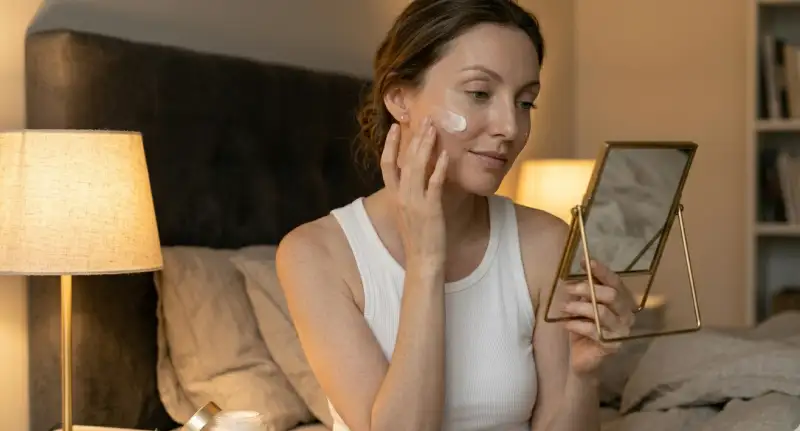
The science of skin aging is evolving rapidly — and for women navigating the skin changes that come with menopause and beyond, evidence-based skincare represents a fundamentally different approach: working with your skin's biology rather than against it.
Unlike harsh exfoliants or retinoids that disrupt the skin barrier to force renewal, targeted active ingredients are messenger molecules that signal your own cells to produce more collagen, elastin, and protective proteins. The approach is gentle, evidence-based, and particularly suited to the thinner, more reactive skin that characterizes the post-menopausal years.
Overnight Strategies That Produce Visible Morning Results
Waking up with more prominent wrinkles than you went to sleep with is not your imagination — two distinct mechanisms deepen wrinkles overnight: positional compression and dehydration. Sleep compression wrinkles form when the face is pressed against the pillow for hours, physically folding the skin in patterns that don't correspond to natural expression lines. Over years, these compression patterns become permanent creases. Overnight dehydration wrinkles appear because transepidermal water loss continues during sleep while no new hydration is applied, concentrating the morning appearance of lines that are less visible when the skin is well-hydrated during the day.[1]
Addressing positional compression: (1) Sleep position modification — back sleeping eliminates facial compression entirely. If you can't sleep on your back consistently, alternating sides nightly prevents the same compression pattern from reinforcing one-sided wrinkles. (2) Silk or satin pillowcase — these fabrics create less friction and allow the skin to glide rather than fold when you shift positions. The wrinkle-prevention benefit is real but modest — silk reduces compression force but doesn't eliminate it. (3) Contoured pillow — pillows with facial cutouts or cradle shapes reduce the surface area of face-to-pillow contact, decreasing the total compression area.
Clinical research confirms that addressing overnight dehydration: this is where the most dramatic morning improvement is possible. (1) Hyaluronic acid serum applied to damp skin before bed — HA holds 1,000x its weight in water, maintaining dermal hydration throughout the night. (2) Peptide cream applied generously as a treatment layer — provides both collagen stimulation and a moisture-retaining medium. (3) Occlusive seal — squalane oil or ceramide balm applied over the HA and peptide cream prevents overnight evaporation. This three-layer approach (humectant → active treatment → occlusive seal) maintains skin hydration at levels that keep wrinkles at their shallowest overnight appearance.
The complete overnight protocol for waking up with fewer wrinkles: Evening — (1) Gentle cleanse. (2) HA serum on damp skin. (3) Peptide cream, generous application, pressed into wrinkle-prone areas. (4) Eye cream with ceramides for the thin periorbital skin. (5) Squalane or ceramide balm as overnight seal. (6) Lip balm with ceramides for the perioral area. Sleep — silk pillowcase, back sleeping when possible, bedroom humidifier if air is dry (humidity below 40% significantly increases overnight TEWL). Morning — you should notice smoother, more hydrated skin immediately upon waking. The fine lines that were deepened by dehydration will be visibly reduced. This is not permanent wrinkle reversal — it's hydration-based optimization that keeps wrinkles at their shallowest possible appearance. Over months of consistent overnight treatment, the cumulative collagen-building effect from nightly peptide delivery produces genuine structural improvement beneath the hydration effect.
Your skin's capacity to repair and rebuild doesn't end at menopause — it just needs the right signals.
— Dr. Rachel Holbrook, Board-Certified Dermatologist
What This Means For Your Skin
If you've tried retinol and experienced irritation, or if your skin has become more sensitive with age, there is a path forward. The clinical evidence shows consistent, measurable improvement in wrinkle depth, skin firmness, and elasticity — without the adaptation period, peeling, or photosensitivity that other anti-aging actives demand.
Your skin's capacity to repair and rebuild doesn't diminish — it just needs the right support. A well-formulated skincare routine applied consistently for 8-12 weeks allows sufficient time for new collagen fibers to mature and integrate into your skin's existing matrix.
The science is clear. The evidence is consistent. The results are measurable.
What happens next is up to you.