
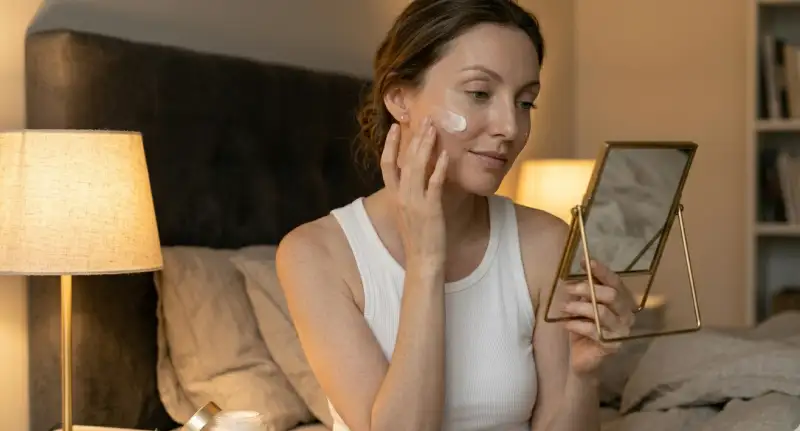
The science of skin aging is evolving rapidly — and for women navigating the skin changes that come with menopause and beyond, evidence-based skincare represents a fundamentally different approach: working with your skin's biology rather than against it.
Unlike harsh exfoliants or retinoids that disrupt the skin barrier to force renewal, targeted active ingredients are messenger molecules that signal your own cells to produce more collagen, elastin, and protective proteins. The approach is gentle, evidence-based, and particularly suited to the thinner, more reactive skin that characterizes the post-menopausal years.
The Nightly Behaviors Silently Deepening Your Lines
Sleep is supposed to be restorative for the skin — and it is, biologically. But several common sleeping habits work against the skin's nocturnal repair process, creating and deepening wrinkles through mechanical compression, dehydration, and environmental factors that operate for 7-8 hours every night. Given that you spend roughly one-third of your life sleeping, these habits have a cumulative impact that rivals UV exposure in their contribution to visible facial aging.[1]
Habit 1: Side sleeping. When you sleep on your side, the full weight of your head (approximately 5 kg) compresses one side of your face against the pillow for hours. This creates 'sleep wrinkles' — creases that form perpendicular to the natural expression lines and are caused purely by mechanical compression. Over years, these compression patterns become permanent. The evidence: dermatologists can reliably identify a patient's preferred sleeping side by the asymmetric wrinkle pattern — the side that sleeps against the pillow shows deeper nasolabial folds, more prominent crow's feet, and additional diagonal cheek lines that the upward-facing side lacks. Solution: train yourself to sleep on your back, or alternate sides nightly. Habit 2: Cotton pillowcases. Cotton's rough fiber structure creates friction that grips the skin, intensifying the compression effect of side sleeping. The skin bunches and folds rather than gliding across the surface. Solution: silk or satin pillowcase — the smooth surface allows the skin to slide rather than grip, reducing compression wrinkle depth by an estimated 30-40%.
Clinical research confirms that habit 3: Mouth breathing during sleep. Mouth breathing reduces relative humidity in the oral-nasal zone, accelerating dehydration of the perioral and nasolabial skin. It also requires the jaw to drop, stretching the lower face in a downward position for hours that reinforces marionette lines and jowl formation. Solution: nasal strips or mouth tape (medical tape designed for this purpose) to encourage nasal breathing. Consult a doctor if mouth breathing is chronic. Habit 4: Sleeping in dry air. Bedroom humidity below 40% significantly increases overnight TEWL, dehydrating the skin and making morning wrinkles appear 20-30% deeper. Solution: bedroom humidifier maintaining 45-55% humidity. This single environmental modification reduces overnight dehydration wrinkle deepening noticeably.
Habit 5: Sleeping without evening skincare. The nocturnal repair window (11 PM - 4 AM) represents the skin's peak collagen production period. Sleeping without applied active ingredients (peptides, retinol) means this repair window is unsupported — the fibroblasts are active but lack the external stimulation that amplifies their output. Solution: consistent evening routine with peptide cream at minimum, retinol 3 nights per week. Habit 6: Sleeping with makeup on. Makeup creates a film that traps oxidized sebum, environmental pollutants, and free radicals against the skin overnight, promoting inflammation that upregulates MMPs (collagen-destroying enzymes). Even one night of sleeping in makeup causes measurable increases in oxidative stress markers. Solution: double cleanse every evening without exception. Addressing all six habits creates a sleep environment that supports rather than undermines the skin's natural overnight repair — allowing you to wake up with measurably smoother, more hydrated skin.
Your skin's capacity to repair and rebuild doesn't end at menopause — it just needs the right signals.
— Dr. Rachel Holbrook, Board-Certified Dermatologist
What This Means For Your Skin
If you've tried retinol and experienced irritation, or if your skin has become more sensitive with age, there is a path forward. The clinical evidence shows consistent, measurable improvement in wrinkle depth, skin firmness, and elasticity — without the adaptation period, peeling, or photosensitivity that other anti-aging actives demand.
Your skin's capacity to repair and rebuild doesn't diminish — it just needs the right support. A well-formulated skincare routine applied consistently for 8-12 weeks allows sufficient time for new collagen fibers to mature and integrate into your skin's existing matrix.
The science is clear. The evidence is consistent. The results are measurable.
What happens next is up to you.