
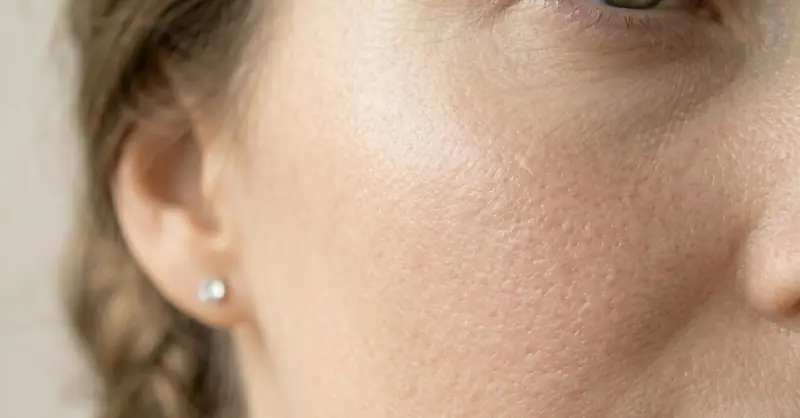
The science of skin aging is evolving rapidly — and for women navigating the skin changes that come with menopause and beyond, evidence-based skincare represents a fundamentally different approach: working with your skin's biology rather than against it.
Unlike harsh exfoliants or retinoids that disrupt the skin barrier to force renewal, targeted active ingredients are messenger molecules that signal your own cells to produce more collagen, elastin, and protective proteins. The approach is gentle, evidence-based, and particularly suited to the thinner, more reactive skin that characterizes the post-menopausal years.
Simple Tests and Signs That Reveal Barrier Compromise
Barrier damage is the most under-diagnosed skin condition because its symptoms overlap with conditions that women typically treat separately: eczema (dryness + redness), rosacea (persistent flushing), adult acne (breakouts), sensitive skin (reactivity), and premature aging (wrinkle deepening). Many women spend years treating these individual symptoms without realizing that a single underlying cause — barrier compromise — is producing all of them simultaneously. Identifying barrier damage as the root cause redirects treatment to the foundation rather than the symptoms.[1]
The at-home barrier assessment tests: Test 1 — The water test: splash lukewarm water on your bare face (no products). If the water causes any stinging, tightness, or discomfort, your barrier is compromised. Healthy barrier skin feels nothing with plain water contact. Test 2 — The absorption test: apply your regular moisturizer and note how quickly it absorbs. If it absorbs in under 30 seconds and leaves no detectable film, your barrier is likely compromised — the gaps in the lipid matrix are absorbing the moisturizer into areas it shouldn't reach rather than forming a surface layer. Healthy barrier skin should show moisturizer absorption in 2-3 minutes. Test 3 — The morning dryness test: if your skin feels tight and dry every morning despite applying night cream, the barrier is losing moisture overnight through structural gaps — a direct indicator of TEWL.
Clinical research confirms that the clinical signs that dermatologists use to assess barrier status: (1) Trans-epidermal water loss (TEWL) — measured with an evaporimeter, TEWL above 15 g/m²/h indicates barrier compromise. While you can't measure this at home, persistent dryness despite moisturizing is a clinical proxy. (2) pH disruption — healthy barrier maintains a slightly acidic pH of 4.5-5.5 (the 'acid mantle'). Barrier damage often coincides with elevated pH, which further weakens the lipid matrix and reduces the skin's antimicrobial defense. Signs of pH disruption: increased breakouts, slower healing, and heightened sensitivity to slightly acidic products. (3) Visible desquamation — the orderly, invisible shedding of stratum corneum cells becomes disordered, producing visible flaking, rough texture, and uneven skin tone.
The diagnostic checklist — if you answer YES to 3 or more, barrier damage is the likely root cause of your skin concerns: Does plain water sting your face? Does moisturizer absorb instantly? Is your skin dry every morning despite night cream? Do products that used to feel comfortable now irritate? Has your skin become more reactive to temperature changes? Do you experience simultaneous dryness AND breakouts? Have your wrinkles appeared to deepen recently without other changes? The treatment is consistent across all cases: stop all actives, simplify to ceramide cream + gentle cleanser + SPF, and allow 2-4 weeks for barrier restoration before reintroducing any treatment products.
Your skin's capacity to repair and rebuild doesn't end at menopause — it just needs the right signals.
— Dr. Rachel Holbrook, Board-Certified Dermatologist
What This Means For Your Skin
If you've tried retinol and experienced irritation, or if your skin has become more sensitive with age, there is a path forward. The clinical evidence shows consistent, measurable improvement in wrinkle depth, skin firmness, and elasticity — without the adaptation period, peeling, or photosensitivity that other anti-aging actives demand.
Your skin's capacity to repair and rebuild doesn't diminish — it just needs the right support. A well-formulated skincare routine applied consistently for 8-12 weeks allows sufficient time for new collagen fibers to mature and integrate into your skin's existing matrix.
The science is clear. The evidence is consistent. The results are measurable.
What happens next is up to you.