
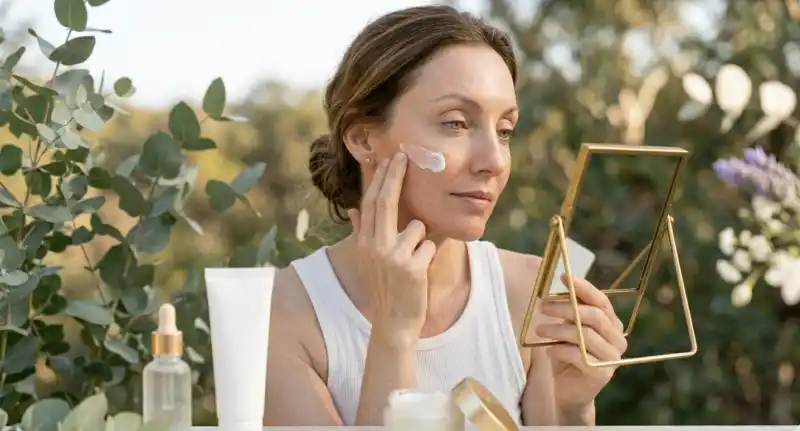
The science of skin aging is evolving rapidly — and for women navigating the skin changes that come with menopause and beyond, evidence-based skincare represents a fundamentally different approach: working with your skin's biology rather than against it.
Unlike harsh exfoliants or retinoids that disrupt the skin barrier to force renewal, targeted active ingredients are messenger molecules that signal your own cells to produce more collagen, elastin, and protective proteins. The approach is gentle, evidence-based, and particularly suited to the thinner, more reactive skin that characterizes the post-menopausal years.
Understanding the Pigmentation That Reveals Your Sun History
The most important thing to understand about 'age spots' versus 'sun spots' is that they are dermatologically identical — both terms describe solar lentigines, flat brown patches caused by cumulative ultraviolet radiation damage to melanocytes. The term 'age spot' is a misnomer that implies aging itself causes these spots. It does not. Age provides the time for UV damage to accumulate, but sun-protected skin — even at age 80 — does not develop solar lentigines. Women who protected their skin from UV throughout their lives have virtually no 'age spots' regardless of their chronological age. The spots are markers of sun exposure history, not biological aging.[1]
The biology of solar lentigines: UV radiation causes focal hyperactivation of melanocytes — the pigment-producing cells in the basal epidermis. In undamaged skin, melanocytes produce melanin evenly in response to UV, creating a uniform tan. In chronically UV-exposed skin, specific melanocytes become permanently hyperactivated — they produce excessive melanin continuously, regardless of current UV exposure. This hyperactivation is caused by UV-induced mutations in the melanocyte's growth signaling pathways. The result: a permanent dark patch that represents a cluster of overactive melanocytes that no longer respond normally to UV regulation signals.
Clinical research confirms that why solar lentigines appear in patterns: they concentrate on the face, backs of the hands, forearms, upper chest, and shoulders — the areas that receive the most cumulative UV over a lifetime. The face develops more spots on the left side than the right in countries where people drive on the right side of the road (the left face receives more UV through the driver's side window). This asymmetric pattern is strong evidence that cumulative UV exposure, not intrinsic aging, determines spot formation. Solar lentigines are distinct from freckles (ephelides), which are genetic, appear in childhood, and fade with reduced sun exposure. Solar lentigines do not fade — once formed, the melanocyte hyperactivation is permanent without treatment.
Treatment approaches for solar lentigines: (1) Prevention — daily SPF 50 prevents new spots from forming and prevents existing spots from darkening. This is the essential first step. (2) Fading — niacinamide (5%) inhibits melanosome transfer, gradually lightening spots over 8-12 weeks. Vitamin C (10-15%) inhibits tyrosinase, reducing melanin production in hyperactive melanocytes. Retinol accelerates cell turnover, shedding pigmented keratinocytes faster. (3) Targeted treatment — for stubborn spots, professional treatments (chemical peels, laser, IPL) can destroy the hyperactive melanocytes directly. The topical combination of SPF + niacinamide + vitamin C + retinol provides gradual but meaningful fading of solar lentigines over 3-6 months while preventing new formation. Complete elimination of deep solar lentigines typically requires professional intervention combined with topical maintenance.
Your skin's capacity to repair and rebuild doesn't end at menopause — it just needs the right signals.
— Dr. Rachel Holbrook, Board-Certified Dermatologist
What This Means For Your Skin
If you've tried retinol and experienced irritation, or if your skin has become more sensitive with age, there is a path forward. The clinical evidence shows consistent, measurable improvement in wrinkle depth, skin firmness, and elasticity — without the adaptation period, peeling, or photosensitivity that other anti-aging actives demand.
Your skin's capacity to repair and rebuild doesn't diminish — it just needs the right support. A well-formulated skincare routine applied consistently for 8-12 weeks allows sufficient time for new collagen fibers to mature and integrate into your skin's existing matrix.
The science is clear. The evidence is consistent. The results are measurable.
What happens next is up to you.