
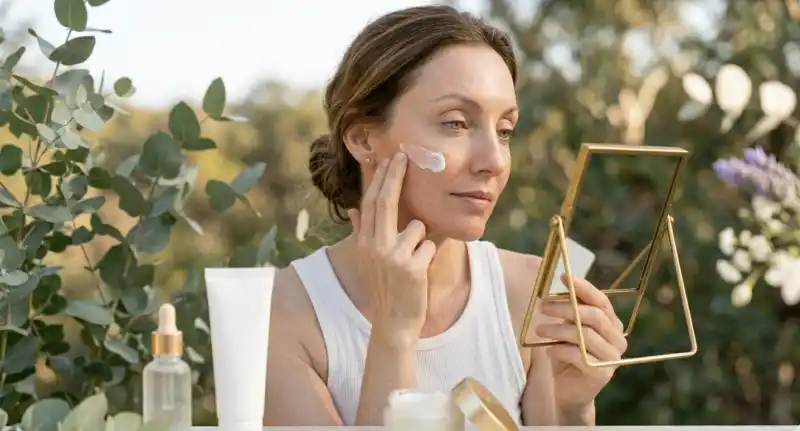
The science of skin aging is evolving rapidly — and for women navigating the skin changes that come with menopause and beyond, evidence-based skincare represents a fundamentally different approach: working with your skin's biology rather than against it.
Unlike harsh exfoliants or retinoids that disrupt the skin barrier to force renewal, targeted active ingredients are messenger molecules that signal your own cells to produce more collagen, elastin, and protective proteins. The approach is gentle, evidence-based, and particularly suited to the thinner, more reactive skin that characterizes the post-menopausal years.
Which Ingredients Actually Reverse Photoaging at the Dermal Level
Most creams marketed for sun damage treatment fall into two categories: those that address the surface symptoms (dark spots, rough texture) and those that address the structural cause (collagen destruction in the dermis). Surface-level treatments provide visible cosmetic improvement but don't repair the underlying damage. Structural treatments take longer to show results but produce genuine reversal of photoaging. The most effective cream combines both approaches — addressing the visible symptoms while simultaneously rebuilding the dermal collagen matrix that UV radiation has degraded.[1]
The structural ingredients that reverse sun damage at the dermal level: (1) Retinol (0.3-1%) — directly activates retinoid acid receptors on fibroblasts, upregulating collagen gene transcription (COL1A1 and COL3A1). In photoaged skin, retinol also normalizes the disordered collagen that has accumulated as solar elastosis — gradually replacing non-functional UV-damaged collagen with properly organized new fibers. Clinical studies using retinol on photoaged skin show measurable dermal thickening after 24 weeks. (2) Peptides (Matrixyl 3000 at 3-8%) — stimulate collagen production through TGF-β signaling, independent of the retinoid pathway. In sun-damaged skin, peptides are particularly valuable because they also reduce the chronic low-grade inflammation that UV exposure creates — inflammation that perpetuates MMP activity even after sun exposure stops.
Clinical research confirms that (3) Vitamin C (10-15% L-ascorbic acid) — serves a dual purpose in sun damage treatment: it is the essential cofactor for collagen assembly (prolyl hydroxylase requires ascorbic acid) AND it neutralizes the residual oxidative stress that accumulated sun damage leaves in the dermis. Sun-damaged skin has depleted antioxidant reserves — replenishing vitamin C restores the dermal environment's capacity to protect newly formed collagen from oxidative degradation. (4) Niacinamide (3-5%) — addresses the pigmentation component of sun damage by inhibiting melanosome transfer from melanocytes to keratinocytes, visibly fading sun spots over 8-12 weeks. Simultaneously stimulates ceramide production, repairing the UV-damaged barrier.
What to look for in a sun damage treatment cream: the active ingredients (retinol, peptides, vitamin C, niacinamide) should appear in the first third of the ingredient list — indicating concentrations likely sufficient for biological effect. The vehicle should include ceramides and hyaluronic acid for barrier repair and hydration. Avoid creams that rely on 'brightening botanicals' as their primary actives without the structural ingredients listed above — botanical brighteners may fade surface spots but don't address the collagen destruction that constitutes 80% of visible sun damage. The application protocol: vitamin C serum morning + SPF 50 (defense), retinol + peptide cream evening (rebuilding). This 24-hour cycle provides continuous photorepair — antioxidant defense by day, structural rebuilding by night.
Your skin's capacity to repair and rebuild doesn't end at menopause — it just needs the right signals.
— Dr. Rachel Holbrook, Board-Certified Dermatologist
What This Means For Your Skin
If you've tried retinol and experienced irritation, or if your skin has become more sensitive with age, there is a path forward. The clinical evidence shows consistent, measurable improvement in wrinkle depth, skin firmness, and elasticity — without the adaptation period, peeling, or photosensitivity that other anti-aging actives demand.
Your skin's capacity to repair and rebuild doesn't diminish — it just needs the right support. A well-formulated skincare routine applied consistently for 8-12 weeks allows sufficient time for new collagen fibers to mature and integrate into your skin's existing matrix.
The science is clear. The evidence is consistent. The results are measurable.
What happens next is up to you.