
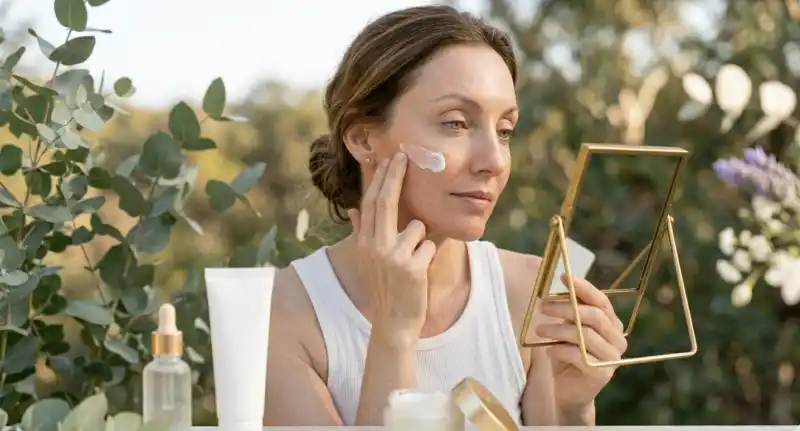
The science of skin aging is evolving rapidly — and for women navigating the skin changes that come with menopause and beyond, evidence-based skincare represents a fundamentally different approach: working with your skin's biology rather than against it.
Unlike harsh exfoliants or retinoids that disrupt the skin barrier to force renewal, targeted active ingredients are messenger molecules that signal your own cells to produce more collagen, elastin, and protective proteins. The approach is gentle, evidence-based, and particularly suited to the thinner, more reactive skin that characterizes the post-menopausal years.
A Multi-Phase Approach to Reversing Photoaging
Repairing sun-damaged skin on the face is a two-phase process that most women approach incorrectly — they focus entirely on Phase 2 (rebuilding) while neglecting Phase 1 (stopping ongoing destruction). Every day without adequate SPF, ultraviolet radiation activates matrix metalloproteinases (MMPs) in the dermis that cleave intact collagen fibers into non-functional fragments. A single unprotected sun exposure event elevates MMP levels for 48-72 hours, degrading more collagen than topical products can rebuild in a week. Without rigorous daily SPF as the foundation, every collagen-stimulating serum and cream is fighting a losing battle against ongoing UV-induced destruction.[1]
Phase 1 — Stop the damage (immediate, ongoing): Daily SPF 50 broad-spectrum sunscreen applied as the final step of the morning routine, reapplied every 2 hours during sun exposure. This single habit prevents approximately 98% of UV-induced MMP activation. Topical antioxidants (vitamin C 10-15%, vitamin E, ferulic acid) applied under sunscreen neutralize the UV-generated reactive oxygen species that trigger MMP expression through the AP-1 signaling pathway. The combination of physical UV blocking (sunscreen) and chemical ROS neutralization (antioxidants) reduces ongoing collagen destruction to near-baseline levels, creating the conditions for net collagen gain in Phase 2.
Clinical research confirms that phase 2 — Rebuild what was lost (months 1-24): With ongoing destruction minimized, collagen-stimulating ingredients can produce net positive results. Retinol (0.3-0.5%) — the most evidence-based topical for photodamage reversal, with clinical trials showing measurable procollagen I increases after 12 weeks. Apply at night, building from 2 nights per week to nightly over 12 weeks. Vitamin C serum (10-15% L-ascorbic acid) — morning application provides the prolyl hydroxylase cofactor essential for stable collagen assembly. Peptide cream (Matrixyl 3000) — provides growth factor signaling through TGF-β pathways independent of the retinoid pathway, creating additive collagen stimulation when combined with retinol.
The repair timeline for sun-damaged facial skin: Weeks 2-4 — improved surface texture and brightness (epidermal remodeling from retinol). Month 2-3 — evening of skin tone, early fading of superficial pigmentation. Month 3-6 — visible softening of fine lines and early wrinkle reduction as new collagen accumulates. Month 6-12 — measurable improvement in skin firmness and elasticity. Month 12-24 — maximum topical improvement, with studies showing up to 80% correction of fine wrinkles and 40-60% improvement in deeper photoaging signs. The critical principle: sun damage accumulated over 20-40 years cannot be reversed in 4 weeks. The women who achieve the most dramatic photodamage reversal are those who commit to the combined SPF + antioxidant + retinol + peptide protocol consistently for 12+ months, understanding that each week of consistent application contributes to the cumulative structural repair.
Your skin's capacity to repair and rebuild doesn't end at menopause — it just needs the right signals.
— Dr. Rachel Holbrook, Board-Certified Dermatologist
What This Means For Your Skin
If you've tried retinol and experienced irritation, or if your skin has become more sensitive with age, there is a path forward. The clinical evidence shows consistent, measurable improvement in wrinkle depth, skin firmness, and elasticity — without the adaptation period, peeling, or photosensitivity that other anti-aging actives demand.
Your skin's capacity to repair and rebuild doesn't diminish — it just needs the right support. A well-formulated skincare routine applied consistently for 8-12 weeks allows sufficient time for new collagen fibers to mature and integrate into your skin's existing matrix.
The science is clear. The evidence is consistent. The results are measurable.
What happens next is up to you.