
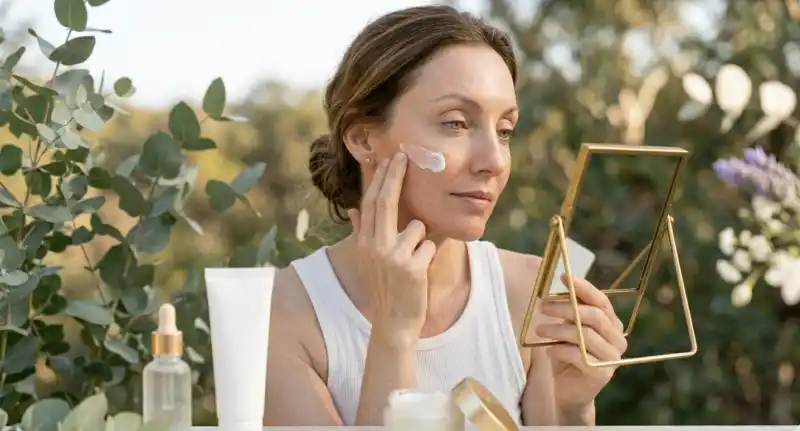
The science of skin aging is evolving rapidly — and for women navigating the skin changes that come with menopause and beyond, evidence-based skincare represents a fundamentally different approach: working with your skin's biology rather than against it.
Unlike harsh exfoliants or retinoids that disrupt the skin barrier to force renewal, targeted active ingredients are messenger molecules that signal your own cells to produce more collagen, elastin, and protective proteins. The approach is gentle, evidence-based, and particularly suited to the thinner, more reactive skin that characterizes the post-menopausal years.
The Active Compounds With Clinical Evidence for Photorepair
Sun-damaged skin has four concurrent problems that each require specific ingredients: (1) collagen destruction — the dermal scaffolding has been degraded by UV-activated MMPs, causing wrinkles and sagging, (2) pigmentation irregularities — melanocytes have been hyperactivated, creating dark spots and uneven tone, (3) barrier compromise — the stratum corneum's lipid matrix has been disrupted by chronic UV exposure, increasing TEWL and sensitivity, (4) oxidative stress — UV-generated free radicals have depleted the skin's antioxidant reserves, leaving it vulnerable to ongoing damage. The most effective ingredient strategy addresses all four problems simultaneously.[1]
For collagen destruction — Retinol (0.3-1%): the gold standard for photoaging reversal. Retinol directly activates fibroblast collagen production through retinoid receptors, producing measurable dermal thickening within 6 months. For sun-damaged skin specifically, retinol also reorganizes the solar elastosis (disordered UV-damaged collagen) that characterizes photoaged dermis, gradually replacing it with properly structured collagen fibers. Peptides (Matrixyl 3000): provide collagen stimulation through an independent TGF-β pathway, additive with retinol. Particularly effective in sun-damaged skin because they also suppress the chronic IL-6 inflammation that perpetuates MMP activity.
Clinical research confirms that for pigmentation — Niacinamide (5%): inhibits melanosome transfer from melanocytes to keratinocytes, gradually fading solar lentigines without irritation. Safe for all skin types and compatible with every other active ingredient. Vitamin C (10-15% L-ascorbic acid): inhibits tyrosinase (the rate-limiting enzyme in melanin production), reducing excess pigment production in hyperactive melanocytes. Also provides antioxidant protection and collagen cofactor support — the most multi-functional ingredient for sun-damaged skin. Alpha arbutin (2%): a natural tyrosinase inhibitor derived from bearberry, providing additional pigmentation control without the irritation risk of hydroquinone.
For barrier repair — Ceramides (NP, AP, EOP with cholesterol and fatty acids): replenish the barrier lipids that chronic UV exposure depletes. Sun-damaged skin has measurably reduced ceramide content, resulting in chronic TEWL that makes the skin appear drier and thinner than its structural condition warrants. Restoring ceramides improves hydration retention, reduces sensitivity, and creates the moist dermal environment that supports collagen assembly. For oxidative stress — Vitamin E (tocopherol): lipid-soluble antioxidant that protects cell membranes from oxidative damage. Ferulic acid: stabilizes and enhances the antioxidant activity of vitamins C and E when combined (the Skinceuticals CE Ferulic formula demonstrated 8x UV protection enhancement). The ideal sun damage routine uses ALL of these ingredients in a layered protocol: morning — vitamin C + niacinamide + SPF 50 (defense + brightening). Evening — retinol + peptides + ceramide cream (rebuilding + repair). This comprehensive approach addresses all four damage dimensions simultaneously.
Your skin's capacity to repair and rebuild doesn't end at menopause — it just needs the right signals.
— Dr. Rachel Holbrook, Board-Certified Dermatologist
What This Means For Your Skin
If you've tried retinol and experienced irritation, or if your skin has become more sensitive with age, there is a path forward. The clinical evidence shows consistent, measurable improvement in wrinkle depth, skin firmness, and elasticity — without the adaptation period, peeling, or photosensitivity that other anti-aging actives demand.
Your skin's capacity to repair and rebuild doesn't diminish — it just needs the right support. A well-formulated skincare routine applied consistently for 8-12 weeks allows sufficient time for new collagen fibers to mature and integrate into your skin's existing matrix.
The science is clear. The evidence is consistent. The results are measurable.
What happens next is up to you.