
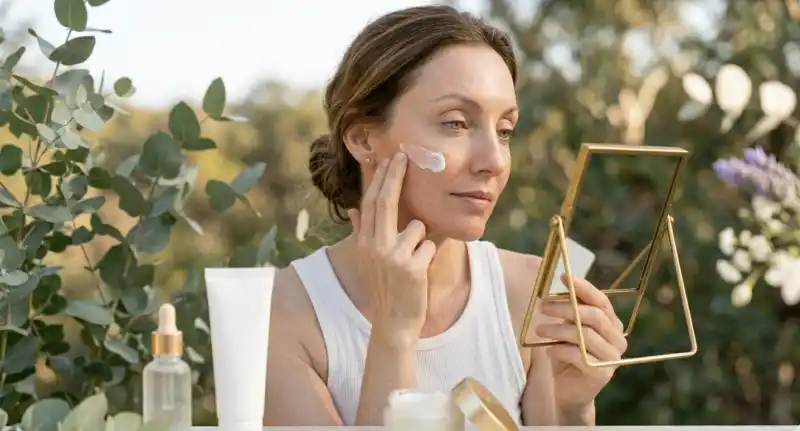
The science of skin aging is evolving rapidly — and for women navigating the skin changes that come with menopause and beyond, evidence-based skincare represents a fundamentally different approach: working with your skin's biology rather than against it.
Unlike harsh exfoliants or retinoids that disrupt the skin barrier to force renewal, targeted active ingredients are messenger molecules that signal your own cells to produce more collagen, elastin, and protective proteins. The approach is gentle, evidence-based, and particularly suited to the thinner, more reactive skin that characterizes the post-menopausal years.
How Antioxidants Protect and Repair Photoaged Skin Simultaneously
Antioxidant serums serve a dual function in sun-damaged skin that makes them uniquely valuable: they simultaneously PROTECT remaining collagen from ongoing oxidative destruction AND SUPPORT the repair process that rebuilds lost collagen. Sun-damaged skin exists in a state of chronic oxidative stress — UV radiation has depleted the skin's natural antioxidant reserves (glutathione, vitamins C and E, ubiquinone), leaving the dermal collagen vulnerable to ongoing free radical attack even from routine daily UV exposure, pollution, and normal cellular metabolism. An antioxidant serum replenishes these depleted reserves, restoring the protective environment that healthy skin maintains naturally.[1]
The key antioxidants for sun-damaged skin, ranked by evidence strength: (1) L-ascorbic acid (vitamin C, 10-15%) — the most studied topical antioxidant, with extensive evidence for photoprotection enhancement and collagen synthesis support. In sun-damaged skin, vitamin C provides both immediate free radical neutralization and long-term cofactor support for collagen assembly. (2) Alpha-tocopherol (vitamin E, 1-2%) — lipid-soluble antioxidant that protects cell membranes from oxidative damage. Particularly important for sun-damaged skin because UV radiation specifically targets the lipid-rich cell membranes of fibroblasts, potentially reducing their collagen-producing capacity. (3) Ferulic acid (0.5-1%) — plant-derived antioxidant that stabilizes vitamins C and E and enhances their photoprotective efficacy 8-fold when combined.
Clinical research confirms that the synergy of the vitamin C + E + ferulic acid combination is well-documented: a landmark study showed that this triple antioxidant combination applied under sunscreen reduced UV-induced erythema by 4-8x compared to sunscreen alone, and reduced thymine dimer formation (a direct measure of UV-induced DNA damage) by 80%. For sun-damaged skin, this translates to dramatically reduced ongoing damage per day, creating the conditions for net collagen repair. (4) Niacinamide (3-5%) — while primarily known for barrier support and pigmentation reduction, niacinamide also provides antioxidant activity through the NAD+ pathway and inhibits lipid peroxidation.
How to choose and use an antioxidant serum for sun-damaged skin: the gold standard formulation combines L-ascorbic acid (15%) + tocopherol (1%) + ferulic acid (0.5%) at pH 2.5-3.5. Apply every morning to clean, dry skin as the first treatment step. Wait 2-3 minutes for absorption, then apply moisturizer and SPF 50. The antioxidant serum provides a 'second shield' of protection beneath the physical/chemical shield of sunscreen. Common mistakes: (1) applying antioxidant serum at night — while not harmful, the primary benefit of antioxidant defense is daytime UV protection, making morning application optimal. (2) Skipping antioxidant serum on days when sunscreen is applied — the two products are complementary, not alternative. (3) Using an oxidized vitamin C serum (turned yellow-brown) — oxidized vitamin C is pro-oxidant and can increase free radical damage rather than prevent it.
Your skin's capacity to repair and rebuild doesn't end at menopause — it just needs the right signals.
— Dr. Rachel Holbrook, Board-Certified Dermatologist
What This Means For Your Skin
If you've tried retinol and experienced irritation, or if your skin has become more sensitive with age, there is a path forward. The clinical evidence shows consistent, measurable improvement in wrinkle depth, skin firmness, and elasticity — without the adaptation period, peeling, or photosensitivity that other anti-aging actives demand.
Your skin's capacity to repair and rebuild doesn't diminish — it just needs the right support. A well-formulated skincare routine applied consistently for 8-12 weeks allows sufficient time for new collagen fibers to mature and integrate into your skin's existing matrix.
The science is clear. The evidence is consistent. The results are measurable.
What happens next is up to you.