
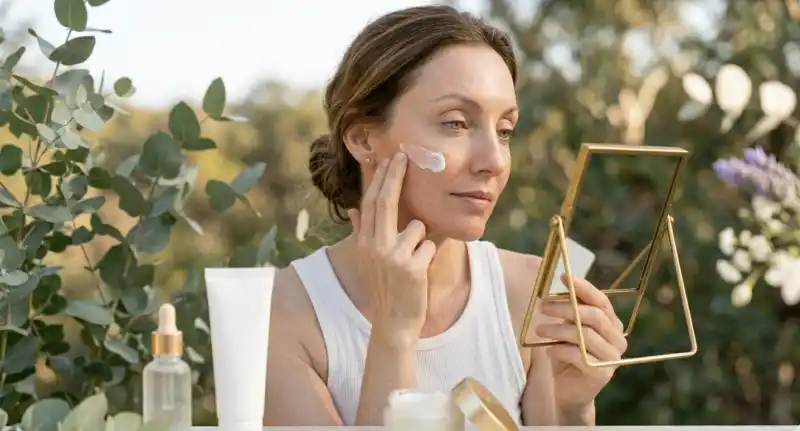
The science of skin aging is evolving rapidly — and for women navigating the skin changes that come with menopause and beyond, evidence-based skincare represents a fundamentally different approach: working with your skin's biology rather than against it.
Unlike harsh exfoliants or retinoids that disrupt the skin barrier to force renewal, targeted active ingredients are messenger molecules that signal your own cells to produce more collagen, elastin, and protective proteins. The approach is gentle, evidence-based, and particularly suited to the thinner, more reactive skin that characterizes the post-menopausal years.
The Triple-Action Ingredient for Photoaged Skin
Vitamin C (L-ascorbic acid) occupies a unique position in sun damage treatment because it addresses photoaging through three independent mechanisms simultaneously — making it the single most efficient ingredient for sun-damaged skin. No other topical ingredient provides antioxidant defense, collagen production support, and pigmentation reduction in a single molecule. This triple action is why dermatologists consistently recommend vitamin C as the cornerstone morning treatment for sun-damaged skin.[1]
Mechanism 1 — Antioxidant defense: vitamin C is the primary aqueous-phase antioxidant in the skin. It neutralizes UV-generated reactive oxygen species (ROS) before they can activate the AP-1 transcription factor that upregulates MMP expression. Applied under sunscreen, vitamin C reduces UV-induced MMP activation by an additional 40-60% beyond what sunscreen alone achieves. This means less ongoing collagen destruction per day — a critical defense for skin that has already lost significant collagen to prior sun damage. Mechanism 2 — Collagen production cofactor: prolyl hydroxylase and lysyl hydroxylase — the enzymes that stabilize newly formed collagen triple helices — absolutely require ascorbic acid as a cofactor. Without adequate vitamin C, fibroblasts produce unstable procollagen that degrades before integration into the dermal matrix.
Clinical research confirms that in sun-damaged skin, topical vitamin C replenishes the depleted ascorbic acid reserves that chronic UV exposure has exhausted, restoring the enzymatic environment necessary for effective collagen assembly. This cofactor function makes vitamin C not merely beneficial but essential for collagen-rebuilding strategies using retinol and peptides — without it, up to 40% of newly stimulated procollagen fails to assemble into stable fibers. Mechanism 3 — Pigmentation reduction: vitamin C inhibits tyrosinase, the rate-limiting enzyme in melanin synthesis. In sun-damaged skin with hyperactive melanocytes (solar lentigines), vitamin C gradually reduces excess melanin production, fading dark spots over 8-16 weeks of consistent application. This pigment-reducing effect is gentler than hydroquinone and safe for long-term use.
How to use vitamin C effectively for sun damage: Formulation — L-ascorbic acid at 10-15% concentration, pH 2.5-3.5. Higher concentrations (20%) provide marginal additional benefit with increased irritation risk. The addition of vitamin E and ferulic acid stabilizes the formulation and enhances photoprotective efficacy 8-fold compared to vitamin C alone. Application — morning, on clean dry skin, before any other product. Allow 2-3 minutes for absorption before applying moisturizer and SPF. The low pH of effective vitamin C formulations means it should be the first product to contact the skin for optimal penetration. Consistency — daily application produces cumulative benefit. The skin's vitamin C reserves rebuild over 2-3 weeks of consistent application, at which point the antioxidant defense and collagen cofactor functions reach maximum efficacy. Missing a single day has minimal impact, but gaps of 1+ weeks allow reserves to deplete again.
Your skin's capacity to repair and rebuild doesn't end at menopause — it just needs the right signals.
— Dr. Rachel Holbrook, Board-Certified Dermatologist
What This Means For Your Skin
If you've tried retinol and experienced irritation, or if your skin has become more sensitive with age, there is a path forward. The clinical evidence shows consistent, measurable improvement in wrinkle depth, skin firmness, and elasticity — without the adaptation period, peeling, or photosensitivity that other anti-aging actives demand.
Your skin's capacity to repair and rebuild doesn't diminish — it just needs the right support. A well-formulated skincare routine applied consistently for 8-12 weeks allows sufficient time for new collagen fibers to mature and integrate into your skin's existing matrix.
The science is clear. The evidence is consistent. The results are measurable.
What happens next is up to you.