
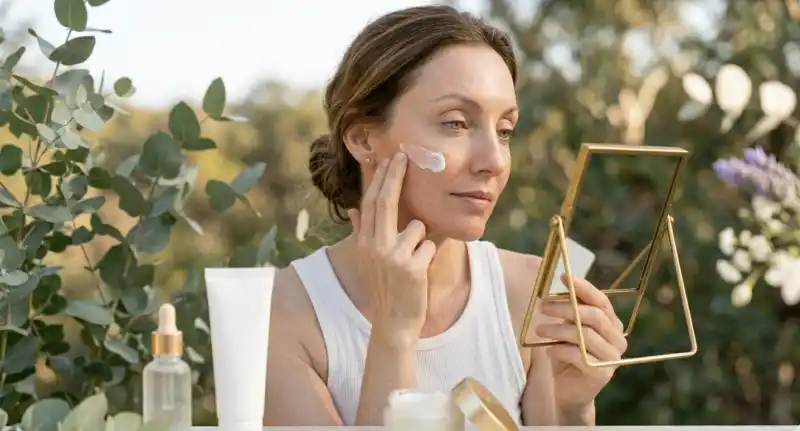
The science of skin aging is evolving rapidly — and for women navigating the skin changes that come with menopause and beyond, evidence-based skincare represents a fundamentally different approach: working with your skin's biology rather than against it.
Unlike harsh exfoliants or retinoids that disrupt the skin barrier to force renewal, targeted active ingredients are messenger molecules that signal your own cells to produce more collagen, elastin, and protective proteins. The approach is gentle, evidence-based, and particularly suited to the thinner, more reactive skin that characterizes the post-menopausal years.
Evidence-Based Natural Approaches to Photoaging Repair
Reversing sun damage naturally — without lasers, chemical peels, or prescription drugs — is achievable within specific parameters. Natural approaches can meaningfully improve fine wrinkles (up to 30-40% reduction), skin texture (significant smoothing), uneven pigmentation (gradual fading), and skin firmness (measurable improvement). They cannot fully reverse deep wrinkles, severe sagging, or deeply embedded pigmentation that has been accumulating for decades. Understanding these realistic boundaries prevents disappointment while appreciating the substantial improvement that natural methods genuinely provide.[1]
The natural collagen rebuilding protocol: (1) Retinol — a naturally derived form of vitamin A that has the strongest evidence base of any topical ingredient for photoaging reversal. Applied nightly at 0.3-0.5%, retinol stimulates fibroblast collagen production through retinoid receptor activation. Over 12-24 months of consistent use, retinol produces clinically measurable increases in dermal collagen density — directly addressing the structural damage that UV radiation caused. (2) Vitamin C — naturally occurring in citrus and many plants, L-ascorbic acid is both a potent antioxidant (preventing ongoing damage) and an essential cofactor for collagen assembly (supporting repair). Applied as a 10-15% serum each morning, vitamin C addresses both sides of the damage equation simultaneously.
Clinical research confirms that (3) Peptides — naturally occurring amino acid sequences that signal fibroblast collagen production through growth factor pathways. Applied twice daily in a cream base, peptides provide sustained collagen stimulation independent of retinol, making the two ingredients additive when used together. (4) Plant-derived antioxidants — green tea extract (EGCG), resveratrol, and ferulic acid provide supplementary antioxidant protection that extends vitamin C's defense throughout the day. These natural compounds have been shown to inhibit MMP expression, directly reducing the enzymatic collagen destruction that UV triggered.
The natural nutrition component: (1) Oral collagen peptides (5-10g daily) — hydrolyzed collagen derived from natural sources provides the amino acid building blocks fibroblasts need to produce new collagen. Clinical trials show improved skin elasticity and wrinkle reduction after 8 weeks. (2) Omega-3 fatty acids (2-3g daily from fish oil) — reduce the chronic inflammation that maintains elevated MMP levels in sun-damaged skin. (3) Antioxidant-rich foods — berries, dark leafy greens, tomatoes (lycopene), and dark chocolate provide systemic antioxidant support that complements topical application. (4) Reduced sugar intake — glucose glycates collagen (forming AGEs), making existing collagen stiff and brittle. Reducing sugar slows this process. The complete natural photorepair protocol: Morning — vitamin C serum + peptide cream + SPF 50. Evening — retinol + peptide cream + ceramide cream. Daily — collagen peptides + omega-3 + antioxidant-rich nutrition. Results timeline: visible improvement begins at month 2-3, meaningful reversal by month 6-12, maximum natural improvement by month 18-24.
Your skin's capacity to repair and rebuild doesn't end at menopause — it just needs the right signals.
— Dr. Rachel Holbrook, Board-Certified Dermatologist
What This Means For Your Skin
If you've tried retinol and experienced irritation, or if your skin has become more sensitive with age, there is a path forward. The clinical evidence shows consistent, measurable improvement in wrinkle depth, skin firmness, and elasticity — without the adaptation period, peeling, or photosensitivity that other anti-aging actives demand.
Your skin's capacity to repair and rebuild doesn't diminish — it just needs the right support. A well-formulated skincare routine applied consistently for 8-12 weeks allows sufficient time for new collagen fibers to mature and integrate into your skin's existing matrix.
The science is clear. The evidence is consistent. The results are measurable.
What happens next is up to you.