
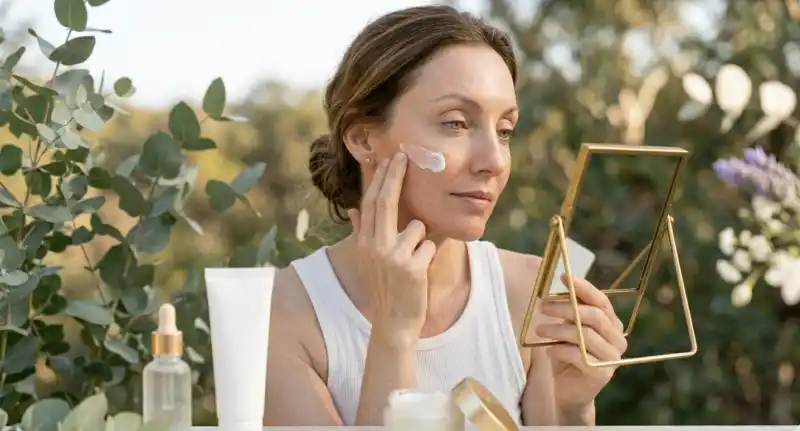
The science of skin aging is evolving rapidly — and for women navigating the skin changes that come with menopause and beyond, evidence-based skincare represents a fundamentally different approach: working with your skin's biology rather than against it.
Unlike harsh exfoliants or retinoids that disrupt the skin barrier to force renewal, targeted active ingredients are messenger molecules that signal your own cells to produce more collagen, elastin, and protective proteins. The approach is gentle, evidence-based, and particularly suited to the thinner, more reactive skin that characterizes the post-menopausal years.
Understanding Which Type of Aging You're Actually Treating
Photoaging and chronological aging both produce wrinkles, sagging, and textural changes — but they operate through different biological mechanisms, affect the skin at different structural levels, and respond to different treatments. Identifying which type of aging dominates your skin is essential for choosing the most effective treatment approach, because the intervention that best addresses photoaging (antioxidants + retinol + SPF) differs from the intervention that best addresses chronological aging (peptides + barrier support + hormonal compensation).[1]
Chronological aging (intrinsic aging): caused by genetic programming, hormonal changes, and time. The hallmarks are generalized skin thinning (the dermis loses approximately 1% of its thickness per year after age 25), reduced cell turnover, decreased sebum production, and gradual collagen decline. Chronological aging produces fine, evenly distributed wrinkles, generalized laxity, and dryness — but relatively preserved skin color and texture. The skin appears thin and delicate but without the rough, mottled appearance of photoaging. Chronological aging is accelerated significantly by menopause, which removes the estrogen stimulus for collagen production.
Clinical research confirms that photoaging (extrinsic aging): caused by cumulative UV radiation. The hallmarks are deep, coarse wrinkles concentrated in UV-exposed areas, rough leathery texture, mottled pigmentation (solar lentigines, poikiloderma), solar elastosis (yellow thickening from disorganized collagen), telangiectasia (visible blood vessels from UV-damaged capillaries), and actinic keratoses (precancerous lesions). Photoaging is unevenly distributed — severe on the face, chest, and hands but absent on sun-protected areas like the inner arms and abdomen. Photoaging accounts for an estimated 80% of visible aging in fair-skinned individuals.
Treatment implications: For primarily photoaged skin (deep wrinkles in sun-exposed areas, mottled pigmentation, rough texture) — prioritize: daily SPF 50 (stop ongoing damage), vitamin C morning (antioxidant + pigment reduction + collagen cofactor), retinol evening (collagen rebuilding + texture normalization), niacinamide (pigmentation control). For primarily chronologically aged skin (fine wrinkles, generalized laxity, dryness without pigmentation) — prioritize: peptide cream morning and evening (growth factor collagen stimulation independent of UV pathways), ceramide cream (barrier repair for sebum-deficient skin), retinol evening (collagen stimulation), HA serum (hydration for chronically dry skin). Most women over 50 have both types — the face shows primarily photoaging, while sun-protected areas show chronological aging. The optimal protocol addresses both: SPF + vitamin C + retinol for the photoaging component, peptides + ceramides for the chronological component.
Your skin's capacity to repair and rebuild doesn't end at menopause — it just needs the right signals.
— Dr. Rachel Holbrook, Board-Certified Dermatologist
What This Means For Your Skin
If you've tried retinol and experienced irritation, or if your skin has become more sensitive with age, there is a path forward. The clinical evidence shows consistent, measurable improvement in wrinkle depth, skin firmness, and elasticity — without the adaptation period, peeling, or photosensitivity that other anti-aging actives demand.
Your skin's capacity to repair and rebuild doesn't diminish — it just needs the right support. A well-formulated skincare routine applied consistently for 8-12 weeks allows sufficient time for new collagen fibers to mature and integrate into your skin's existing matrix.
The science is clear. The evidence is consistent. The results are measurable.
What happens next is up to you.