
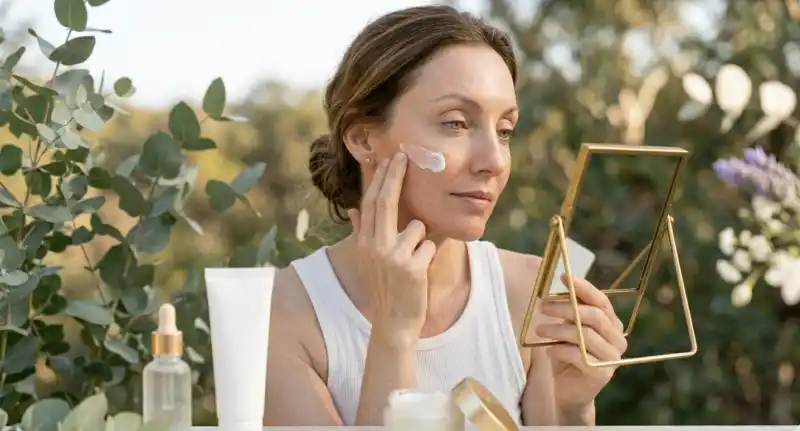
The science of skin aging is evolving rapidly — and for women navigating the skin changes that come with menopause and beyond, evidence-based skincare represents a fundamentally different approach: working with your skin's biology rather than against it.
Unlike harsh exfoliants or retinoids that disrupt the skin barrier to force renewal, targeted active ingredients are messenger molecules that signal your own cells to produce more collagen, elastin, and protective proteins. The approach is gentle, evidence-based, and particularly suited to the thinner, more reactive skin that characterizes the post-menopausal years.
The Evidence That UV Is the Primary Driver of Early Aging
Sun damage does not merely contribute to premature aging — it is the single most significant cause. Dermatological research has established that photoaging (UV-induced aging) accounts for approximately 80% of visible facial aging in fair-to-medium-skinned individuals. The remaining 20% is attributed to intrinsic (chronological) aging, genetics, and other environmental factors combined. This 80% attribution is not theoretical — it comes from comparing sun-exposed and sun-protected skin on the same individuals, controlled twin studies, and occupational exposure research.[1]
The evidence is compelling: (1) Twin studies — pairs of identical twins where one had significantly more lifetime sun exposure showed striking differences in visible aging. The high-exposure twin consistently appeared 5-10 years older than the protected twin, despite identical genetics. (2) Occupational studies — outdoor workers (farmers, construction workers, sailors) show dramatically more facial aging than age-matched indoor workers, with the difference increasing with each decade of exposure. (3) Anatomical comparison — on any individual, the sun-protected inner upper arm shows minimal aging signs at age 60-70, while the sun-exposed face of the same individual shows extensive wrinkles, pigmentation, and textural damage. Same body, same age, same genetics — only the UV exposure differs.
Clinical research confirms that how UV causes premature aging at the cellular level: (1) Collagen destruction — UV-activated MMPs degrade collagen fibers at a rate that far exceeds normal age-related decline. Chronic sun exposure can accelerate collagen loss from the intrinsic rate of 1-1.5% per year to 3-5% per year. (2) Elastin damage — UV causes abnormal accumulation of dystrophic elastin (solar elastosis), replacing functional elastic fibers with non-functional material that cannot provide skin recoil. (3) DNA damage — UV-induced thymine dimers and other DNA lesions accumulate in fibroblasts, reducing their functional capacity over time. (4) Melanocyte dysfunction — chronic UV creates permanent melanocyte hyperactivation, producing the mottled pigmentation characteristic of photoaged skin. (5) Vascular damage — UV destroys dermal capillaries, creating telangiectasia (visible blood vessels) and reducing nutrient delivery to the dermis.
The implications for anti-aging treatment: because sun damage is the dominant cause of premature aging, the single most effective anti-aging intervention is daily broad-spectrum SPF 50 sunscreen. Starting rigorous sun protection at any age produces measurable improvement — not just prevention of future damage, but actual reversal of existing photoaging signs as the skin's repair mechanisms operate without ongoing UV interference. For women who already show signs of photoaging, the treatment priority order is: (1) daily SPF 50 (stop the 80% cause), (2) vitamin C serum (antioxidant defense + collagen cofactor), (3) retinol (collagen rebuilding), (4) peptides (additional collagen stimulation). This priority order reflects the relative impact of each intervention on the primary aging mechanism.
Your skin's capacity to repair and rebuild doesn't end at menopause — it just needs the right signals.
— Dr. Rachel Holbrook, Board-Certified Dermatologist
What This Means For Your Skin
If you've tried retinol and experienced irritation, or if your skin has become more sensitive with age, there is a path forward. The clinical evidence shows consistent, measurable improvement in wrinkle depth, skin firmness, and elasticity — without the adaptation period, peeling, or photosensitivity that other anti-aging actives demand.
Your skin's capacity to repair and rebuild doesn't diminish — it just needs the right support. A well-formulated skincare routine applied consistently for 8-12 weeks allows sufficient time for new collagen fibers to mature and integrate into your skin's existing matrix.
The science is clear. The evidence is consistent. The results are measurable.
What happens next is up to you.