
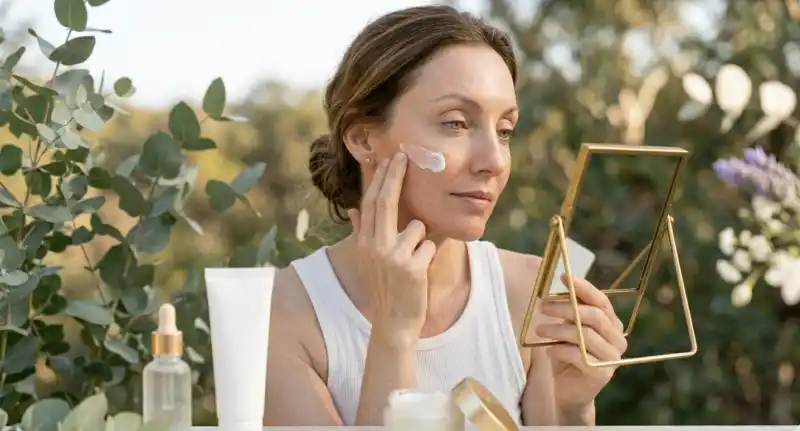
The science of skin aging is evolving rapidly — and for women navigating the skin changes that come with menopause and beyond, evidence-based skincare represents a fundamentally different approach: working with your skin's biology rather than against it.
Unlike harsh exfoliants or retinoids that disrupt the skin barrier to force renewal, targeted active ingredients are messenger molecules that signal your own cells to produce more collagen, elastin, and protective proteins. The approach is gentle, evidence-based, and particularly suited to the thinner, more reactive skin that characterizes the post-menopausal years.
How UV Radiation Destroys Your Skin's Structural Foundation
The connection between sun damage and collagen loss is not merely correlational — it is the primary mechanism of visible facial aging. Dermatologists estimate that photoaging (UV-induced aging) accounts for approximately 80% of visible facial aging in fair-skinned individuals, with intrinsic (chronological) aging responsible for only 20%. The evidence for this attribution comes from comparing sun-exposed and sun-protected skin on the same individual: the inner upper arm of a 60-year-old woman (rarely sun-exposed) has significantly more collagen, better elasticity, and fewer wrinkles than her face (decades of sun exposure) — despite being the same biological age.[1]
The molecular mechanism: UVA radiation (320-400nm) penetrates through the epidermis into the dermis, where it generates reactive oxygen species (ROS) through photochemical reactions with cellular chromophores. These ROS activate the AP-1 transcription factor, which upregulates the expression of three key matrix metalloproteinases: MMP-1 (collagenase, which cleaves intact collagen fibers), MMP-3 (stromelysin, which activates other MMPs and degrades collagen fragments), and MMP-9 (gelatinase, which degrades collagen fragments and basement membrane components). This triple MMP activation creates a coordinated collagen destruction system that fragments the dermal collagen matrix.
Clinical research confirms that the cumulative nature of photoaging: each UV exposure event triggers a burst of MMP activity lasting 48-72 hours. A single episode of visible sunburn can degrade collagen equivalent to weeks of normal aging. Even sub-erythemal UV exposure (doses too low to cause visible redness) activates MMPs — meaning that everyday sun exposure without sunscreen contributes to progressive collagen destruction without any visible warning. Over decades, these accumulated destruction events produce the characteristic features of photoaged skin: deep wrinkles (collagen loss beneath expression lines), rough texture (disordered collagen replacement), sallowness (solar elastosis — non-functional collagen accumulation), and laxity (insufficient collagen to resist gravity).
The repair potential: the same fibroblasts that produce collagen under UV assault can produce new collagen when protected from ongoing UV damage and stimulated with appropriate ingredients. Studies show that consistent daily SPF use alone — without any active anti-aging ingredients — produces measurable improvement in photoaging signs over 12 months, because stopping the MMP-driven destruction allows the skin's baseline collagen production to gradually rebuild the deficit. Adding collagen stimulators (retinol, peptides, vitamin C) to a rigorous SPF protocol accelerates this recovery dramatically. The most powerful message in sun damage research: it is never too late to start protecting your skin. Even severe photoaging can be partially reversed — but only if the ongoing UV-driven destruction is stopped first through daily broad-spectrum SPF.
Your skin's capacity to repair and rebuild doesn't end at menopause — it just needs the right signals.
— Dr. Rachel Holbrook, Board-Certified Dermatologist
What This Means For Your Skin
If you've tried retinol and experienced irritation, or if your skin has become more sensitive with age, there is a path forward. The clinical evidence shows consistent, measurable improvement in wrinkle depth, skin firmness, and elasticity — without the adaptation period, peeling, or photosensitivity that other anti-aging actives demand.
Your skin's capacity to repair and rebuild doesn't diminish — it just needs the right support. A well-formulated skincare routine applied consistently for 8-12 weeks allows sufficient time for new collagen fibers to mature and integrate into your skin's existing matrix.
The science is clear. The evidence is consistent. The results are measurable.
What happens next is up to you.