
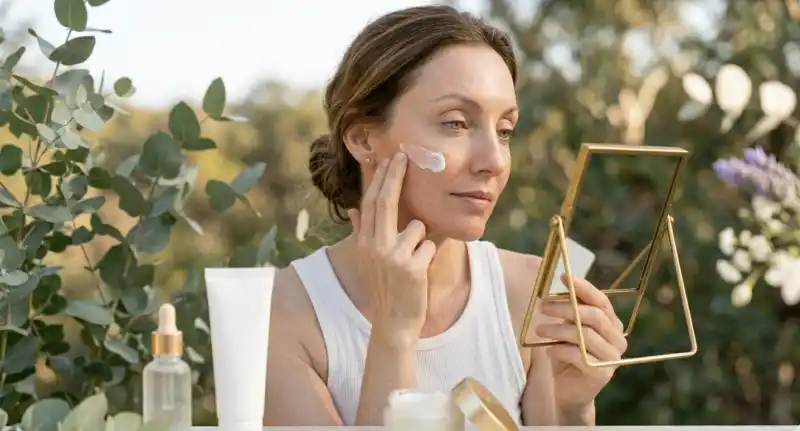
The science of skin aging is evolving rapidly — and for women navigating the skin changes that come with menopause and beyond, evidence-based skincare represents a fundamentally different approach: working with your skin's biology rather than against it.
Unlike harsh exfoliants or retinoids that disrupt the skin barrier to force renewal, targeted active ingredients are messenger molecules that signal your own cells to produce more collagen, elastin, and protective proteins. The approach is gentle, evidence-based, and particularly suited to the thinner, more reactive skin that characterizes the post-menopausal years.
Why Starting SPF Today Produces Measurable Improvement Tomorrow
The most common misconception about sun protection is that it's only useful for prevention — that once sun damage has occurred, sunscreen is 'too late.' This misconception is definitively wrong. A landmark Australian study followed 903 adults for 4.5 years, comparing daily sunscreen users to discretionary users. The daily sunscreen group showed no detectable increase in skin aging over the study period — and more remarkably, showed measurable improvement in existing photoaging signs. Sunscreen alone, without any active anti-aging ingredients, reversed some of the visible damage. The explanation is biological: stopping the UV-driven MMP activation allows the skin's baseline collagen production to gradually rebuild the deficit that ongoing sun exposure was perpetuating.[1]
Why sunscreen helps after the damage is done: Sun-damaged skin exists in a state of chronic collagen imbalance — UV-activated MMPs continue destroying collagen at an elevated rate even from routine daily sun exposure, while the damaged fibroblasts produce collagen at a reduced rate. This persistent imbalance means the skin is losing more collagen every day than it produces, creating a widening structural deficit. Daily SPF 50 application eliminates approximately 98% of the UV-driven MMP activation, dramatically reducing the destruction side of the equation. With destruction minimized, even the reduced collagen production of damaged fibroblasts can gradually close the gap — producing net collagen gain over months and years.
Clinical research confirms that the measurable improvements from starting SPF on sun-damaged skin: Within 3-6 months of daily SPF use, studies show: reduced inflammation markers in the dermis (less chronic UV-induced inflammation), initial normalization of MMP levels (less ongoing collagen destruction), and slight improvement in skin hydration (barrier recovery from reduced UV assault). Within 12 months: measurable improvement in skin texture, reduced progression of solar lentigines, and in some studies, actual wrinkle depth reduction from SPF alone. The improvements are modest compared to adding active ingredients (retinol, vitamin C), but they demonstrate that the skin retains meaningful repair capacity even after decades of damage.
The compounding effect: sunscreen dramatically amplifies the results of every other anti-aging treatment. Retinol stimulates new collagen production, but without SPF, a significant portion of that new collagen is destroyed by UV-activated MMPs before it can mature and integrate. With daily SPF, virtually all retinol-stimulated collagen survives to provide structural benefit. The same applies to peptides, vitamin C, and every collagen-building intervention. One study quantified this: retinol + daily SPF produced 3x the wrinkle improvement of retinol alone without consistent SPF. The practical message: if you're 50, 60, or 70 and have never used daily sunscreen, starting today will produce measurable improvement in your skin over the coming year. It is genuinely never too late. Every day of SPF application shifts the collagen balance toward repair.
Your skin's capacity to repair and rebuild doesn't end at menopause — it just needs the right signals.
— Dr. Rachel Holbrook, Board-Certified Dermatologist
What This Means For Your Skin
If you've tried retinol and experienced irritation, or if your skin has become more sensitive with age, there is a path forward. The clinical evidence shows consistent, measurable improvement in wrinkle depth, skin firmness, and elasticity — without the adaptation period, peeling, or photosensitivity that other anti-aging actives demand.
Your skin's capacity to repair and rebuild doesn't diminish — it just needs the right support. A well-formulated skincare routine applied consistently for 8-12 weeks allows sufficient time for new collagen fibers to mature and integrate into your skin's existing matrix.
The science is clear. The evidence is consistent. The results are measurable.
What happens next is up to you.