
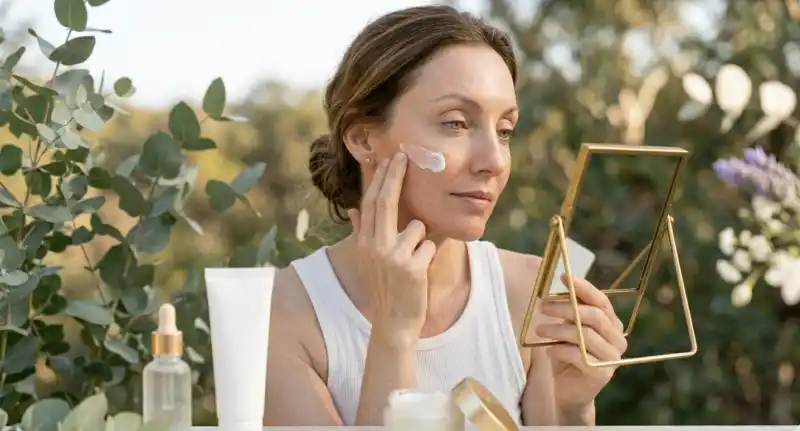
The science of skin aging is evolving rapidly — and for women navigating the skin changes that come with menopause and beyond, evidence-based skincare represents a fundamentally different approach: working with your skin's biology rather than against it.
Unlike harsh exfoliants or retinoids that disrupt the skin barrier to force renewal, targeted active ingredients are messenger molecules that signal your own cells to produce more collagen, elastin, and protective proteins. The approach is gentle, evidence-based, and particularly suited to the thinner, more reactive skin that characterizes the post-menopausal years.
Choosing and Applying Sunscreen for Maximum Anti-Aging Protection
If dermatologists could recommend only one anti-aging product, the overwhelming consensus would be sunscreen — not retinol, not vitamin C, not any serum or cream. SPF prevents more collagen loss per day than any anti-aging active ingredient can rebuild. The arithmetic is stark: a single hour of unprotected midday sun exposure activates enough MMPs to destroy more collagen than a month of retinol use can produce. Daily SPF 50 application prevents approximately 98% of this UV-induced collagen destruction, making it the foundation upon which every other anti-aging strategy is built.[1]
What dermatologists specifically recommend for aging skin: (1) SPF 50 or higher — not SPF 30. While SPF 30 blocks 97% of UVB, SPF 50 blocks 98%, and the difference is clinically meaningful for photosensitive aging skin. More importantly, real-world application is typically thinner than the test standard, meaning that SPF 50 applied at half-thickness provides effective SPF 25, while SPF 30 at half-thickness provides only SPF 15. Higher labeled SPF provides a safety margin for real-world use. (2) Broad-spectrum — must protect against both UVB (290-320nm, primary sunburn cause) AND UVA (320-400nm, primary collagen-destroying wavelength). UVA penetrates clouds, glass, and deep into the dermis. Without broad-spectrum protection, a high SPF product may prevent sunburn while allowing the UVA-driven collagen destruction to continue unchecked.
Clinical research confirms that (3) Daily application — not just on sunny days or beach days. UVA radiation is present year-round, penetrates clouds (80% of UVA reaches earth on overcast days), and passes through untinted window glass. Indoor workers who sit near windows accumulate significant UVA exposure through office and car windows. Dermatologists recommend daily SPF application as a non-negotiable morning habit, regardless of planned activities. (4) Adequate amount — the sunscreen test standard uses 2mg/cm², which translates to approximately 1/4 teaspoon for the face alone. Most women apply 25-50% of this amount, dramatically reducing effective protection. For aging skin, generous application is essential.
Sunscreen formulation preferences for aging skin: mineral (zinc oxide + titanium dioxide) sunscreens are preferred for aging skin because they (1) provide immediate protection (no 20-minute wait), (2) are less likely to irritate sensitive or compromised skin, (3) provide broad-spectrum UVA protection through physical UV reflection rather than chemical absorption, and (4) do not degrade under UV exposure (chemical filters lose efficacy over hours). The white cast concern has been largely resolved by modern micro-sized mineral particles that blend transparently. For aging skin specifically, sunscreens with added ceramides and hyaluronic acid provide SPF protection alongside barrier support and hydration — combining the most impactful anti-aging intervention (SPF) with the barrier repair that aging skin requires.
Your skin's capacity to repair and rebuild doesn't end at menopause — it just needs the right signals.
— Dr. Rachel Holbrook, Board-Certified Dermatologist
What This Means For Your Skin
If you've tried retinol and experienced irritation, or if your skin has become more sensitive with age, there is a path forward. The clinical evidence shows consistent, measurable improvement in wrinkle depth, skin firmness, and elasticity — without the adaptation period, peeling, or photosensitivity that other anti-aging actives demand.
Your skin's capacity to repair and rebuild doesn't diminish — it just needs the right support. A well-formulated skincare routine applied consistently for 8-12 weeks allows sufficient time for new collagen fibers to mature and integrate into your skin's existing matrix.
The science is clear. The evidence is consistent. The results are measurable.
What happens next is up to you.