
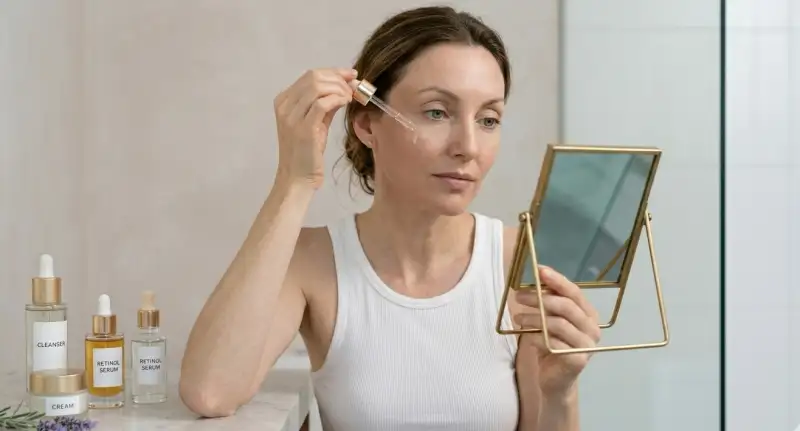
The science of skin aging is evolving rapidly — and for women navigating the skin changes that come with menopause and beyond, evidence-based skincare represents a fundamentally different approach: working with your skin's biology rather than against it.
Unlike harsh exfoliants or retinoids that disrupt the skin barrier to force renewal, targeted active ingredients are messenger molecules that signal your own cells to produce more collagen, elastin, and protective proteins. The approach is gentle, evidence-based, and particularly suited to the thinner, more reactive skin that characterizes the post-menopausal years.
Effective Collagen Stimulators That Skip the Irritation
Approximately 15-20% of women cannot tolerate retinol at any concentration due to inherent skin sensitivity — rosacea, eczema history, extremely thin post-menopausal skin, or retinoid receptor hypersensitivity that produces disproportionate irritation even at 0.1% with the sandwich method. For these women, retinol alternatives that stimulate collagen through non-retinoid pathways provide genuine anti-aging benefit without the irritation barrier that makes retinol unusable. The alternatives below are listed in order of collagen-stimulating evidence strength.[1]
Alternative 1: Peptides (Matrixyl 3000). Evidence level: strong. Mechanism: signal peptides that stimulate fibroblast collagen production through TGF-β growth factor pathways — completely independent of retinoid receptors. Irritation risk: near zero. Peptides are the most evidence-supported retinol alternative for collagen stimulation. Clinical studies show that Matrixyl at 3-8% concentration produces measurable collagen increases and wrinkle reduction comparable to low-concentration retinol (0.25%), without the adaptation period, irritation risk, or photosensitivity. For sensitive skin, peptide cream can be applied twice daily (morning and evening) from day one with no tolerance building required.
Clinical research confirms that alternative 2: Bakuchiol. Evidence level: moderate-strong. Mechanism: activates retinoid-like gene expression through a non-retinoid pathway, stimulating collagen genes (COL1A1) without binding to retinoid receptors. A head-to-head clinical trial comparing bakuchiol 0.5% with retinol 0.5% found comparable wrinkle reduction at 12 weeks with significantly less irritation in the bakuchiol group. Irritation risk: very low. Alternative 3: Vitamin C (10-15% L-ascorbic acid). Evidence level: strong. Mechanism: essential cofactor for prolyl hydroxylase + direct antioxidant protection that prevents collagen degradation. Irritation risk: moderate for sensitive skin (the acidic pH can sting). Use sodium ascorbyl phosphate (SAP) formulations if L-ascorbic acid is irritating — SAP has a neutral pH and converts to ascorbic acid in the skin.
Alternative 4: Niacinamide (3-5%). Evidence level: moderate. Mechanism: stimulates collagen through the NAD+ pathway + enhances ceramide synthesis for barrier repair. Irritation risk: minimal. Niacinamide is the most universally tolerated active ingredient in skincare — even rosacea-affected skin typically tolerates 5% niacinamide without reaction. Alternative 5: Growth factors (EGF, TGF-β). Evidence level: moderate. Mechanism: directly signal fibroblasts to produce collagen, mimicking the body's wound-healing response. Irritation risk: near zero. The optimal retinol-free anti-aging routine for sensitive skin: Morning — vitamin C (SAP formulation) + peptide cream + SPF 50. Evening — bakuchiol serum + peptide cream + ceramide night cream. This protocol activates four independent collagen pathways (growth factor, bakuchiol, vitamin C cofactor, niacinamide/NAD+) without engaging the retinoid receptor pathway that causes irritation in sensitive skin.
Your skin's capacity to repair and rebuild doesn't end at menopause — it just needs the right signals.
— Dr. Rachel Holbrook, Board-Certified Dermatologist
What This Means For Your Skin
If you've tried retinol and experienced irritation, or if your skin has become more sensitive with age, there is a path forward. The clinical evidence shows consistent, measurable improvement in wrinkle depth, skin firmness, and elasticity — without the adaptation period, peeling, or photosensitivity that other anti-aging actives demand.
Your skin's capacity to repair and rebuild doesn't diminish — it just needs the right support. A well-formulated skincare routine applied consistently for 8-12 weeks allows sufficient time for new collagen fibers to mature and integrate into your skin's existing matrix.
The science is clear. The evidence is consistent. The results are measurable.
What happens next is up to you.