
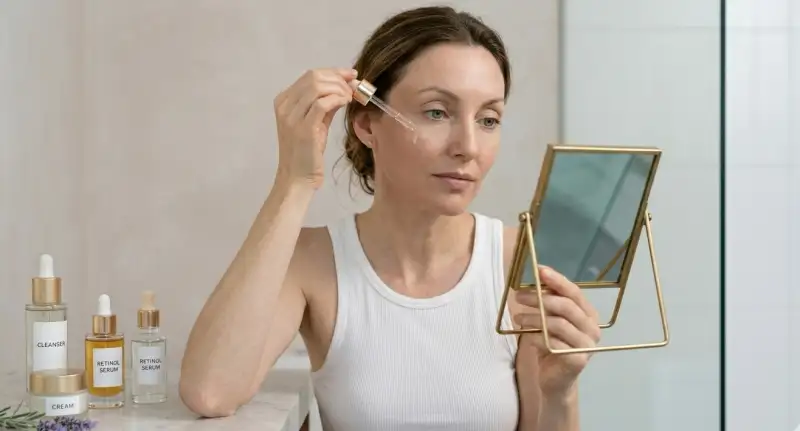
The science of skin aging is evolving rapidly — and for women navigating the skin changes that come with menopause and beyond, evidence-based skincare represents a fundamentally different approach: working with your skin's biology rather than against it.
Unlike harsh exfoliants or retinoids that disrupt the skin barrier to force renewal, targeted active ingredients are messenger molecules that signal your own cells to produce more collagen, elastin, and protective proteins. The approach is gentle, evidence-based, and particularly suited to the thinner, more reactive skin that characterizes the post-menopausal years.
Understanding the Strength Spectrum and When Each Is Appropriate
The prescription retinoid versus OTC retinol distinction is fundamentally about conversion steps: tretinoin (prescription) is retinoic acid — the active form that directly binds to retinoid receptors on fibroblasts. Retinol (OTC) must be converted by skin enzymes through two steps: retinol → retinaldehyde → retinoic acid. Each conversion step loses approximately 90% of the starting material, meaning that 1% retinol delivers roughly the same receptor activation as 0.01% tretinoin. This 100:1 potency ratio explains why prescription retinoids produce faster, more dramatic results — and why they cause more irritation.[1]
When OTC retinol is the appropriate choice: (1) First-time retinoid users — the gentler conversion-based delivery allows the skin's retinoid receptor system to upregulate gradually without the intense irritation that prescription-strength retinoic acid produces in naive skin. (2) Sensitive skin types — rosacea-prone, eczema-prone, or thin post-menopausal skin that cannot tolerate the inflammatory potential of direct retinoic acid. (3) Maintenance phase — women who have achieved their desired results with prescription retinoids and want to maintain them with less irritation risk. (4) Anti-aging prevention — women in their 30s starting retinoid use for prevention rather than treatment of established wrinkles. OTC retinol at 0.3-0.5% provides meaningful collagen stimulation with minimal irritation when used consistently.
Clinical research confirms that when prescription retinoid is the appropriate choice: (1) Moderate to severe photoaging — deep wrinkles, significant textural damage, and advanced collagen loss benefit from the stronger collagen stimulation that tretinoin provides. (2) Hyperpigmentation — tretinoin's accelerated cell turnover more effectively clears melanin deposits than OTC retinol. (3) Acne with aging concerns — tretinoin addresses both conditions simultaneously at prescription strength. (4) Plateau on OTC retinol — if 12+ months of consistent 1% retinol use has stopped producing visible improvement, the skin may have maximized its response to the OTC conversion pathway, and direct retinoic acid delivery may produce additional benefit.
The practical middle ground: retinaldehyde (retinal). Available OTC at 0.05-0.1%, retinaldehyde requires only ONE conversion step to become retinoic acid (instead of retinol's two steps). This makes it approximately 10x more potent than retinol but 10x less irritating than tretinoin — occupying the strength gap between them. For women who have maximized their retinol results but find prescription tretinoin too irritating, retinaldehyde provides an intermediate option. Regardless of which form you use, the supporting routine remains identical: ceramide cream for barrier support, HA for hydration, SPF for photosensitivity protection. The women who achieve the best long-term retinoid results are those who find the strength level they can use CONSISTENTLY without irritation — because 12 months of consistent 0.5% retinol outperforms 3 months of inconsistent tretinoin use every time.
Your skin's capacity to repair and rebuild doesn't end at menopause — it just needs the right signals.
— Dr. Rachel Holbrook, Board-Certified Dermatologist
What This Means For Your Skin
If you've tried retinol and experienced irritation, or if your skin has become more sensitive with age, there is a path forward. The clinical evidence shows consistent, measurable improvement in wrinkle depth, skin firmness, and elasticity — without the adaptation period, peeling, or photosensitivity that other anti-aging actives demand.
Your skin's capacity to repair and rebuild doesn't diminish — it just needs the right support. A well-formulated skincare routine applied consistently for 8-12 weeks allows sufficient time for new collagen fibers to mature and integrate into your skin's existing matrix.
The science is clear. The evidence is consistent. The results are measurable.
What happens next is up to you.