
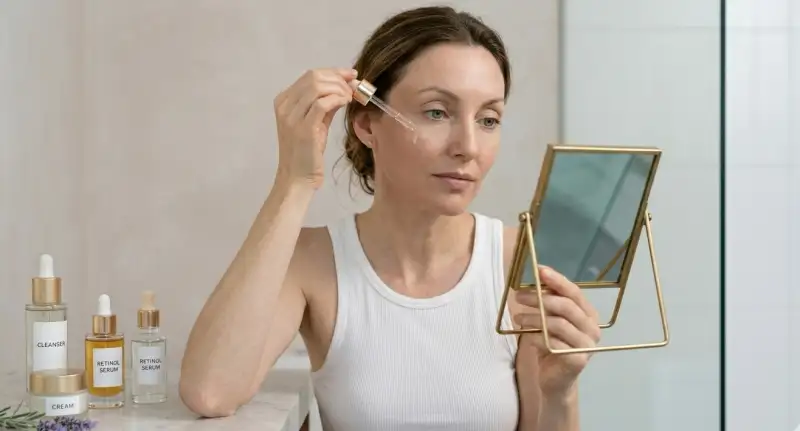
The science of skin aging is evolving rapidly — and for women navigating the skin changes that come with menopause and beyond, evidence-based skincare represents a fundamentally different approach: working with your skin's biology rather than against it.
Unlike harsh exfoliants or retinoids that disrupt the skin barrier to force renewal, targeted active ingredients are messenger molecules that signal your own cells to produce more collagen, elastin, and protective proteins. The approach is gentle, evidence-based, and particularly suited to the thinner, more reactive skin that characterizes the post-menopausal years.
Matching Retinol Concentration to Wrinkle Severity
The retinol strength needed for deep wrinkles is higher than for fine lines — but the path to that strength must be graduated. Deep wrinkles represent significant structural collagen loss in the dermis: the wrinkle crease exists because the dermal floor beneath it has thinned to the point where the skin folds into a permanent valley. Filling this valley requires substantial new collagen deposition — which requires sustained, high-concentration retinol stimulation of the fibroblasts lining the wrinkle's dermal floor. The target concentration for deep wrinkle treatment is 0.5-1% retinol, applied nightly.[1]
Why lower concentrations are insufficient for deep wrinkles: retinol 0.25% produces meaningful results for fine lines (shallow creases with moderate dermal thinning) because a modest increase in collagen density can fill a shallow deficit. Deep wrinkles require substantially more collagen deposition to produce visible improvement — the volume of the wrinkle valley is larger, requiring proportionally more structural material to fill. At 0.25%, the rate of collagen production is too slow relative to the ongoing collagen degradation to produce net filling of a deep wrinkle. At 0.5-1%, the production rate exceeds the degradation rate sufficiently to produce the net collagen gain that deep wrinkles require.
Clinical research confirms that the strength progression for deep wrinkle treatment: Month 1-3 — Retinol 0.25%, building from 1 to 4 nights per week. This phase establishes retinoid receptor upregulation without irritation. The deep wrinkles won't change during this phase — you're building the biological infrastructure that will make higher concentrations effective. Month 4-6 — Retinol 0.5%, transitioning from the 0.25% using the graduated protocol (one night per week at 0.5%, increasing over 8 weeks to nightly). This is the therapeutic concentration range where deep wrinkle improvement begins. Month 7-12 — Retinol 0.5-1%, nightly application. If 0.5% nightly is tolerated without irritation by month 6, consider increasing to 0.75% or 1% using the same graduated protocol. This provides maximum collagen stimulation for deep structural repair.
Enhancing retinol's deep wrinkle efficacy: (1) Combine with peptides — apply peptide cream (Matrixyl 3000) in the morning while retinol works at night. This activates two collagen pathways simultaneously, increasing total daily collagen production. (2) Add vitamin C serum (morning) — provides the prolyl hydroxylase cofactor that stabilizes the collagen retinol stimulates. Without vitamin C, up to 40% of newly produced procollagen degrades before assembly. (3) Targeted application technique — apply retinol directly INTO the wrinkle crease, not just across the general area. Use the ring finger to press retinol into the fold, concentrating the active ingredient at the exact dermal location where collagen rebuilding is needed. (4) Oral collagen peptides (5-10g daily) — provide the amino acid building blocks that fibroblasts need to assemble the collagen retinol is stimulating. Results timeline for deep wrinkles at therapeutic concentration: visible softening begins at month 4-6 (earlier than fine lines appear to improve because deep wrinkles improve incrementally), meaningful reduction by month 9-12, maximum improvement by month 18-24. Deep wrinkles will not disappear with topical treatment — but reducing their depth by 30-40% produces a significant visible improvement.
Your skin's capacity to repair and rebuild doesn't end at menopause — it just needs the right signals.
— Dr. Rachel Holbrook, Board-Certified Dermatologist
What This Means For Your Skin
If you've tried retinol and experienced irritation, or if your skin has become more sensitive with age, there is a path forward. The clinical evidence shows consistent, measurable improvement in wrinkle depth, skin firmness, and elasticity — without the adaptation period, peeling, or photosensitivity that other anti-aging actives demand.
Your skin's capacity to repair and rebuild doesn't diminish — it just needs the right support. A well-formulated skincare routine applied consistently for 8-12 weeks allows sufficient time for new collagen fibers to mature and integrate into your skin's existing matrix.
The science is clear. The evidence is consistent. The results are measurable.
What happens next is up to you.