
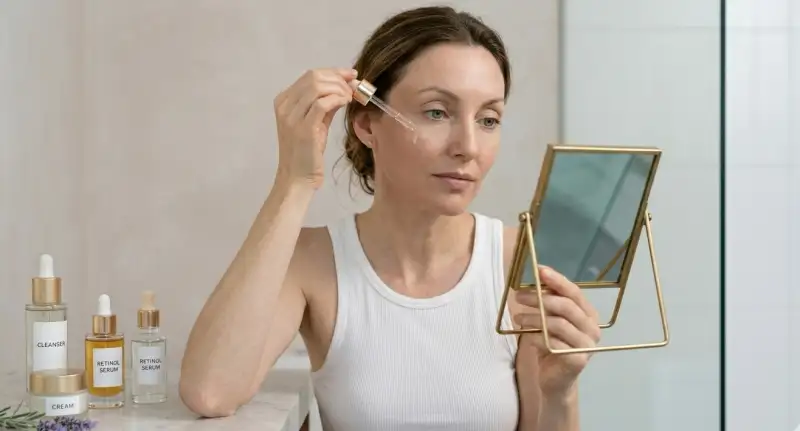
The science of skin aging is evolving rapidly — and for women navigating the skin changes that come with menopause and beyond, evidence-based skincare represents a fundamentally different approach: working with your skin's biology rather than against it.
Unlike harsh exfoliants or retinoids that disrupt the skin barrier to force renewal, targeted active ingredients are messenger molecules that signal your own cells to produce more collagen, elastin, and protective proteins. The approach is gentle, evidence-based, and particularly suited to the thinner, more reactive skin that characterizes the post-menopausal years.
The Graduated Protocol for Moving to Higher Concentrations
Increasing retinol strength is the most common point of failure in long-term retinol use — women who have successfully tolerated 0.25% for months attempt to jump to 0.5% or 1%, experience severe irritation (peeling, redness, burning), and either drop back to their original concentration or abandon retinol entirely. This failure is almost always caused by increasing too quickly, skipping the adaptation phase, or failing to adjust the supporting routine. The skin's retinoid receptors upregulate gradually — they need weeks of exposure at each new concentration to increase the enzymatic capacity that converts retinol to its active form (retinoic acid) without overwhelming the skin's tolerance threshold.[1]
The graduated strength increase protocol: Phase 1 — Preparation (2 weeks before increasing). Strengthen your barrier by adding ceramide cream to both morning and evening routines. A robust barrier absorbs retinol more evenly and recovers faster from any irritation. Stop all other exfoliating actives (AHAs, BHAs, physical scrubs) 2 weeks before the increase — layering exfoliation with a higher retinol concentration is the most common trigger for severe irritation. Phase 2 — Introduction of new concentration: use the higher concentration ONE night per week for 2 weeks, replacing one of your regular retinol nights. Continue your current concentration on the other nights. This gives the skin a single weekly exposure to the higher concentration while maintaining routine retinoid stimulation.
Clinical research confirms that phase 3 — Gradual replacement (weeks 3-8): increase the higher concentration to TWO nights per week in weeks 3-4, THREE nights in weeks 5-6, then alternate nights in weeks 7-8. The remaining nights, continue your previous concentration. This slow replacement ensures that the retinoid receptor system adapts progressively without a sudden increase in retinoic acid conversion that triggers the inflammatory cascade. Phase 4 — Full transition (weeks 9-12): if alternate-night use of the higher concentration causes no irritation, transition to nightly use. Drop the lower concentration entirely.
Critical supporting adjustments when increasing retinol: (1) Always use the sandwich method at the new concentration — ceramide cream before and after retinol. As tolerance builds over weeks 4-8, you can transition to applying retinol directly to clean skin. (2) Increase ceramide cream thickness — the higher concentration creates more TEWL and barrier stress. Compensate with heavier overnight moisture. (3) Be more rigorous with morning SPF — higher retinol concentrations increase photosensitivity proportionally. (4) Monitor for the 'retinoid dermatitis' threshold: mild dryness and light flaking = normal adaptation. Redness, burning, peeling sheets of skin = too much, too fast. If you cross into dermatitis, drop back to the previous concentration for 2 weeks, then restart the protocol at Phase 2. The entire process from 0.25% to 0.5% takes approximately 12 weeks. From 0.5% to 1% takes another 12 weeks. Patience at each level produces better long-term results than rushing to higher concentrations.
Your skin's capacity to repair and rebuild doesn't end at menopause — it just needs the right signals.
— Dr. Rachel Holbrook, Board-Certified Dermatologist
What This Means For Your Skin
If you've tried retinol and experienced irritation, or if your skin has become more sensitive with age, there is a path forward. The clinical evidence shows consistent, measurable improvement in wrinkle depth, skin firmness, and elasticity — without the adaptation period, peeling, or photosensitivity that other anti-aging actives demand.
Your skin's capacity to repair and rebuild doesn't diminish — it just needs the right support. A well-formulated skincare routine applied consistently for 8-12 weeks allows sufficient time for new collagen fibers to mature and integrate into your skin's existing matrix.
The science is clear. The evidence is consistent. The results are measurable.
What happens next is up to you.