
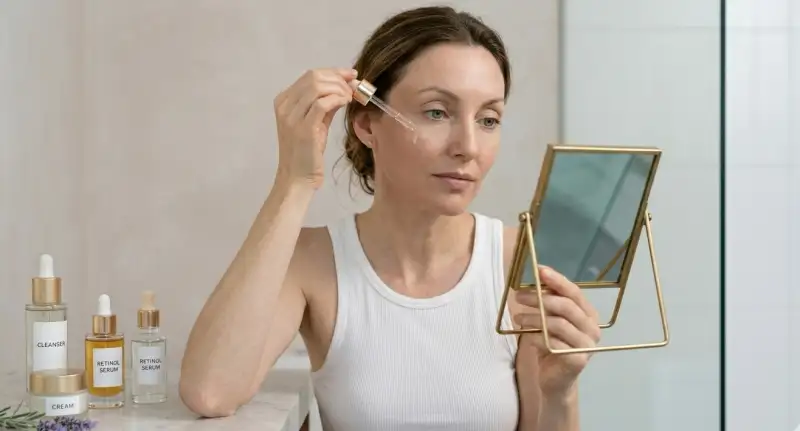
The science of skin aging is evolving rapidly — and for women navigating the skin changes that come with menopause and beyond, evidence-based skincare represents a fundamentally different approach: working with your skin's biology rather than against it.
Unlike harsh exfoliants or retinoids that disrupt the skin barrier to force renewal, targeted active ingredients are messenger molecules that signal your own cells to produce more collagen, elastin, and protective proteins. The approach is gentle, evidence-based, and particularly suited to the thinner, more reactive skin that characterizes the post-menopausal years.
Common Errors That Reduce Results or Cause Unnecessary Irritation
Retinol use after 40 carries specific challenges that don't apply to younger skin: the dermis is thinner (absorbing retinol more rapidly), the barrier is weaker (less tolerant of irritation), sebum production has declined (increasing dryness sensitivity), and for many women, perimenopause or menopause has further compromised barrier function and healing capacity. These age-related changes make retinol mistakes more consequential — the same error that causes mild irritation at 30 can cause significant dermatitis at 45. Understanding these specific mistakes prevents the frustrating cycle of starting, irritating, stopping, and restarting that wastes months of potential collagen-building progress.[1]
Mistake 1: Starting at too high a concentration. After 40, the thinner skin absorbs retinol at a rate 20-30% higher than younger skin — effectively making a 0.5% product behave like a 0.65% product. Start at 0.25% regardless of what you used in your 30s or what a product review recommends. Mistake 2: Applying to damp skin. This increases absorption rate by 40-60%, creating a concentrated retinol burst in already-thin dermis. Always apply to completely dry skin (2-3 minutes after patting dry). Mistake 3: Skipping the sandwich method. After 40, the ceramide sandwich (ceramide cream → retinol → ceramide cream) should be the default application method, not a beginner technique. The barrier support is more critical for mature skin.
Clinical research confirms that mistake 4: Neglecting the barrier. Many women over 40 use retinol with a basic lightweight moisturizer, not realizing that their compromised barrier needs ceramide-specific support to tolerate retinol without chronic low-grade irritation. The invisible barrier damage — persistent tightness, sensitivity, stinging with other products — undermines retinol results even when no visible irritation is present. Mistake 5: Using retinol AND chemical exfoliants on the same night. AHAs and BHAs combined with retinol on mature skin strips the barrier faster than it can repair, creating a chronic state of barrier compromise that paradoxically increases wrinkle visibility. Separate them: retinol 4-5 nights, exfoliant 1-2 nights, never on the same night.
Mistake 6: Expecting concentration to compensate for consistency. Women over 40 sometimes escalate to 1% retinol seeking faster results, using it 3-4 nights per week with irritation breaks. A lower concentration used every night outperforms a higher concentration used intermittently — because collagen building is a cumulative process driven by consistent stimulation, not acute intensity. 0.3% retinol used nightly for 12 months produces more collagen than 1% retinol used 3 nights per week with frequent irritation breaks. Mistake 7: Stopping retinol in summer. UV protection (SPF 50 daily) makes year-round retinol use safe. Stopping for 3 summer months means losing 10-15% of the year's collagen-building progress and requiring 2-3 weeks of re-adaptation when restarting in autumn. The optimal retinol strategy after 40: low-moderate concentration (0.3-0.5%), sandwich method, ceramide-rich barrier support, nightly consistency, year-round use with rigorous SPF.
Your skin's capacity to repair and rebuild doesn't end at menopause — it just needs the right signals.
— Dr. Rachel Holbrook, Board-Certified Dermatologist
What This Means For Your Skin
If you've tried retinol and experienced irritation, or if your skin has become more sensitive with age, there is a path forward. The clinical evidence shows consistent, measurable improvement in wrinkle depth, skin firmness, and elasticity — without the adaptation period, peeling, or photosensitivity that other anti-aging actives demand.
Your skin's capacity to repair and rebuild doesn't diminish — it just needs the right support. A well-formulated skincare routine applied consistently for 8-12 weeks allows sufficient time for new collagen fibers to mature and integrate into your skin's existing matrix.
The science is clear. The evidence is consistent. The results are measurable.
What happens next is up to you.