
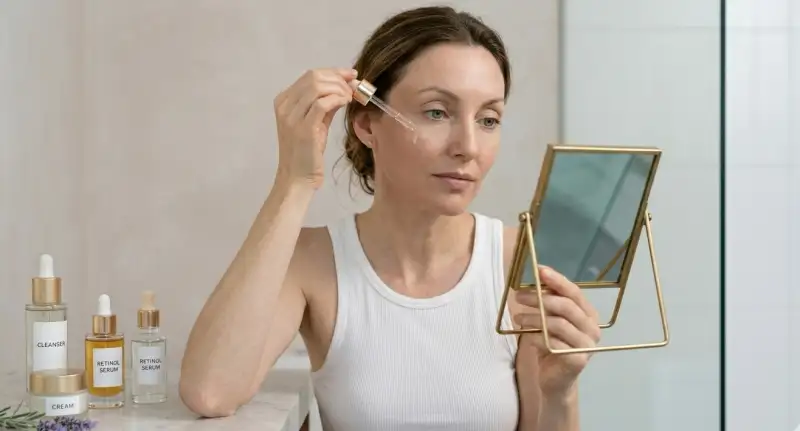
The science of skin aging is evolving rapidly — and for women navigating the skin changes that come with menopause and beyond, evidence-based skincare represents a fundamentally different approach: working with your skin's biology rather than against it.
Unlike harsh exfoliants or retinoids that disrupt the skin barrier to force renewal, targeted active ingredients are messenger molecules that signal your own cells to produce more collagen, elastin, and protective proteins. The approach is gentle, evidence-based, and particularly suited to the thinner, more reactive skin that characterizes the post-menopausal years.
A Week-by-Week Plan for Adaptation Without Irritation
Retinol tolerance is not an inherent skin characteristic — it's an acquired adaptation that develops through systematic exposure. The skin's retinoid receptor system upregulates in response to consistent retinol application, increasing the enzymatic capacity to convert retinol to retinoic acid without triggering the inflammatory cascade that causes visible irritation. This upregulation follows a predictable timeline that can be mapped to a weekly schedule, removing the guesswork that leads to either under-use (no results) or over-use (irritation and abandonment).[1]
The 12-week retinol tolerance building schedule: Weeks 1-2 — Apply retinol 0.25% ONE night per week (e.g., Sunday night). Use the sandwich method: thin ceramide cream → retinol → ceramide cream. Monitor for irritation on Monday and Tuesday. If no redness, dryness, or peeling occurs by Wednesday, the application was tolerated. Weeks 3-4 — Increase to TWO nights per week (e.g., Sunday and Wednesday). Maintain the sandwich method. Continue monitoring for delayed reactions. Weeks 5-6 — Increase to THREE nights per week (e.g., Sunday, Tuesday, Thursday). At this frequency, you may notice mild dryness on the morning after application — this is normal adaptation, not irritation. Increase ceramide cream thickness on retinol nights.
Clinical research confirms that weeks 7-8 — Increase to EVERY OTHER NIGHT (3-4 applications per week). The skin's retinoid receptors have now upregulated sufficiently to handle regular retinol exposure. Mild flaking may occur — this is accelerated cell turnover (desquamation), a therapeutic effect of retinol. It typically resolves by week 10 as the skin adjusts. Weeks 9-10 — If every-other-night is tolerated without significant irritation, try CONSECUTIVE NIGHTS for the first time — apply 2 nights in a row, then skip a night. This tests whether your retinoid receptor capacity can handle back-to-back exposure. Weeks 11-12 — If consecutive night use is tolerated, transition to NIGHTLY application. You have reached full retinol tolerance at 0.25%.
The tolerance indicators to monitor: GREEN (continue schedule) — no visible irritation, mild transient dryness on morning after application that resolves by midday. YELLOW (hold at current frequency for 2 extra weeks) — persistent dryness that lasts 24+ hours, visible tightness, mild redness that fades within hours. RED (drop back one frequency level for 2 weeks) — peeling, burning sensation, persistent redness lasting 24+ hours, increased sensitivity to other products. The most important principle: tolerance is not a race. Women who reach nightly application at week 12 and women who reach it at week 20 achieve identical long-term collagen-building results — because the collagen benefit comes from CONSISTENT long-term use, not from how quickly you reached maximum frequency. A slower build that avoids irritation produces better results than an aggressive schedule that causes a 3-week break for skin recovery.
Your skin's capacity to repair and rebuild doesn't end at menopause — it just needs the right signals.
— Dr. Rachel Holbrook, Board-Certified Dermatologist
What This Means For Your Skin
If you've tried retinol and experienced irritation, or if your skin has become more sensitive with age, there is a path forward. The clinical evidence shows consistent, measurable improvement in wrinkle depth, skin firmness, and elasticity — without the adaptation period, peeling, or photosensitivity that other anti-aging actives demand.
Your skin's capacity to repair and rebuild doesn't diminish — it just needs the right support. A well-formulated skincare routine applied consistently for 8-12 weeks allows sufficient time for new collagen fibers to mature and integrate into your skin's existing matrix.
The science is clear. The evidence is consistent. The results are measurable.
What happens next is up to you.