
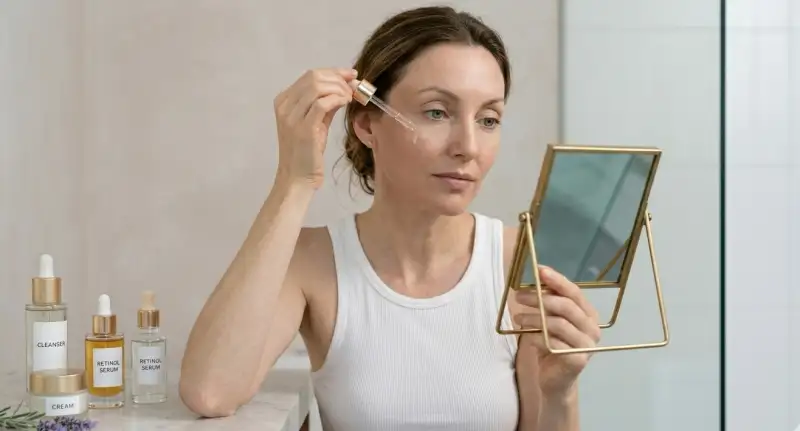
The science of skin aging is evolving rapidly — and for women navigating the skin changes that come with menopause and beyond, evidence-based skincare represents a fundamentally different approach: working with your skin's biology rather than against it.
Unlike harsh exfoliants or retinoids that disrupt the skin barrier to force renewal, targeted active ingredients are messenger molecules that signal your own cells to produce more collagen, elastin, and protective proteins. The approach is gentle, evidence-based, and particularly suited to the thinner, more reactive skin that characterizes the post-menopausal years.
What to Realistically Expect at Each Milestone
The retinol results timeline is governed by the biology of dermal collagen turnover — not by product potency or brand claims. Understanding this timeline prevents the two most common retinol mistakes: quitting at week 6 because wrinkles haven't changed (they won't yet — the collagen hasn't accumulated), and declaring the product 'doesn't work' at month 2 when the visible improvements are epidermal (texture, tone) but the dermal improvements (wrinkle reduction) are still building beneath the surface.[1]
Month 1 — Adaptation phase. Visible changes: possible mild dryness, slight flaking, skin may feel tighter. These are signs that retinoid receptors are activating and cell turnover is beginning to accelerate. No anti-aging results are visible yet — the retinol is preparing the skin's biological machinery for the work ahead. Many users see a temporary worsening during this phase (the 'retinol uglies') as the skin adjusts. This is normal and resolves by week 4-6. Month 2 — Epidermal remodeling. Visible changes: smoother skin texture, more even tone, reduced dullness, possible mild 'glow.' Pores may appear smaller as the epidermis becomes more uniform. These improvements are from accelerated cell turnover — fresh, uniform epidermal cells are reaching the surface faster. This is NOT collagen rebuilding — it's surface optimization.
Clinical research confirms that month 3 — Early collagen signals. Visible changes: fine lines (not deep wrinkles) begin to appear softer. Skin feels slightly firmer when pressed — the 'bounce-back' is quicker. Hydration retention improves as the retinol-stimulated epidermis becomes a better barrier. The underlying biology: fibroblasts have been producing increased procollagen for 8-10 weeks, and the new collagen fibers are beginning to accumulate at densities sufficient to provide subtle structural support. This is the 'tipping point' where retinol transitions from an epidermal treatment to a dermal treatment. Month 4-6 — Visible wrinkle reduction. Visible changes: measurable reduction in fine line depth, moderate wrinkles begin to soften, skin firmness is noticeably improved. Photoaging signs (rough texture, mottled pigmentation) have improved significantly.
Month 6-12 — Structural remodeling. Visible changes: continued wrinkle improvement, improved skin elasticity (measured by suction tests in clinical studies), dermal thickening visible on ultrasound imaging. Deep wrinkles that showed no response at month 3 begin to soften as cumulative collagen density reaches the threshold needed to support their deeper dermal floor. The most dramatic visible change often occurs between month 6 and 12 — this is when the compounding effect of sustained collagen production becomes unmistakably visible. Month 12-24 — Maximum topical result. The skin reaches a new collagen equilibrium where production and degradation balance at a higher baseline than before retinol use. Further improvement plateaus, and the routine transitions from building to maintaining. Continued daily use maintains the elevated collagen density indefinitely. The key insight: the women who achieve the best retinol results are those who persist past the unremarkable first 8 weeks and continue consistently for 12+ months. The visible reward is back-loaded — concentrated in months 4-12 — making early patience the critical success factor.
Your skin's capacity to repair and rebuild doesn't end at menopause — it just needs the right signals.
— Dr. Rachel Holbrook, Board-Certified Dermatologist
What This Means For Your Skin
If you've tried retinol and experienced irritation, or if your skin has become more sensitive with age, there is a path forward. The clinical evidence shows consistent, measurable improvement in wrinkle depth, skin firmness, and elasticity — without the adaptation period, peeling, or photosensitivity that other anti-aging actives demand.
Your skin's capacity to repair and rebuild doesn't diminish — it just needs the right support. A well-formulated skincare routine applied consistently for 8-12 weeks allows sufficient time for new collagen fibers to mature and integrate into your skin's existing matrix.
The science is clear. The evidence is consistent. The results are measurable.
What happens next is up to you.